
1521 Einbeck Original
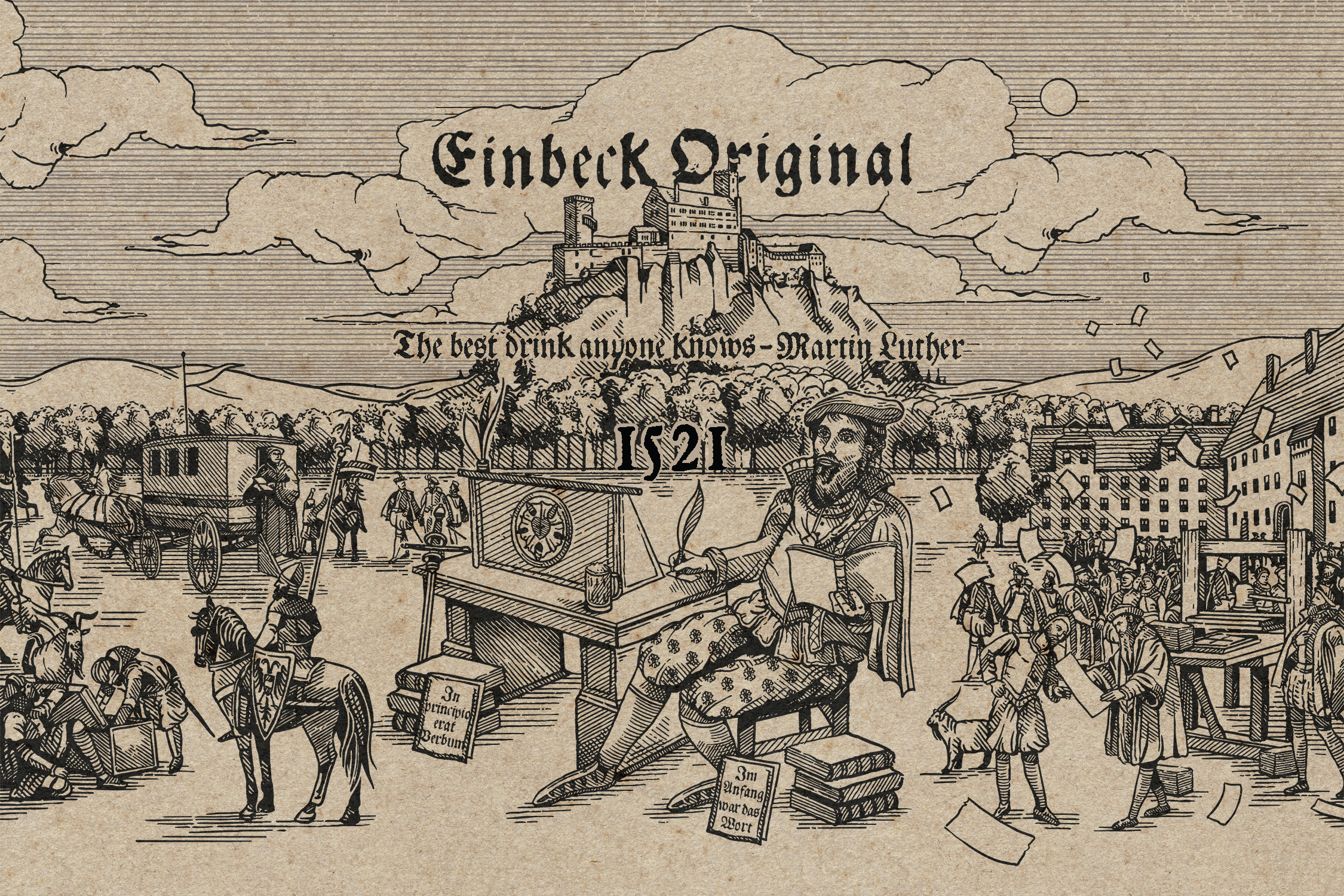
Martin Luther was travelling under armed guard when he drank the beer that would become his favourite.
The year was 1521. Luther had just stood before the Imperial Diet at Worms, where the Holy Roman Emperor Charles V demanded that he recant his writings. Luther refused. This monk and theologian had openly challenged the authority of the Catholic Church and, by extension, the foundations of political and social authority in Europe.
It can be difficult for contemporary people to grasp the danger of this moment. Medieval Europe was not simply religious. Religion formed the structure of reality. Luther asserted that people could bypass the Church and have a direct, personal relationship with God. This idea sprouted like a weed in the foundation of a cathedral, slowly cracking what seemed like an unbreakable foundation. The Church, centre of intellectual life, morality, law, politics, and salvation itself, was on the defensive. Luther had to die.
But it was too late.
Luther’s most revolutionary idea was his translation of the Bible from Latin into vernacular German. And, carried around Europe on the wings of the printing press, the Church could not contain it. Before Luther, scripture in Western Europe was largely encountered through Latin. But almost nobody spoke it. Latin reinforced the Church's power by creating distance between people and God.
Imagine sitting in a cathedral larger and grander than any building you've ever seen. Candles cast dancing firelight onto Gothic pillars. Incense fills the air. Priests speak a sacred language you don't understand. Then, at the proper moment, you rise to repeat sounds whose meaning had been explained to you. Religion was not a relationship with God. It was obedience.
Luther believed ordinary people should confront scripture directly in the language they actually spoke. So, he translated it into vernacular German. He printed his ideas onto paper. Pamphlets, sermons, and translated scripture moved across the German states faster than authorities could suppress them. Ordinary literate people suddenly found themselves reading arguments that previously belonged only to clergy and scholars. This was not merely a religious shift. It changed the relationship between individuals and authority. The consequences would reshape Europe for centuries.
But in 1521, Luther’s future looked bleak. After Worms, he was declared an outlaw. Not in the Wild West sense, in the original sense: outside the protection of the law. Anyone could legally kill him, steal his property, do anything to him, without consequence.
Then he vanished.
While travelling through a forest near Eisenach, Luther’s carriage was suddenly intercepted by armed horsemen. He was dragged away and disappeared into the mountains. To much of Europe, it appeared that Martin Luther had been kidnapped or murdered.
Neither happened. The kidnapping was staged by Frederick the Wise, Elector of Saxony, who understood that Luther would likely be executed if left exposed. Luther was secretly hidden at Wartburg Castle under the false identity “Junker Jörg,” or Knight George. There he grew a beard, lived in isolation, and began translating the New Testament into German.
It was during this turbulent period that Luther encountered the famous beer of Einbeck.
Einbeck, in Lower Saxony, had become one of Europe’s great brewing centres during the late Middle Ages. Improved copper brewing kettles allowed beer to be produced in great quantities. Large breweries made enough beer that they could export it, and the brewers of Einbeck produced some of the best. It was a strong, pale, highly regarded ale exported across the continent by the Hanseatic League. The beer became so famous that its name evolved linguistically as it spread through German dialects. “Einpöckisch Bier” would eventually become “Bockbier.”
Luther loved it.
According to tradition, Luther declared: “The best drink known to man is called Einbeck beer.”
Einbeck beer represented the wealth, confidence, and growing independence of the German towns and merchant classes transforming Europe during the Reformation era. Strong, refined, and widely traded, it was a product of a changing world.
Our 1521 Einbeck Original is brewed in tribute to these early North German ales. We use floor-malted grain and a quadruple-decoction mash to make a very traditional, and very labour intensive, beer from a time before modern malting technology streamlined the brewing process.
Einbeck Original is a step back in time to when Europe was in upheaval. Printing presses ran day and night. Pamphlets crossed borders in secret. And a fugitive theologian drank Einbeck beer, dressed like a knight and hidden in a castle, while translating the Bible into the language of ordinary people.
Availability: Seasonal
Release Date: Spring
First Produced: 2026
Alc/vol. 6.1%