
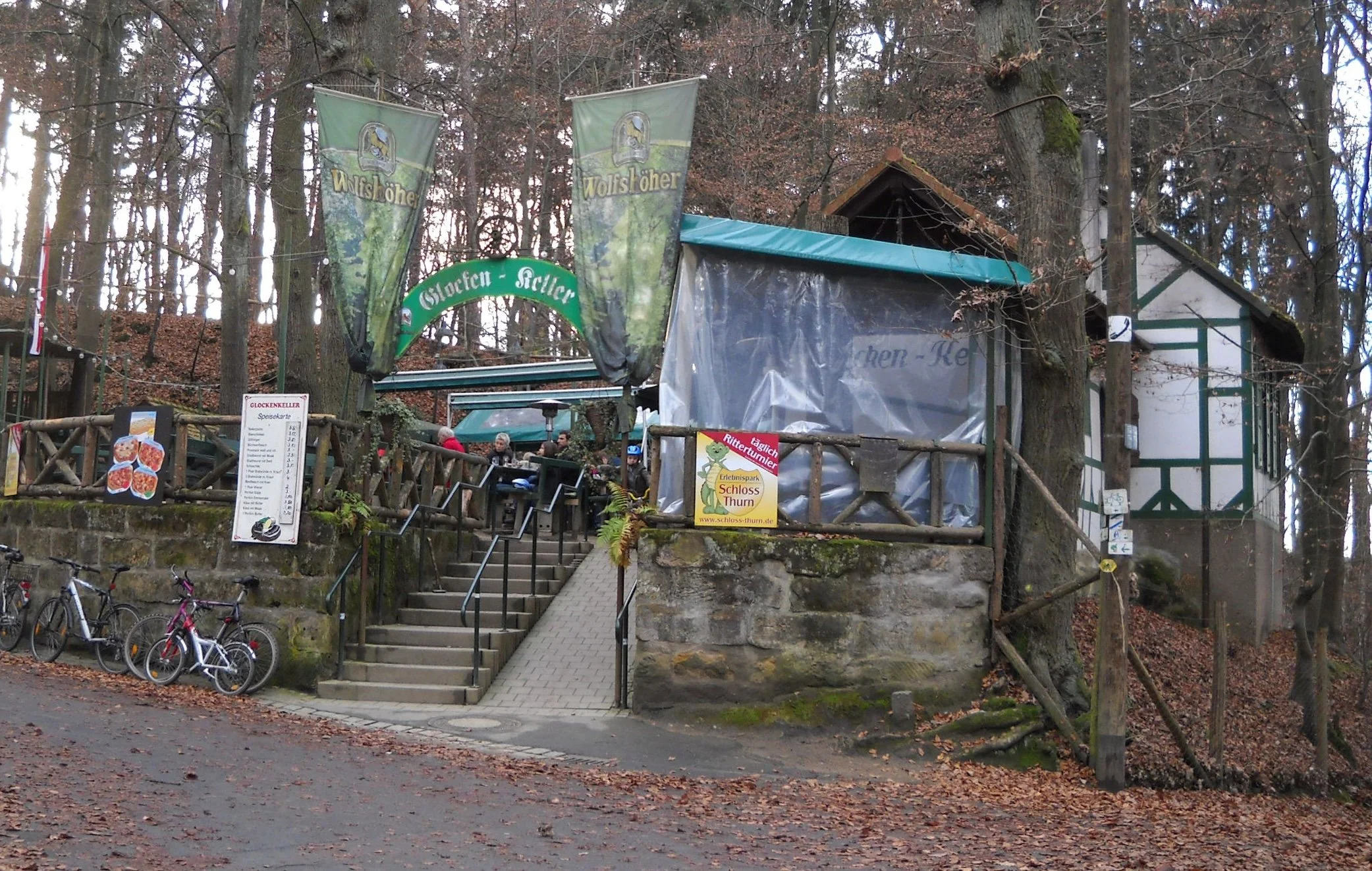
Glockenkeller cellar and beer garden, since 1697.
Carved into a mountain on a Franconian hillside is an old stone arch. The heavy wooden door is closed, but broken in places, allowing a viewer to peer into the dark beyond. Soil has washed down over the years, half-burying it as the hill swallows what was once a busy portal to the underground.
There’s another passageway just like it nearby. This one protrudes, bunker-like, from another hill. Leaf litter has piled like a snowdrift against the door. A large ash grows awkwardly against the base of a stone wall. Caught between the masonry and a pathway, it looks like an enormous weed emerging from a crack in the sidewalk.
These are old beer cellars in Franconia, south-central Germany. Dug into hillsides, they provide a cool microclimate perfect for lagering. Being on a hill, melting winter ice used to keep the cellars cool during summer can easily drain away through gutters carved into the floor. There’s also a great view of the city skyline.
Auf den Keller gehen / Go onto the cellar means go for a drink in a beer garden. For centuries the trees, often chesnuts, planted above these cellars provided shade for customers as they sat to enjoy a cool beer.
The tradition continues today. Though some cellars are abandoned, some are still storing and serving beer. The operator of Glockenkeller dates their cellar and beer garden to 1697.
Like many traditions, it takes deliberate effort to maintain. Beer is now stored, transported, and aged in stainless steel. Double-jacketed tanks allow the temperature of a batch to be precisely controlled by a chiller without the need to dig into a hill, cut ice, and then drag it inside before the spring melt. Steel kegs are much easier to maintain than wooden barrels.
Industrial processes have contributed a lot to brewing. Beer can be made, served and packaged more quickly from metal than wood. But technology has also taken something away. The micro-oxidation of wood-aged beer, the flavour and aroma of the wood itself, and how the two blend over time can’t be replicated in even the most advanced breweries.
There’s a sign at a famous Belgian brewery, Cantillon, that still uses 19th century equipment and wooden barrels to produce its ales: Le temps ne respecte pas ce qui se fait sans lui (time does not respect that which is made without it). All of Cantillon’s brews are aged for years, so they’re on the extreme end of the aging spectrum, but even months can make a big difference.
From a historical perspective, there are two categories of beer defined by time. In the English brewing tradition these are called keeping beers, sometimes stock ales. The German style lager literally means to store.
English keeping beers are very strong ales that matured in oak barrels, often for years. They produce big, bold flavours. Lagers were stored cool for months as the sulfur-producing lager yeast cleaned up their own off-flavours to produce crisp, easy drinking pints.
But it’s rare to find either aged in wood.
Some traditional European breweries have maintained a continuous wood-aging tradition but in North America the technique virtually disappeared during the 20th century. It came back in a new form during the craft beer boom: the spirit barrel aged ale.
The first brewery to use freshly dumped spirit barrels for aging beer was probably Samuel Adams. They released their Tripel Bock, aged in Jack Daniels whisky barrels, in 1994. That same year, Goose Island brewery began putting its imperial stout in Jim Beam bourbon barrels. Drinking the resulting beer, Bourbon County Stout, was a quasi-religious experience for some beer geeks. Spirit barrel aged beers took off as a new craft beer category.
This delicious, expensive, trend became mainstream during the 2010s. Even old European breweries like Chimay began putting some of their beer in spirit barrels. The combination of oak and spirit contributes a depth of flavour unmatched by neutral, oxygen-free, stainless-steel aging.
When sour beers became trendy in the 2010s, craft breweries began using non-spirit barrels for wood-aging beer. Using large wooden tanks called foeders, sour beers were aged in oak as slow-fermenting yeast and bacteria acidified the beer over months. More recently, some breweries have begun experimenting with neutral wood for aging regular strength non-sour beer, like lagers. Spirit barrels, though, remain the most common wood-aged beers on the North American market.
Today’s barrel aged beers are more likely to be stacked high in warehouses than tucked into carved-out hillsides. The spirit character infused into the beer by the porous staves of freshly dumped barrels make spirit-aged beer stand out compared to their historical counterparts. If you haven’t tried a spirit barrel aged beer, I strongly recommend it. But there is one thing this new trend can’t replicate.
Sitting at a communal table in the shade of chesnut trees above an old cellar imparts the drinker with a human spirit the distilled kind can’t match. Beer is a social, communal drink. The experience of beer isn’t just the liquid. As they say in the restaurant industry, you eat with the eyes first. Presentation matters. And so does presence.
The long history of social drinking-as-ritual makes place matter enormously for beer. It could at a pub with friends, a backyard barbecue with family, or on a Franconian hillside where generations have been gathering to unwind and share stories. When the beer we drink is aged in wood, it illuminates for us a world we might otherwise know only as darkness beyond an old cellar door.