
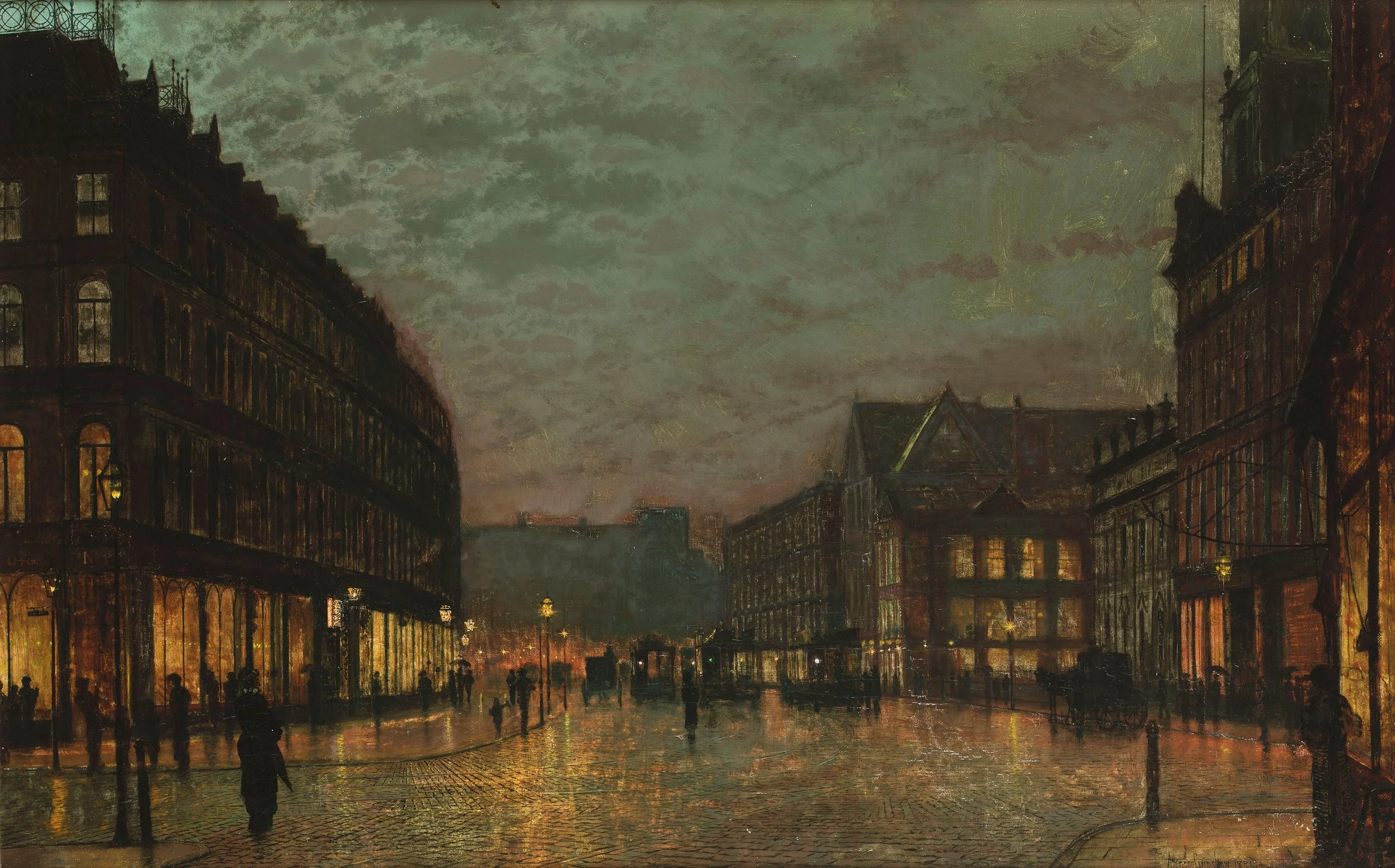
Boar Lane, Leeds, by lamplight. Atkinson Grimshaw, 1881. Oil on canvas.
Dear Reader,
Do we live in an age of advertising, or is it in our nature?
Cicero defeated Cataline in 63 BC and wouldn’t let people hear the end of it. Julius Caesar released eight volumes about how great he is (The Gallic Wars) from 58-49 BC. Cato the Younger, realising he lost the Roman Republic to Caesar in 46 BC ran himself through with a sword. Then, when his friends tried to save him, ripped out his innards by hand to be sure he’d never let Caesar take him alive. Quite the statement.
So why did it take beer so long to enter the advertising game? It could be because, for a long time, it never had an empire to build or defend. That would change during the Victorian era.
The industrial revolution and British Empire combined to allow brands to scale to previously unimaginable size and sell throughout the world. Brewing was still about production, but the brewing industry had become a battle for hearts and minds.
And so, at the threshold of a great transformation of industry and society, what does a brewery do to adapt?
This week, we explore this question during the beginning of the second century of IPA, from the mid-1850s to about 1880. It was a time of great upheaval, great hope, and the first salvos of the advertising battles that still rage in the jungle that is the beer market.
—
The Taste of Progress
They rushed into dim tunnels illuminated by gas light. Men of means, labourers, women and children. Steam and smoke made the air at times heavy and rotten.
Men struggled to exchange money for tickets, but the crowd was so thick many were unable to do so. Those who paid and gained the platform found themselves waiting anxiously as train after train rolled past, packed with riders from stations further down the line.
During the morning, the crowds were immense, and the constant cry, as the trains arrived, of “No room”, appeared to have a very depressing effect on those assembled… Towards afternoon, however, the tide set the other way, and the approaches to the trains at Victoria-street can be compared to none other than the crush at the doors of a theatre on the first night... -Opening of the Metropolitan Railway to the Public, The Guardian, Sunday, 11 January 1863
It was a time of excitement, disruption, and progress. London had just opened the world’s first subway.
Within two decades of the opening of the London subway the telephone would be invented. Recorded sound (phonograph), the electric lightbulb and internal combustion engine would follow. The tide of modernity was washing over the old world, still visible everywhere but clearly passing away.
It was the height of the British Imperial Century and the peak of the Industrial Revolution and India Pale Ale was the flavour of this new world order. It sailed over oceans, carried in the holds of the world’s largest merchant fleet.
The best brewers embraced the times by using technology to boost production, consistency, and quality for their now global brands. Samuel Allsopp’s son, Henry, had modernised his brewery and increased annual production to hundreds of thousands of barrels per year. He was in fierce competition with Michael Bass, another innovative Burton brewer.
The two men were among the first to use steam power in brewing. Steam plants powered pumps and mills, elevators and conveyors, making their breweries run as if guided by the hands of invisible workers. Bass even used mechanical refrigeration, allowing him to brew high-quality ales year-round, and leveraged scientific brewing methods by employing chemists to study fermentation.
So much ale was being produced that Michael Bass maintained a stock of IPA that covered three floors, each two acres in size containing 30,000 barrels of ale apiece, right in the middle of London. It was destined for export, but IPA was now just as popular at home as it was abroad.
No drink from the era was as closely associated with progress and national pride as the IPA.
The pale, even golden, IPA was sophisticated when compared to hazy, dark traditional ales. It was also expensive, requiring far more hops than other styles. This, combined with its exotic origin story, association with expanding British influence and rapid technological progress, gave it the reputation as a status drink. The timing was perfect, because there was by the mid-1800s a new middle-class thirsty for a taste of progress.
British GDP grew by 150% from 1840 to 1870, creating millions of new upwardly mobile drinkers ready to show off. Breweries like Bass and Allsopp tailored their marketing to reinforce this message by tying their brand to their nation’s glorious rise to power and, crucially, its people’s hope for the future. Partly due to the politics of these marketing campaigns, and also simply due to price, drinking IPA became a question of class. And it wasn’t simply what you ordered that made you stand out. It was where you drank.
IPA for the Club and Mild in the Pub
The pub was the heart of the community for working-class men in Britain and ale was the blood that pumped through its veins. Pub is the short form of this institution’s full name, Public House. It was a space open to any man. Working men often collected their wages at the pub. They also settled debts, organised mutual aid societies, and held informal meetings that sometimes evolved into more structured entities like trade unions or activist groups. Pubs were also entertainment centres where men could play games like darts and billiards, creating a lively and, the later it got in the day, rowdy atmosphere.
Men gathered in pubs to unwind after long hours in factories, mines, or at the docks. Ale was viewed as a nourishing, responsible beverage for the respectable Victorian man because it contained less alcohol than spirits. Pub-goers had traditional tastes for dark ales like porter and its stronger cousin, stout, because these were seen as more nourishing than light coloured ales. Mild ales were popular, too. IPA was unusual here. For the working class, it was a patriotic drink for special occasions, if at all. IPA was not a drink for the pub, but for the club.
Middle class men spent their leisure time in clubs. These were private spaces and their membership was restricted to men with similar social or professional status. Young men joined clubs to network with older men whose favour they would need for a successful middle-class career. Doctors, lawyers, and entrepreneurs frequented clubs that offered a refined and exclusive environment for the upwardly mobile. They also offered an opportunity for men to better themselves in the Victorian self-help tradition. Members discussed politics, conducted business, and used their club’s private libraries for intellectual pursuits or even to attend lectures. Ale, in particular Bass or Allsopp’s IPA, was the drink of choice in the club.
The idea that IPA was a sophisticated, premium, and patriotic drink for an ambitious nation helped it gain market share from traditional ales, particularly in urban areas of the UK. It was the favourite among young people and the middle- and upper-class, who could afford bottled ale to take home. This aspirant class saw traditional ales as archaic. They were for stodgy geezers, backwards country folk and labourers. All this was a bit off-putting for working-class pub goers who felt patronized by the middle-class and couldn’t afford IPA anyway.
But IPA still had a ferociously British identity, and frustrations were more about drinkers than the drink. Marketing had by then become a key part of the brewing business. The middle-class market was huge, and growing. If a brewery could make people who couldn’t afford IPA aspire to its product, that first sale to a newly minted middle-class man would build brand loyalty and enjoy the rewards. This is where the great Allsopp Brewery was outdone by Michael Bass.
The Struggle for the Domestic British Market
Allsopp had come to dominate the overseas IPA trade when, with the help of the East India Company and naturally occurring sulphates in his water supply that made hops taste better, he put Hodgson’s brewery out of business (you can read that story here). But Allsopp’s success in bringing the brewing industry of Burton-Upon-Trent from near destitution to Brewing Capital of the World had created the competition that would eventually be his downfall.
Unlike the management of Hodgson’s brewery that angered important people, Allsopp’s brewery didn’t do anything wrong. Rather, it’s what they didn’t do that would get them. By the 1860s Bass brewing was an ascendant brewery with a charismatic leader, Michael Bass.
Bass leveraged the new technologies of the Victorian age more quickly and to better effect than Allsopp. By 1870 he was producing roughly four times as much ale as Allsopp. Allsopp, for his part, was by then producing twenty-five times more beer than the entire city of Burton-Upon-Trent was in 1823, the year his father Samuel Allsopp sent his first shipment to India. But during this new age of industrial production, it still wasn’t enough to keep pace with Bass.
While Allsopp’s brewery focused on scaling production Bass leveraged his resources in what we would today call aura farming. A century and a half before the advent of social media, Bass set out to show the world he was the ideal Victorian gentleman.
There is no reason to doubt that Michael Bass was anything less than the personification of Victorian ideals. Nor is there any question that he went to great lengths to be sure everyone knew it.
Bass was a philanthropist who donated public parks, swimming baths, libraries, a church, and a hospital to the people of Burton and Derby, where his business was based. He showcased his innovative brewing technology at world exhibitions, pitching his brewery as a model of British technological advancement. He was also a Member of Parliament for thirty-five years where he helped advance popular causes like the abolition of debtors’ prisons and supported labourers in their efforts to reduce oppressive working hours.
He was the kind of guy you’d want to have a beer with. Or at least, the kind of guy whose beer you’d be sure to drink as soon as you could afford it.
Bass wasn’t all show, he demonstrated good character in private, too. He improved the working conditions of his thousands of employees and turned down offers to become a baron, and separately a peer, preferring to remain a commoner. His famous red triangle logo, one of the world’s first registered trademarks and the first in Britain, was synonymous with quality and British progress. To have a pint of Bass IPA was to hold the best of the modern world in your hand. It was also a way to show your support for a rich man who worked tirelessly to improve the lot of working men, while sticking it to the upper class by turning down fancy titles.
That was a tough act to follow.
Henry Allsopp was himself an impressive man but in contrast to Bass he was a quiet old-school gentleman from an age that was fading away. Like Bass, Allsopp was a philanthropist but preferred to donate to local charities and infrastructure projects as one donor among several. While it may have been his preference to donate in a less ostentatious way, he was not afraid of status symbols. He became a member of parliament in 1874 and purchased a stately manor home, Hindlip Hall, as a legacy for his family. He accepted a baronetcy upon his retirement from the House of Commons and in 1886 was elevated to the peerage to become the first Baron Hindlip.
He was an ideal citizen of the Old World, successful, generous, titled, but his life and brand did not reflect the excitement, progress, and appetite for social change that Victorians craved. Allsopp’s was a brand people were proud of, and a part of British history. But it was not a brand for the future and that’s where the aspiring Victorian masses had cast their gaze.
Bass, with his skilful embrace of technology and cunning marketing, had succeeded in changing IPA’s reputation from the ale of power to the taste of progress. The ale of sailing ships was becoming one of subways and streetcars, and the exciting new world just coming over the horizon.