
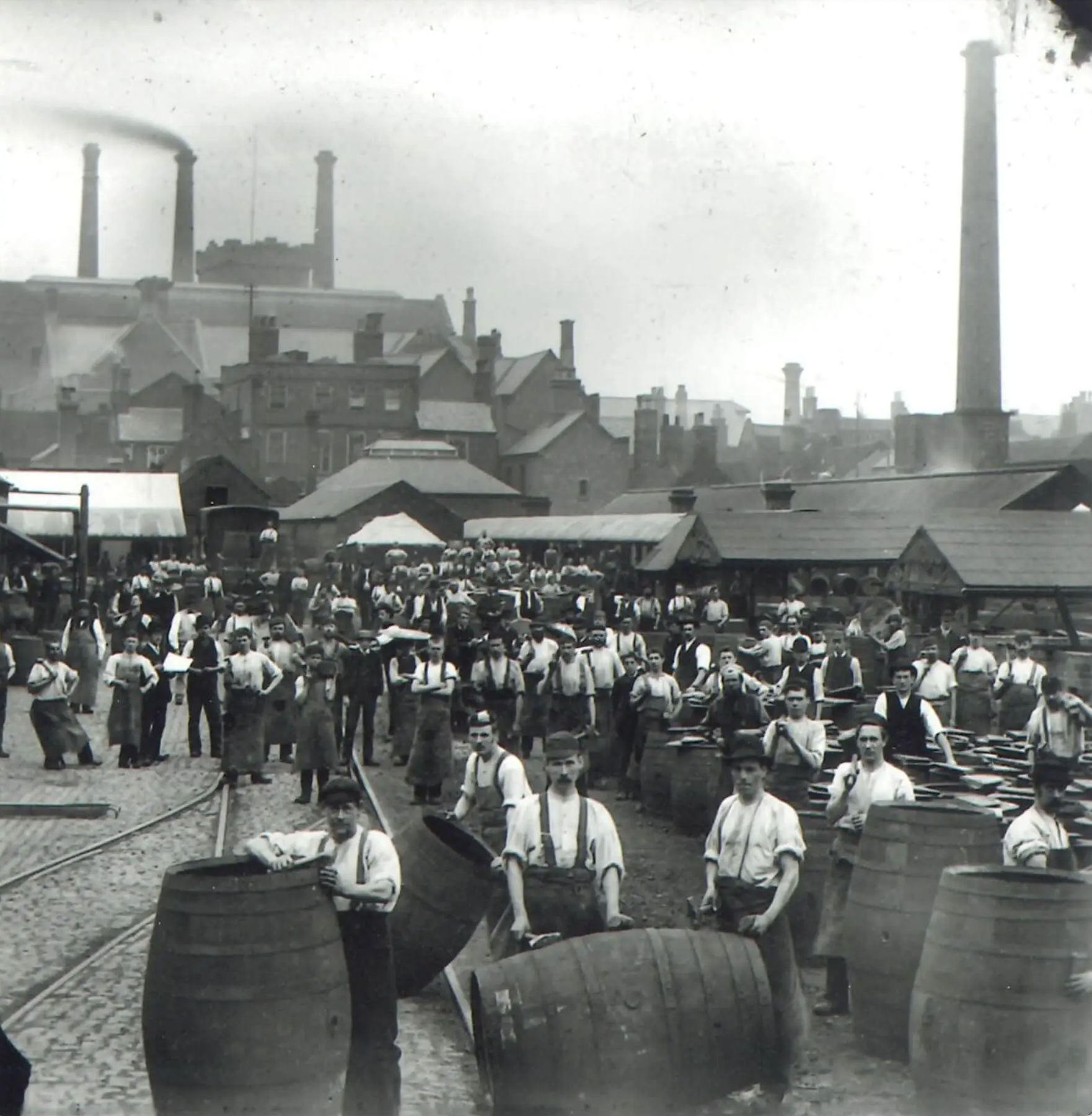
In 1752 an upstart London brewer named George Hodgson walked two miles from his brewery on the river Lee to its confluence with the Thames. He continued along the docks of the East India Company offering Captains his beer on credit. They could take it now and, if it sold, pay him when they returned 18 months later. Many took the deal and his beer first landed in India in 1754.
England had been exporting ale to India since the 1600s and by the 1750s their export market had reached 1,500 barrels per year. It was small, but it was a market that could grow fast. And Hodgeson’s ale was unlike the others that made the four months-long voyage to the Indian subcontinent. It was lighter, stronger, and heavily hopped, helping it not only withstand the harsh conditions of a months-long tropical sea voyage. His ale seemed to thrive.
The first IPAs, then just called Pale Ales, seems to have benefited from a secret ingredient that thrived in warm barrels rolling on the waves. This secret was likely a hearty yeast called Brettanomyces claussenii that was accidentally introduced into the ale via the barrels Hodgson shipped it in. It likes warm, even hot temperatures and has the special ability to eat long chain polysaccharides that regular brewer’s yeast (saccharomyces cerevisiae) can’t digest. This meant that it could continue fermenting an otherwise finished beer, drying it out and consuming some of the oxygen that could lead to off flavours. The high-gravity ales Hodgeson made would have had enough sugars left for a solid secondary fermentation with Brett c.
Written descriptions of the ale’s flavour support this idea. Although no one had yet discovered microbes, we know today that Brett. c. was common in historical English ales. It’s also responsible for flavours Hodgson’s contemporaries in India described as “old,” “stock,” and especially “farmhouse.” It would also make ale taste more dry, since there would be fewer residual sugars left to add the mild sweetness common in strong ales. All four of these telltale Brett. c. terms were used to describe Hodgsons’s IPA, just as they were to describe the ales brewers brewed to compete with Hodgson and the stock ales many English expats loved to drink when they were back home.
IPA filled the stomachs of happy expats and the wallets of the East India captains. It turned a good profit for the merchants who sold it. It was the most popular brand in India. Hodgson’s pale ale soon became known as the East India Pale Ale. Other London breweries rushed to copy it, shipping their versions to India in the hope they could get some of Hodgson’s market share. But they had limited success.
Hodgson’s early market position and generous credit terms with East India Company captains would help him gain half the of Indian export market. All this happened at a time when the Indian market was on its way to quintupling from 1,500 barrels per year in 1750 to 9,000 barrels per year by the turn of the century.
Three years after his beers first arrived, British victory at the battle of Plassey would transform India into a massive market. At Plassey (Palashi in modern-day West Bengal), British general Robert Clive made a secret deal with a senior Bengali commander named Mir Jafar to usurp power from Bengal’s ruler Siraj ud-Daulah. Clive stood with 3,000 men against over 10,000, but most of them stepped aside and did not fight. Siraj fled. He was later captured and killed. Jafar became the ruler of Bengal. The Company received enormous power and influence in the region.
As British power in India expanded, IPA changed from representing a taste of home to the taste of a growing empire. It was a steadfast part of a new social dynamic and developed a romantic appeal as the unofficial flavour of the expatriate experience.
They were soldiers, labourers, traders and administrators who sought to establish and defend outposts used for strategic economic and military goals. Women began emigrating to colonies in India once the early male colonists had made them secure. They often came as the wives of officials, merchants, and military officers. Although still heavily outnumbered by men, women were central to the structure and organisation of imperial social life by the late 1700s.
The role of women as social, cultural, and even diplomatic organisers and ambassadors was then an informal but critical and recognisable institution. Mixed-gender socializing was much more common in the colonies than in Britain and played a crucial role in building community and providing social and psychological support for small expatriate outposts.
Garden parties, picnics and other outdoor events were, even in the UK, mixed-gender gatherings. But the famously cool, wet weather in the UK limited social gatherings there to indoors for much of the year, where they were much more likely to be segregated. This was not a problem in India. Mixed social gatherings there were more frequent and focused on fostering a sense of unity rather than on maintaining hierarchy. This was where women and men, military officers, civil servants, and merchants got together to reinforce their common British identity.
IPA was the flavour of these get-togethers. British expats rarely drank water. Instead, they had tea, coffee, ale, and spirits. As a refreshing alternative to tea and coffee that lacked the intoxicating power of spirits, IPA was the most popular social drink for both men and women. Men appreciated its strong, bitter flavour as masculine traits. Women found it appropriately modest because of its relatively low alcohol content when compared to spirits. It’s connection to home also helped set it apart from tea and coffee which, being imports from other colonies, lacked the patriotic symbolism of the IPA.
Hodgson’s IPA had become the flavour of social life for many among Britain’s ruling classes. But after decades of success Hodgeson’s heirs grew complacent. His success would outlive him but this good fortune would not continue for his business. Almost seventy years after Hodgson shipped his first barrels of ale to India the new owners of his Bow Brewery, his grandson Frederik Hodgson and a business partner named Thomas Drane made an ambitious move.
The pair tried to cut out the East India Company.
Gone was the 70-year-old credit agreement. Prices went up. The Hodgson brewery was trying to cut out the middleman selling ale in India.
Campbel Marjoribanks, the Company chairman, was furious. He began looking for a brewer to replace Hodgson. He found one in Samuel Allsopp, a brewer in Burton-Upon-Trent.
Allsopp bought his uncle’s brewery in 1807 and almost immediately went bankrupt. The Allsopp brewery made its money exporting strong porters to the Baltic nations, but the Napoleonic wars put an end to that. Trade opened up in 1812 following a decisive British naval victory over Napoleon’s ally Denmark, but Russian protectionism again shut it down a few years later. The Burton brewing industry collapsed, and Allsopps’ fortunes collapsed with it.
On a business trip to London in 1822, Allsopp met Marchbanks over dinner. Marchbanks pulled out some bottles of Hodgeson’s ale and proclaimed that whoever could copy it would be a rich man. Allsopp, desperate for new customers, said he could. It wasn’t a particularly difficult task because there were only two ingredients: pale malt and East Kent Goldings hops. The trick was getting the temperature right and keeping it there throughout the brewing and fermenting process.
Marjoribanks sent a case of beer to him in Burton to support his efforts. We can’t be sure what happened next but the legend goes like this: Job poured himself a pint of Hodgson’s bitter ale, raised it to his lips for a sip, and then spat it out in horror. “Yes, I can make this” he is said, “But why would anyone want to drink it?” Then he brewed a test batch in his kitchen using a teapot and, finding the result similar, scaled up production to the brewery.
He ramped up production later that year and his first shipment landed in India in 1823 with support from the East India Company. And like Hodgeson, he had his own secret ingredient.
Burton-Upon-Trent sits in the Trent Valley Basin atop layers of sedimentary rocks formed during the Triassic period 250 million years ago. The water used by Burton brewers fell upon the earth as rain. It filtered through rocks tread upon by dinosaurs like Asylosaurus in the hot English prehistoric, flowed through beds of Keuper marl and gypsum, and past layers of chalk and limestone before collecting in underground springs.
When pumped back to the surface the unique mineral content of this water was ideal for brewing hoppy ales. It is rich in calcium sulphate, enhancing hop bitterness and sharpening flavour. It has high calcium carbonate and magnesium, promoting enzyme activity during the brewing process and supporting yeast metabolism during fermentation. It is also high in sodium and chloride, which are balanced in a way that brings out the sweetness in malt so that it complements the more assertive hop character.
Marjoribanks didn’t know Burton water would have this effect when he approached Allsopp. Allsopp didn’t know it when he claimed he could replicate Hodgson’s IPA. But it didn’t take long for the magical properties of Burton water to transform the city into the brewing capital of the world.
Allsopp’s IPA was a success from the moment it landed in Calcutta. It certainly helped that the first shipment of Allsopp IPA landed at the same time as a spoiled shipment of Hodgson’s. But one bad shipment on its own isn’t enough to dethrone a brewery with market dominance of the kind Hodgson enjoyed. Allsopp’s product had to be consistently better, too. It was. Whether this is because Burton water changed the flavour of a virtually indistinguishable recipe is an open question. What is clear is that Burton water supported healthier yeast, and this may have resulted in cleaner, dryer fermentations that were more consistent and less likely to develop off-flavours.
Allsopp pushed Hodgson out of the Indian market throughout the 1820s and became the new dominant player in Asian market. The struggling brewer was now one of the most successful in the world.
His success inspired other Burton brewers to begin making their own hoppy ales. And like Hodgeson seventy years prior, Allsopp’s timing was ideal. When British victory against Napoleon came in 1815 it created a period of peace and stability where Great Britain dominated the world as the only global superpower. The nation had access to an ever-increasing international market for its products through its vast network of colonies. Allsopps ale was sold across the globe, from the Caribbean to North Africa, and India to Indonesia, the IPA became the definitive beer of the mid-19th Century.