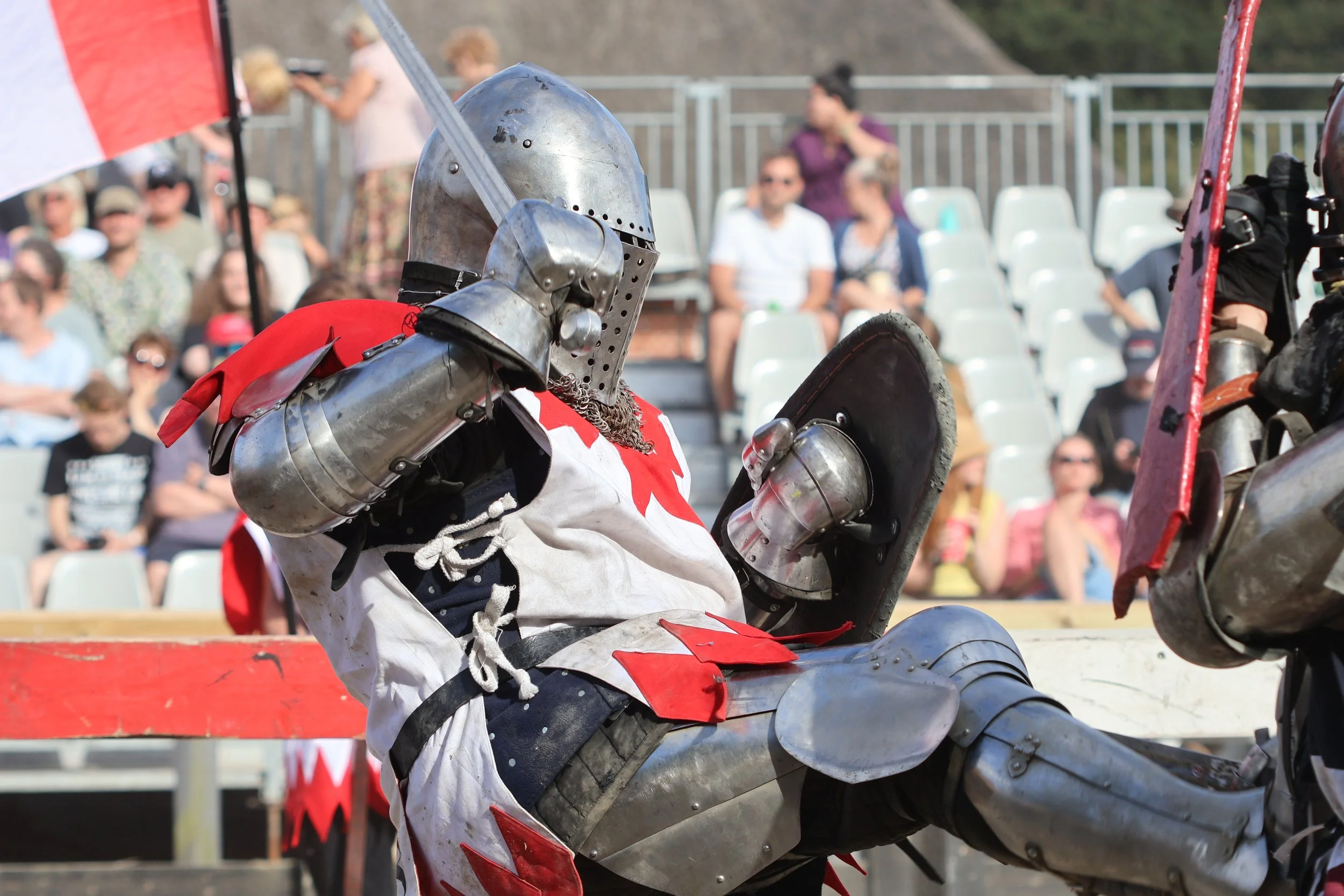
Join us at noon for a medieval festival featuring three medieval ale re-creations, knights in armour, armoured combat demonstrations, and medieval crafts.
Learn about life in Europe one thousand years ago with short presentations about medieval brewing and society.
Feeling tough? Armour up and fight a knight to help raise money for the Silver Gryphons, the group putting on the combat demonstration (you’ll need to sign a waver and fight the knight before you start drinking the ales…).
We’ll be pouring our Norwegian Råøl (raw ale) from the 10th century, a Carolingian ale from the 9th century, and a gruit from roughly the same period.
Tickets are $15 and include a pint of medieval ale and a donation to support the Silver Gryphons.
The event runs from noon to 5pm with combat demonstrations throughout.
Kids are welcome and can get a non-alcoholic drink with their ticket.
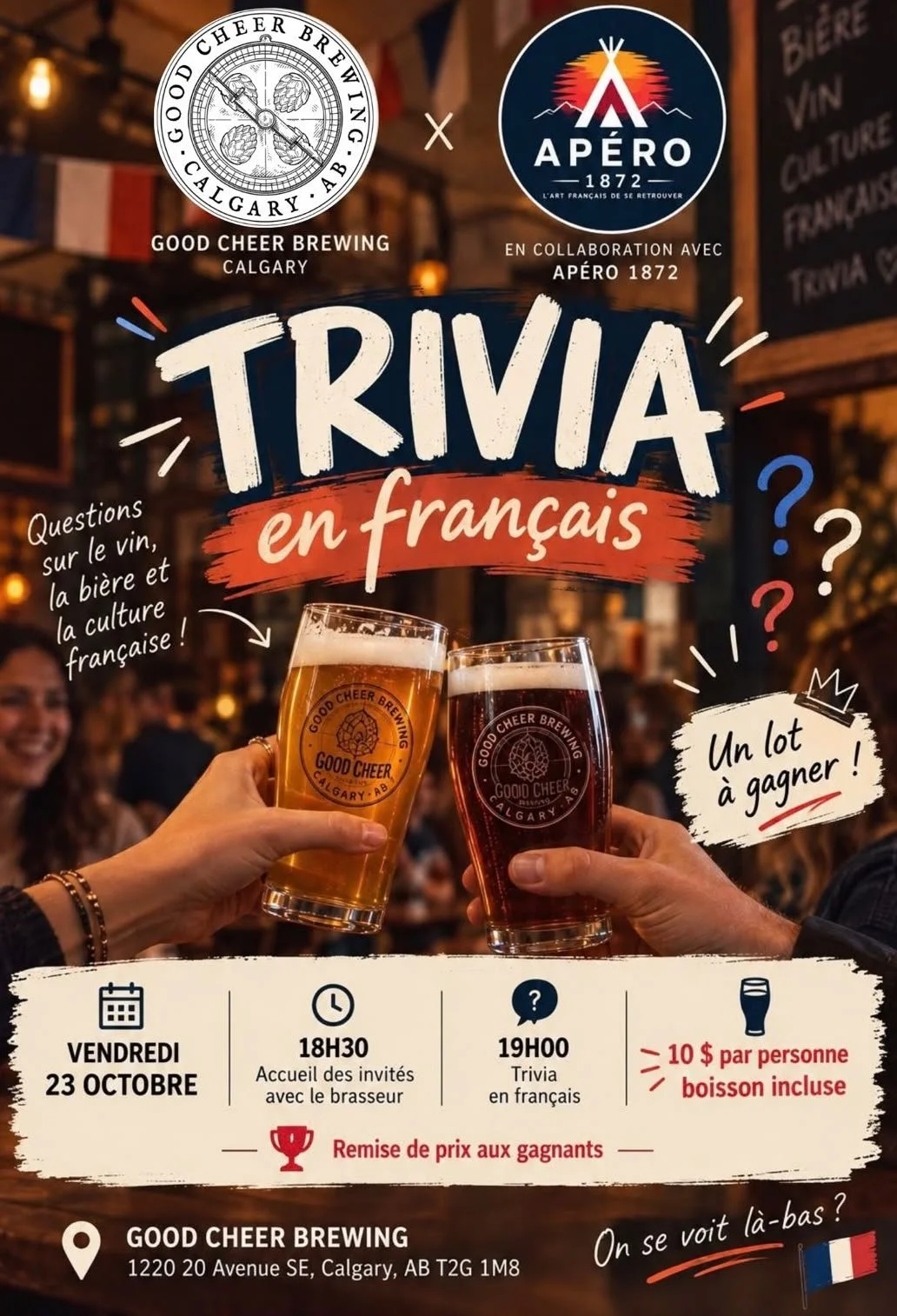
Venez passer une soirée conviviale 100 % en français chez Good Cheer Brewing, en collaboration avec Apéro 1872 ! Le vendredi 23 octobre, testez vos connaissances sur le vin, la bière et la culture française lors d’un trivia dans une ambiance détendue. L’accueil commence à 18 h 30 avec le brasseur, puis le trivia débute à 19 h, avec des prix à gagner. Réservez votre place en préachetant une boisson au prix de 10 $, taxes et pourboire inclus. Que vous soyez francophone, francophile ou simplement à la recherche d’une occasion de pratiquer votre français autour d’un verre, venez jouer, échanger et vous amuser avec nous à Good Cheer Brewing, 1220 20 Avenue SE, Calgary.
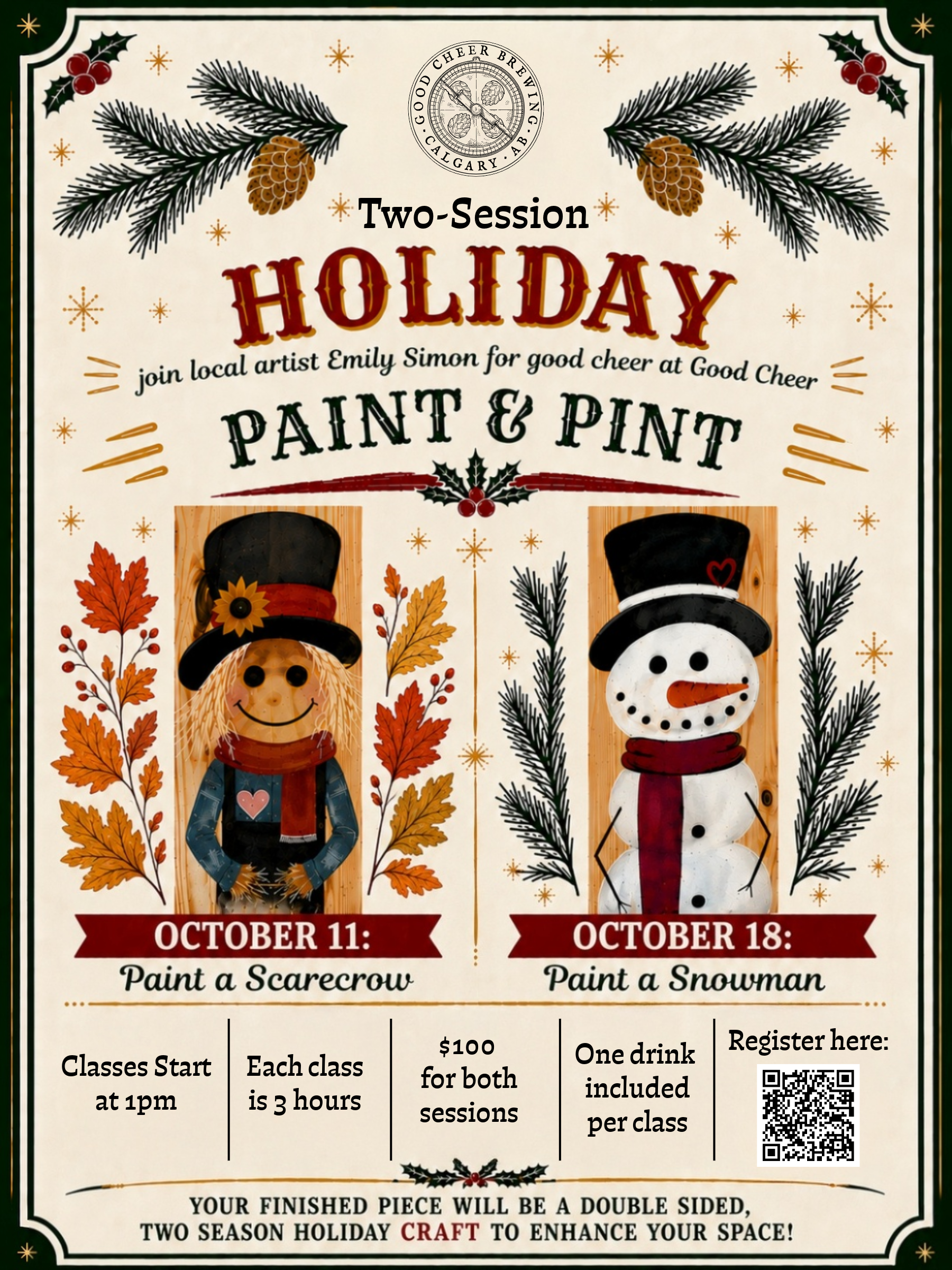
In this two-session workshop you’ll make a double-sided festive display featuring a a scarecrow for autumn/Halloween on one side and a snowman on the other for winter/Christmas!
All materials are provided.
This workshop is hosted by local artist Emily Simon, with proceeds supporting her work.
One drink is included for each workshop.
Sessions are on two Sundays, October 11 and 18 and run from 1-4pm.

Join the Stein Club and get your very own special edition 1L stein.
You’ll receive exclusive 1L pours and discounts during Oktoberfest, Sept 19 - Oct 4, 2026.
Pick-up your stein at the brewery Sept 19 onwards.
Join us for German beer, food and music as we kick off Oktoberfest on Sept 19 with four German beers on tap, including two special guest kegs imported from Germany and exclusive bottles.
Launch Party: Saturday, September 19 from noon until close.
Stein Club special 1L pours and discounts: September 19 to October 4
Note: We’re closed Mondays
Join us for an evening of unique beer, sensory tasting, and brewing science as we explore two experimental beers brewed specifically for this event: a pair of Bavarian IPAs.
What exactly is a Bavarian IPA? Good question. We’re going to find out along with you.
We brewed a single IPA base recipe and split it into two batches. Both feature the German hop varieties Hallertauer Blanc and Hersbrucker, creating an IPA with a distinctly German flavour profile. But we changed one important variable: the yeast.
One batch was fermented with a traditional Bavarian Hefeweizen yeast. The other used an American ale yeast commonly found in modern hazy IPAs.
How much difference can yeast make? Can you tell which is which? And which one makes the better beer?
This one-hour event begins with a short introduction to Project Hop - our monthly public brewing science experiment. You'll then receive samples of both Bavarian IPAs for a guided sensory analysis. We’ll taste them blind, compare what you experience, and talk about the aromas and flavours you find in each glass. You can then choose a pint of your favourite.
Then comes the reveal. We’ll tell you which beer is which and explore the brewing science behind the differences you tasted as you finish the evening with a pint of your favourite. A limited amount of cans will be available for purchase at the event.
When: Friday, September 25 at 6:30pm
$15 - includes two tasters (one of each beer) and a pint of your favourite.
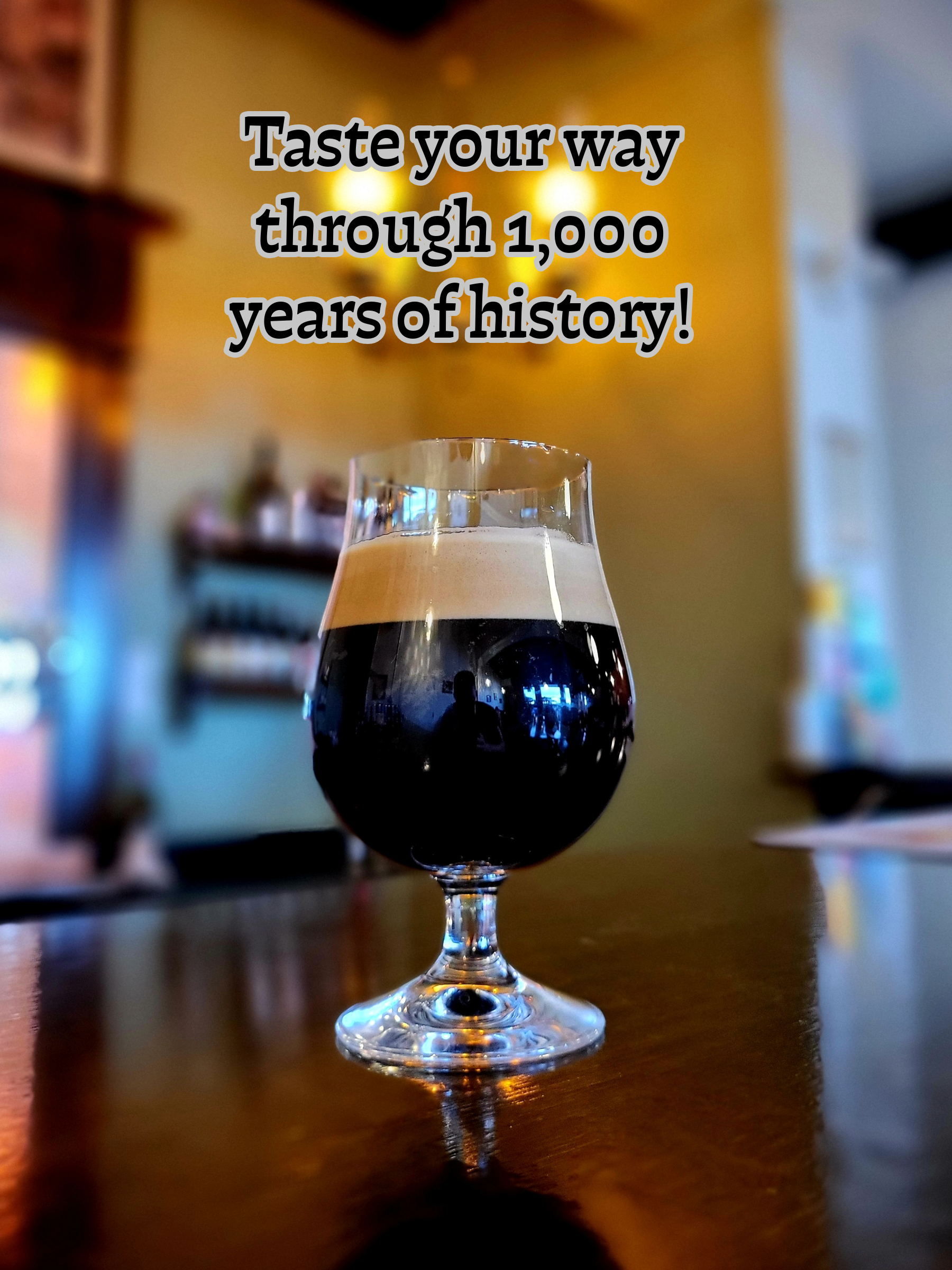
What did beer taste like a thousand years ago?
Travel through nearly 900 years of brewing history as you sample three historically beers while uncovering the stories behind them. From the distinctive raw ales of the Vikings, to the dark porter that fueled the Industrial Revolution, to the bold, hop-forward India Pale Ale that conquered the British Empire, each glass opens a window into a different world.
More than a tasting, this is an evening of history, storytelling, and beer. You'll discover why these styles emerged, who brewed them, how they reflected the societies that produced them, and why their influence can still be found in your pint today.
Your ticket includes:
Three 250 mL pours of historically inspired beers
A guided presentation exploring nearly 900 years of brewing history
Opportunities to ask questions and discuss the beers as you taste them
Whether you're a history enthusiast, a craft beer lover, or simply curious about the stories hidden in your glass, this unique tasting experience will change the way you think about beer.
Thursday, September 10 • 6:30 PM
Good Cheer Brewing
Tickets: $25(includes three 250 mL beers, tip included)
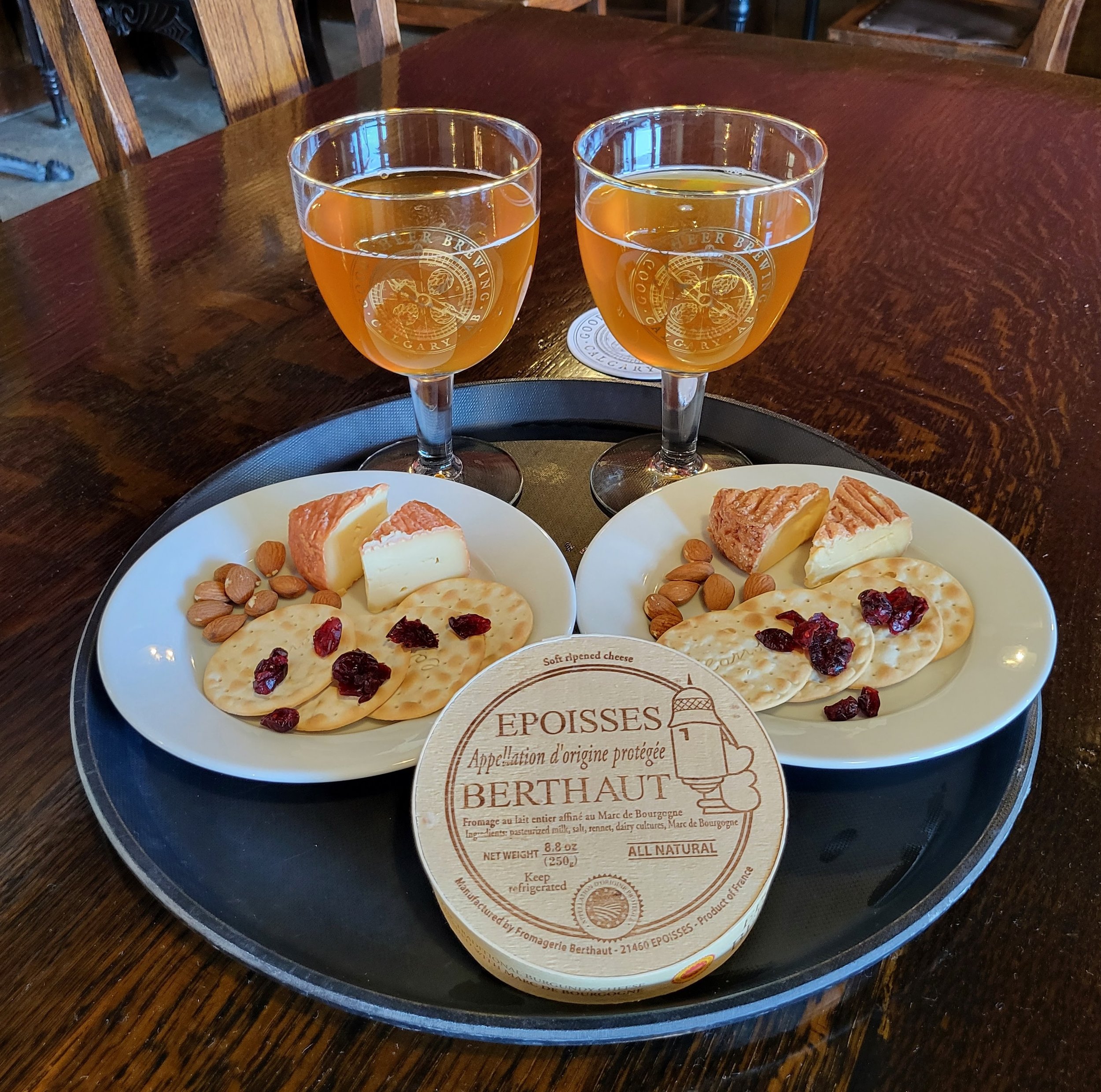
Ready to taste some great pairings and learn the science behind matching beer with food?
Join us for an in-depth guided tasting led by one of our brewers exploring the chemistry of great beer and cheese pairings. Using sight, aroma, and taste, we’ll identify the dominant compounds in four distinct historical beer styles and discover how they interact with carefully selected cheeses.
Through a structured but relaxed tasting of four historical beers (200ml each) and four premium cheeses (20g each), you’ll experience how fat, salt, protein, and rind microbiology influence flavour perception - softening bitterness, amplifying aromatics, and creating harmony between malt, hops, yeast, and dairy. Each pairing will be demonstrated and explored together, and at 800ml of beer and 90g of cheese this is a serious tasting!
This workshop blends sensory training, brewing history, and delicious pairings in a convivial setting. By the end, you’ll understand why certain combinations work — and how to predict great pairings on your own.
September 17, 6:30pm.
Seats are limited to maintain an intimate tasting environment.
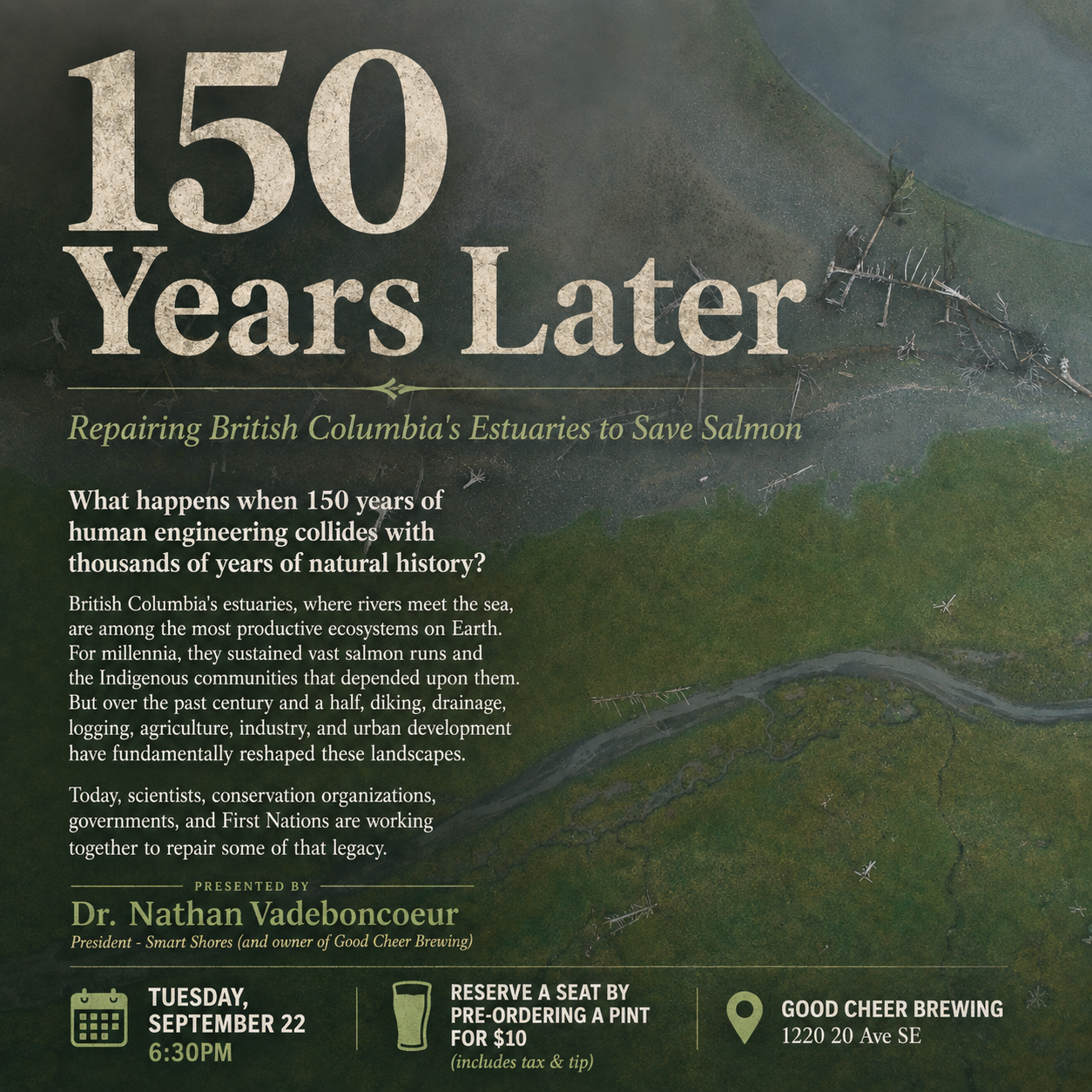
What happens when 150 years of human engineering collides with thousands of years of natural history?
British Columbia's estuaries, where rivers meet the sea, are among the most productive ecosystems on Earth. For millennia, they sustained vast salmon runs and the Indigenous communities that depended upon them. But over the past century and a half, diking, drainage, logging, agriculture, industry, and urban development have fundamentally reshaped these landscapes.
Today, scientists, conservation organisations, governments, and First Nations are working together to repair some of that legacy.
Join us for a fascinating journey along the British Columbia coast, from Alaska to Washington State and throughout Vancouver Island, exploring one of Canada's largest efforts to restore salmon habitat. Through stunning drone imagery, LiDAR mapping, historical photographs, and coastal science, you'll discover how researchers are monitoring fragile estuaries, projecting the impacts of sea level rise, and helping rebuild ecosystems that have been changing for generations.
Along the way, we'll explore the remarkable natural history of salmon, the history of human settlement along the coast, and how modern technology is helping us understand, and begin repairing, the ecological consequences of the past.
The talk will be presented by Dr. Nathan Vadeboncoeur, who led national and international coastal science assessments and worked on estuary restoration projects throughout British Columbia under the Salmon Restoration and Innovation Fund.
Tuesday, September 22 - 6:30pm
Good Cheer Brewing - 1220 20 Ave SE
Reserve a seat for $10 (includes a pint!)
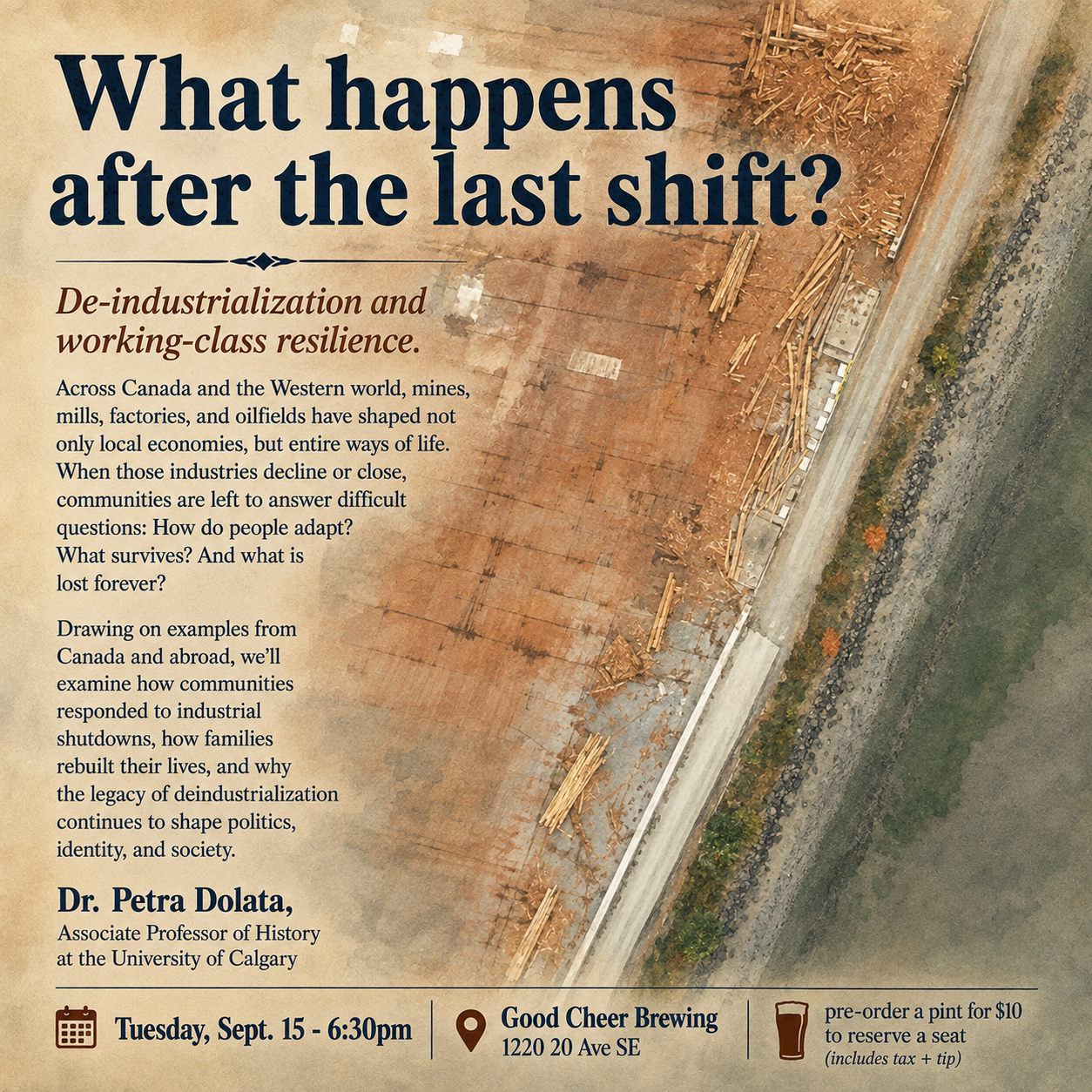
Across Canada and the Western world, mines, mills, factories, and oilfields have shaped not only local economies, but entire ways of life. When those industries decline or close, communities are left to answer difficult questions: How do people adapt? What survives? And what is lost forever?
Join us for a fascinating evening exploring the history of deindustrialization and the resilience of working-class communities. As governments and industries grapple with today's energy transition and the realities of a changing climate, this talk asks what we can learn from places that have already navigated profound economic change.
Drawing on examples from Canada and abroad, we'll examine how communities responded to industrial shutdowns, how families rebuilt their lives, and why the legacy of deindustrialization continues to shape politics, identity, and society decades later.
The talk will be presented by Dr. Petra Dolata, Associate Professor of History at the University of Calgary and a leading researcher with the international Deindustrialization and the Politics of Our Time (DePOT) project, which examines the lived experience and lasting consequences of industrial decline.
Reserve your seat for $10 (includes a pint!).
Tuesday, September 15 - 6:30pm
Good Cheer Brewing - 1220 20 Ave SE, Calgary
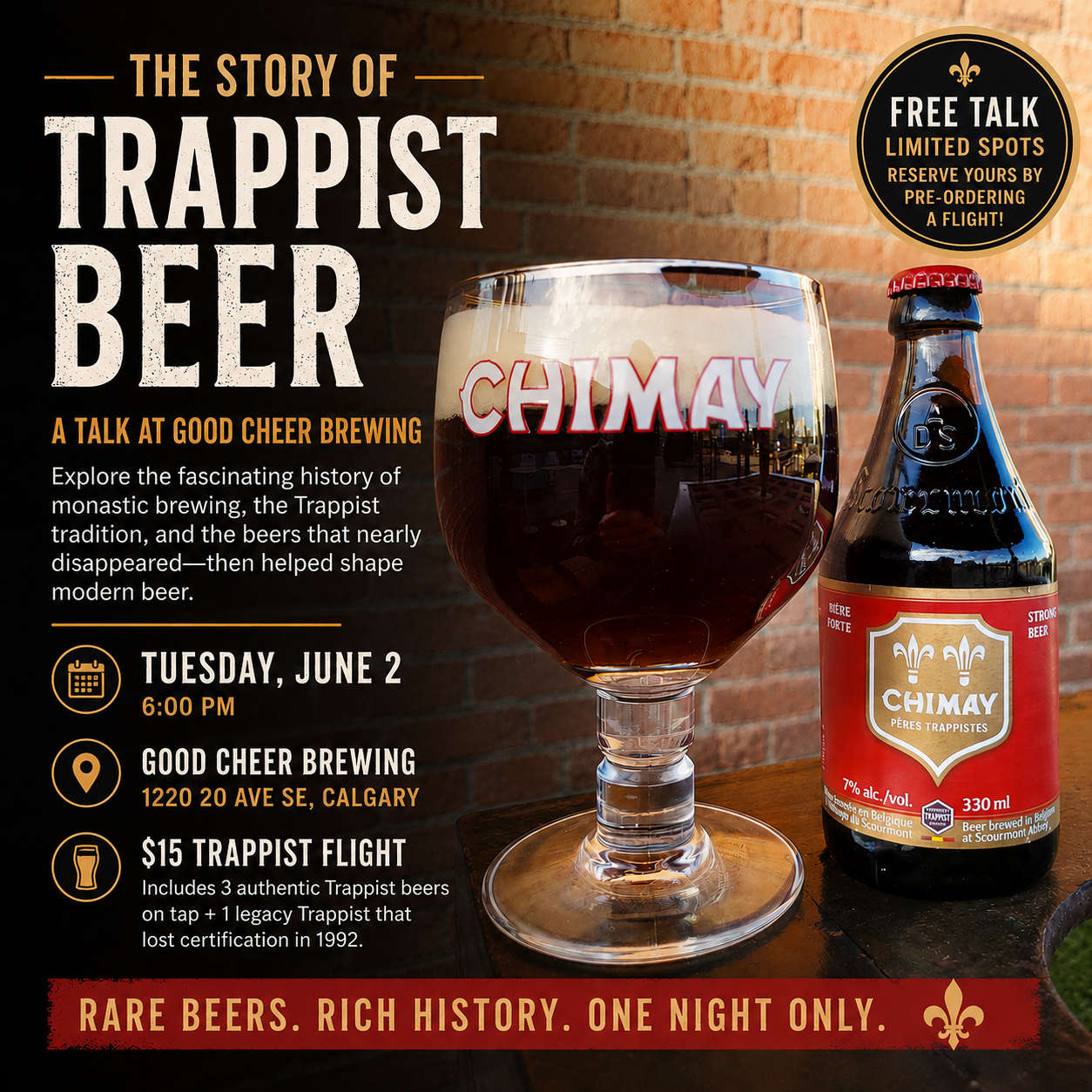
The is a free event, pre-purchasing a Trappist beer flight guarantees you a seat.
Monks have brewed some of the most revered beers in the world for a millenia. For some, like the Trappists, this was not for profit, but to sustain monastic life and support charitable work.
From the quiet abbeys of medieval Europe to the globally celebrated breweries of Belgium and the Netherlands today, Trappist beer represents one of the longest continuous brewing traditions in human history.
Join us on Tuesday, July 21 at 6:00 for an engaging and story-driven talk exploring how this remarkable tradition developed. We’ll trace the origins of monastic brewing, the rise of the Trappist orders, and how their disciplined way of life shaped the beers we know today.
Along the way we’ll explore:
• Why monks brewed beer in the first place
• How monasteries became centres of brewing excellence
• The difference between Trappist and Abbey beer
• The unique rules that govern Trappist brewing today
• The stories behind famous monasteries like Westmalle, Chimay, and Orval
This talk is informal, fascinating, and designed for both beer lovers and history enthusiasts alike.
Seats are limited.
Reserve yours by pre-purchasing a Trappist beer flight to enjoy during the talk. We have Chimay Blue, Chimay 175 (anniversary beer), Westmalle Duo, and St. Bernardus ABT 12.
Grab a drink, take a seat, and discover the extraordinary story behind the monks who brew.
Tuesday, July 21, 6pm, Good Cheer Brewing 1220 20 Ave SE.
No results match your search. Try removing a few filters.
