
Can This Really Work?
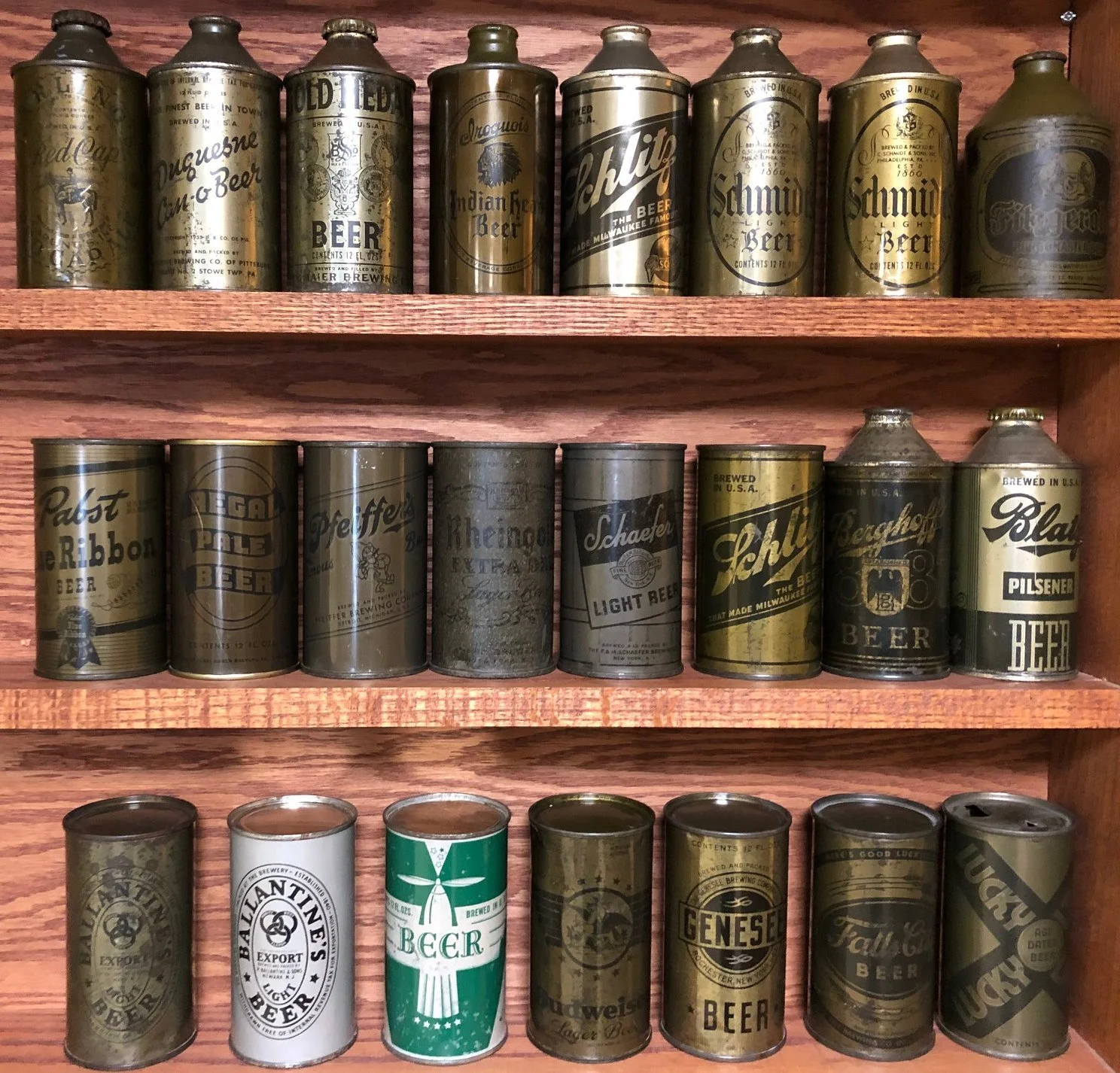
1940s beer cans, often made of steel, sometimes with cone tops in the style of motor oil or metal polish containers... (image: Porterhse via Wikimedia Commons)
Dear Reader,
Success is rarely about if something can be done. More often, it’s about recognising the right thing to do, and the right time to do it.
So, can this really work? That is, can we make the right decisions to secure success as a new business in a competitive landscape?
Yes, we can.
Can beer that is.
Turning a noun into a verb is more than just a dad joke. It's also one of the biggest decisions we've made as a young brewery. Packaging our beer lets us reach people who may never have walked through our doors. And so, like nearly every other brewery, now we can.
So, as a historical brewery, what better way is there to launch our first wholesale campaign than with a story about the history of the humble beer can? Why, when and where did it begin? I invite you to step into the weekly time machine (below) and explore the origin story of what is now an indispensable package for everything bubbly.
Can This Really Work?
A dusting of snow covered the ground.
It was just enough to obscure the gravel, at least beyond the tire tracks and footprints that crossed the railyard. Boxcars clattered along slowly beneath soot-blackened bridges. They caried coils of sheet metal, barrels of nails, and every other product America’s mills could still persuade people to buy.
This is Richmond, Virginia in December, 1934. The freeze of the Great Depression had just begun to thaw. Six years after the stock market crash men still searched for work in factories that stood quieter than anyone could remember.
Across the industrial northeast, manufacturers hunted desperately for new products that might keep furnaces burning and assembly lines moving. And, slowly, breweries were starting up again.
Prohibition had ended only a year earlier. Brewers reopened old plants, hired back workers, and fired kettles that had sat cold for more than a decade. Beer had returned, but brewing it was the easy part. Getting it to customers remained stubbornly expensive, and price mattered perhaps more than ever. This was a decade where the 300 year-old expression “penny pincher” suddenly exploded back into use.
Every bottle of beer was an opportunity and a burden. Glass was heavy. It broke easily on railway platforms and delivery wagons. Empty bottles had to be collected from taverns, hauled back to the brewery, washed, inspected, and filled again. Entire warehouses existed simply to manage mountains of empty glass. Brewers started looking for a way to lighten the load.
Could beer be sold in cans?
People had canned vegetables, peaches, and soup for generations, but beer was a different beast. It was acidic. It was bubbled with dissolved carbon dioxide. It sat under pressure, searching constantly for the smallest weakness in its container. Ordinary steel rusted. Bare metal tainted the flavour. What worked perfectly for tomatoes failed spectacularly for lager.
Then, a breakthrough. Engineers learned to coat the inside of steel cans with a protective lining that kept beer away from the metal itself. Suddenly, something impossible became practical.
On a cold January day in 1935, drinkers in Richmond, Virginia became the first to test the idea. Krueger's Finest Beer arrived not in familiar brown bottles, but in squat steel cans unlike anything most people had ever seen. The brewery proceeded cautiously, releasing only a few thousand cases. If customers rejected them, the experiment would quietly disappear.
Instead, they wanted more.
The beer was fresh. The cans travelled well. They stacked neatly in warehouses and railway cars. They chilled quickly in ice. Before long, breweries across the country were placing orders for canning equipment, and an invention born from economic necessity was beginning to reshape an industry.
There was, however, one small inconvenience. Unlike bottles, there was no obvious way to open a can. So drinkers but down their bottle openers and reached for a tool affectionately known as a Church Key.
With two firm punches it cut triangular holes into the steel lid. One large enough to drink from, another to admit air. It became as common in pockets and glove compartments as the bottle opener. You probably have one at home.
There was great variety among the earliest cans. Like the earliest dinosaurs roaming an antediluvian plain, they were a hodgepodge of evolutionary dead-ends.
Some had cone-tops so that they were compatible with existing bottling lines. But these looked like cans of motor oil or metal polish.
Some evolved narrow necks and crown caps so breweries could continue using their bottling equipment. Others remained squat steel cylinders that looked more at home in a mechanic's workshop than a pub. But as the decades passed, economics continued to favour metal over glass.
A truck had a limited amount of space. Better to carry beer than packaging. Warehouses could stack cans higher than bottles. Railway companies charged less to move them. They cooled faster in a household refrigerator and never shattered on a concrete floor. Most importantly for brewers, they protected beer completely from sunlight, the invisible enemy that turned fresh beer into something stale and skunky.
Then the can itself became lighter.
Steel gradually gave way to aluminium, a material that resisted rust, weighed even less, and proved easier to recycle. By the 1960s a process called Draw and Iron allowed the production of aluminum cans with walls thinner than paper, and engineers designed what is today the iconic dome bottom the simple pull tab opener that lifted away from the lid with a satisfying snap.
But convenience came at a cost. Beaches, campsites, parks, and roadside ditches glittered with discarded tabs sharp enough to cut bare feet. Children swallowed them. Wildlife encountered them. A tiny piece of metal became a nuisance.
Then, in 1975, engineers introduced the stay-on tab, leaving the ring attached to the can itself. Millions of pieces of litter vanished. The iconic beer can was born.
It was a package made for beer. Not stewed tomatoes. Not paint.
The beer can was an industrial triumph. And for that reason, many early craft brewers forsook it and went back to glass.
The 650ml (22oz) bomber bottle became a symbol of independence. No one knows for sure where the name comes from, but its larger format and familiar shape distinguished small breweries from the industrial lagers that filled supermarket shelves. Glass looked artisanal. Imported beers came in bottles. Serious beer, many people believed, belonged in glass.
That changed in the 2010s. Craft breweries became large enough, and competition strong enough, to make craft producers care about packaging costs, too.
Cans admitted virtually no light, almost no oxygen, chilled quickly, travelled cheaply, and arrived in better condition. The container itself had never been the compromise many imagined. If anything, it was the superior vessel. This argument, formerly obscured behind the opaque green or brown of the craft beer bomber, became crystal clear once craft brewers started to compete more on price.
Like biological evolution, industrial evolution has no destination in mind. It simply rewards whatever survives. Every gram of packaging saved, every pallet stacked a little higher, every truck carrying a little more beer became an advantage.
Today, some of the world's finest beers are poured from aluminium.
Though we may long for the historical continuity of glass bottles, or look with fascination upon the odd shapes of early beer cans, the evolutionary pressure of the modern beer market is pushing them toward extinction.
These dinosaurs of the packaging world will pass away and be forgotten by future generations until, perhaps, someone pauses before opening a cold can and wonders how it came to be.