
The Most Famous Man You’ve Never Heard Of
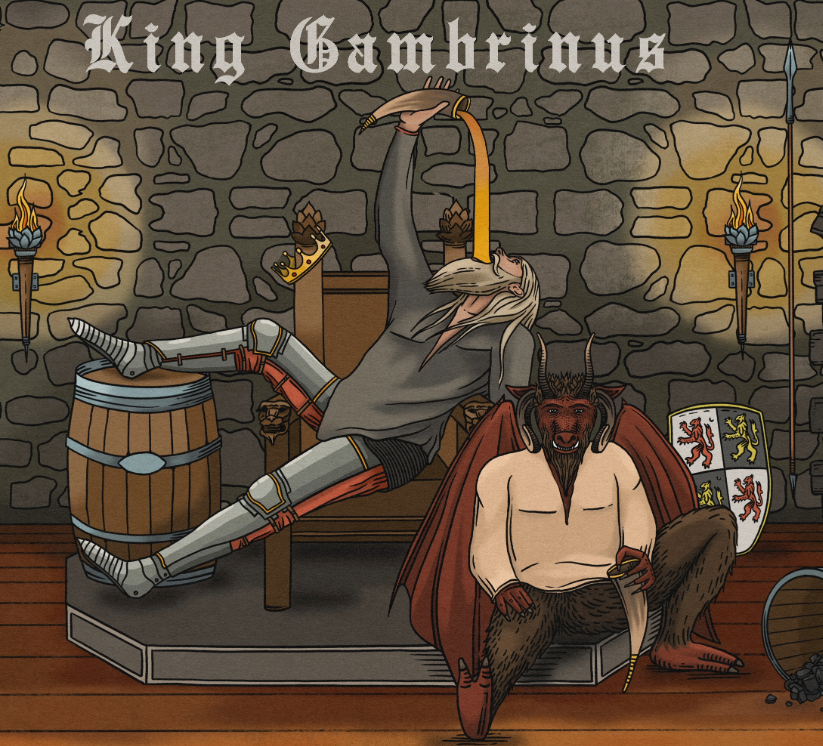
Our version of King Gambrinus, the mythical King of Beer.
Dear Reader,
I’ve spent much of the past decade in the company of ghosts.
Not the supernatural kind, but the voices that speak to us through books.
In Delphi, over 2,300 years ago, a man named Zeno asked the Oracle what he should do so that he may live the best life. According to Diogenes Laërtius, who wrote about Zeno in the decades after his death, the answer was that he should “take on the complexion of the dead.” The meaning would become clear to him later.
Zeno, a rich man from Citium, had lost a great deal of money in a shipwreck. Shortly afterward he was walking through Athenian streets wondering what to do when he heard a man reading about Socrates from Xenophon’s book Memorabilia. He was so taken with the portrayal of Socrates that he asked the bookseller where he might find a man like that so he could learn from him. At that moment, the famous philosopher Crates of Thebes was walking by. The bookseller pointed to him and said “right there.”
Zeno became a student of Crates. He would later become the founder of the philosophic school of Stoicism. This fame would lead Diogenes Laërtius to write about him in his Lives of the Prominent Philosophers, and that’s why this anecdote survives today.
My story is less dramatic.
I’ve always enjoyed reading old books and contemplating what it might have been like to live in a different time and place. The Zeno anecdote about taking on the complexion of, or having conversations with, the dead was a great cue that changed my thinking about how to read historic texts. A book, on its own, is one thing. But to really understand what it’s getting at, maybe we need to immerse ourselves in the time and place where it was written.
Beer has been a part of the daily life of both peasants and kings for millennia. It’s one of the common experiences people share across classes, cultures, and time. Pairing historical beer, a tactile experience, with stories about the where it comes from is a way of getting closer to a different time. But to really understand what things were like long ago we need more than beer and historical events. We need to try and understand what people were thinking and feeling. What were the tales they told that helped them make sense of the world?
Folktales are a way of getting closer to our ancestors’ state of mind. And there are some great ones that take us straight to the tavern.
For centuries, between about the year 1500 and 1900, tales of King Gambrinus were shared across tables throughout Europe. Gambrinus, the mythical King of Beer and Joviality, captured a sense of humor, political satire, and personal fantasy that doesn’t come through in history books. These folktales provide a window into the state of mind of people from the formative centuries of the modern world.
And so, I would like to introduce you to King Gambrinus. I’ll bring you stories about his adventures through this newsletter from time to time, but first it’s worth reading the story about how this legendary folk hero came to be.
The Most Famous Man You’ve Never Heard Of
A strong young man of intimidating stature with the confidence of a God, Gambrinus happily accepted Lucifer’s wager. How could a footrace with men be a challenge to someone like him? The Devil’s in the details, as it were, and Gambrinus would have to win the race while carrying a full barrel of ale or forfeit his soul. Our hero devised a solution to this infernal demand - he quickly drank the barrel dry to lighten his load.
King Gambrinus, the mythical king of beer and joviality, was a popular European folk legend for centuries. The first stories about Gambrinus go back over five hundred years and were inspired by the lives of three legendary medieval nobles, Charles the Great (aka Charlemagne), Jan Primus (John the First) and Jean Sans Peur (Fearless John). These men were swashbuckling conquerors whose lives were made more interesting by rumors of sexual intrigue. A few stories are worth briefly telling here.
Charles the Great (748-814) was visiting St. Peter’s Basilica in Rome when he knelt to say his prayers on Christmas Day in the year 800. That’s when Pope Leo III snuck up behind him, placed a crown on his head and declared him the first Holy Roman Emperor. This six-foot-four Defender of Christianity had just founded an empire that would last for a millennium. He had seven wives over his lifetime and his unmarried, famously attractive daughters had several illegitimate children with his courtiers. Charles’ epic life blended into myth in the years following his death. He is the inspiration for one hundred folktales and there are even special prayers asking him to help people resist the devil, evil spirits, and even fire.
Jan Primus (1252-1294) was a young warrior prince with a reputation for bravery and adventure. He became the Duke of Brabant (in modern day Holland) at age 15 and endeared himself to his people with his military cunning, feats of strength and many illegitimate children. He has for centuries been honoured in folk songs and poetry, idealized as the very model of a prince. Several popular beers carry his name today, over 700 years after his death in a jousting tournament at the age of 42.
Jean Sans Peur (1371-1419), Duke of Burgundy, loved outrageous looking hats. But no one dared tell him that he looked ridiculous. He had a such a reputation for ruthlessness and courage that king of France he ran away when he heard Jean was coming to Paris. Jean arrived in 1418 to find the throne vacant, made the Queen his lover, and took over. He later set out alone and unarmed to meet the exiled king to made a deal to formally consolidate his power. The king had other plans and Jean was ambushed on a bridge and hacked to death with an axe.
Centuries of telling and re-telling stories about these men has embellished, amplified, and blended their incredible lives into the legend of King Gambrinus. But why the king of beer and joviality? It could be because these men threw famous parties. Charles the Great held lavish banquets and toured his realm with an entourage of hundreds, drinking the cellars of aristocrats dry as he travelled his kingdom. Jan Primus was a young man who liked festivals and bibulous sporting events, and Jean Sans Peur was one of the early promoters of the use of hops in beer. He had a hop vine on his coat of arms and founded The Order of the Hop, an award for people who helped spread hoppy beer around France. It’s possible that as biography turned to myth, and as myth blended into legend, King Gambrinus became an everyman version of the ideal ruler in a world dominated by oppressive hereditary nobles.
Stories about Gambrinus begin with him as a young peasant, typically a glassblower’s apprentice. Through hard work, cunning, and help from the devil, he escapes from the drudgery of medieval working-class life. He becomes a fantastic brewer and enjoys all the pleasures he has longed for. He is the ideal beer drinking peasant-king in a world of wine sipping aristocrats. His audience is swept along by stories of his adventures, from the good cheer of the beer hall to the disorienting heights of power.
Recent examples include a folktale by the French author Charles Deulin that appeared in his 1868 collection Contes d’un buveur de bière (Tales of a Beer Drinker), which was adapted into a play by Frank Dumont in 1876. The French composer Émile Pessard wrote an operetta about Gambrinus in 1897 and the American poet Oliver Herford penned a poem celebrating him in 1907. It has been a quiet century for the King since then.
The social and economic shock of two world wars and the influence of the Temperance movement reduced the role of the beer hall as a hub for social life in the first half of the twentieth century. The industrialization and commercialization of brewing washed much of the local flavour and culture out of the beer scene from the 1950s onward. Old traditions held on here and there in Old World towns, but these faded to dull shadows in the cities of Europe and across the North American continent. The legend of Gambrinus faded with them.
Over the past several decades the tradition of local brewing has been reborn. There are now tens of thousands of small breweries across Europe, North America, Australia, and New Zealand. Craft beer is spreading to South America, Asia, and Africa.
The world is rediscovering beer in its wonderful variety as an expression of local ingredients, cultures, and tastes. Just as it used to be. The time is right for beer’s mythical king to step out from the mists of time and introduce himself to a new generation. And so, now that you’ve been introduced, tales of the King of Beer will, now and then, reach across the centuries to entertain us once again through the pages of this newsletter.