
Is Mexican Beer Really German Beer?
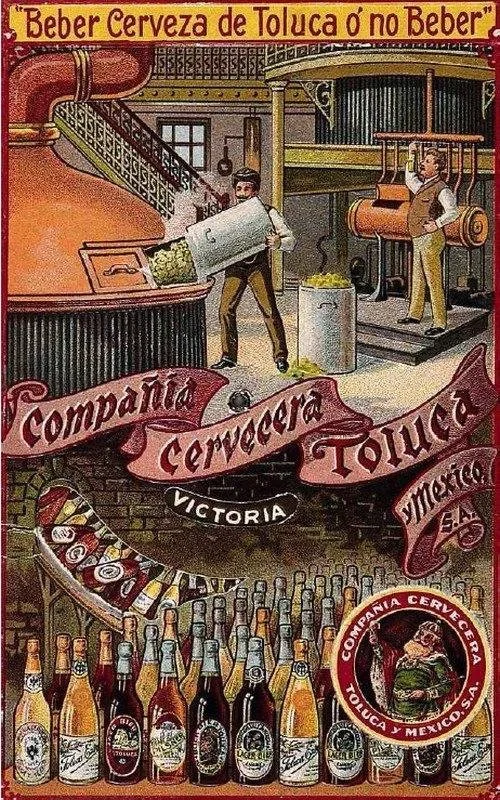
Drink Toluca Beer, or Don’t Drink!
The craft beer world has in recent years began to produce in a style called Mexican Lager, but that’s more marketing than history. Craft “Mexican lager” is pale lager, often flavoured with something like lime, and riffs off Corona (or for those who have spent time in the USA, possibly also Tecate). But these pale lagers aren’t Mexican styles, they’re European styles brewed in Mexico.
In this week’s Time Machine we explore the roots of contemporary Mexican brewing, and it starts in Germany during the 1830s.
—-
King Ludwig I wanted to make Munich the Athens on the Isar. Grand neoclassical boulevards and monumental architecture dominated public spaces during the 1830s. The city was clean, spacious, and carefully planned to reflect the aesthetic of the monarchy. Vienna was still connected to its medieval past. It was a dense city, pressed within massive defensive walls, and filled with imperial bureaucrats, music, and courtly life. The skyline of both cities was shaped by church steeples and palaces that reached up into the reasonably clean air.
Britain was different. Her cities were the beating heart of a nation that pumped capital through the arterial sea routes of a global empire. British skylines were dominated by smokestacks. Towering brick chimneys poured thick coal smoke into the air, creating toxic pea-soup fogs. Manchester was the embodiment of a chaotic race to build international trade with endless fields of factories, iron mills and coal-powered labour.
A trip across the English Channel by two brewers would merge these two worlds and lead to one of the most important innovations in brewing history.
Gabriel Sedlmayr, from Munich, and Anton Dreher, from Vienna, visited the UK in the 1830s as part of a grand tour to learn new techniques that were emerging from chaos of Industrial Britain. They toured breweries across the British Isles seeking to take lessons from famously secretive brewers. Legend has it the two men brought walking canes with hidden mechanical valves so they could steal samples of wort for later analysis.
Whether the two men succeeded, or even attempted, to steal samples is unclear. But they did come away with knowledge of technologies that were revolutionising brewing. First, they learned techniques for hot-air kilning. This technique allowed maltsters to roast grain without smoking it, creating clean, pale malts. Second, they saw the benefit of scientific brewing.
Continental brewers still approached beer making as more of an art than a science. Experience and tradition were the pillars that supported their trade. This idea was dying across the channel. Scientific brewing was the way of the future. This involved carefully measuring and controlling temperature throughout the process and using a relatively new tool, the hydrometer, to measure precisely how much sugar was being extracted from the grains and consumed by the yeast during fermentation.
When Sedlmayr and Dreher returned to their cities they blended British brewing science with the traditional cold fermentation yeasts and techniques of Central Europe. The amber lager was born.
Sedlmayer brewed the ancestor of what would become Märzen / Oktoberfestbier in 1841. That same year, Dreher made the first Vienna Lager, similar to the Märzen, but paler.
Both styles dominated their cities. Märzen became the beer of Oktoberfest and Vienna Lager was the trendiest beer of mid-1800s Austria. Each beer was a cleaner, more refined, and drinkable version of the darker, stronger, smoky beers common for centuries on the Continent. But technology would change again, and tastes would change with it. By the 1880s even paler beer made possible by further advances in malt kilning technology and then refined by experimenting brewers. Pale lager began pushing Vienna Lager out of its hometown. Amber lager was under threat in Munich as well, though it would remain an Oktoberfest staple for generations until Festbier replaced Märzen in the late twentieth century.
Like the capricious will of pagan gods, the ephemeral tastes of consumers suddenly shifted from favouring amber lager to showering their affections on its younger, paler cousins. At least in Europe.
A chain of events put into motion by a decendent of Napoleon Boneaparte, Napoleon III would keep the amber lager tradition alive in Mexico as it began to fade in Europe.
Mexico in the 1860s was a blend of cultures and empires. Thick, stucco covered stone walls painted warm ochre and red surrounded centuries-old Baroque cathedrals and Spanish colonial architecture. Narrow dusty streets led to the Zócalo, a central plaza filled with market stalls that played host to the social life of towns and cities. Aztec infrastructure remained in some places, like the waterways of Mexico City.
Centuries of turbulence continued to send tremors through the populace during the civil wars of the 1860s. In 1861 the Mexican government defaulted on its debts and was invaded by a joint force of its creditors, France, England, and Spain. The French captured Mexico City in June 1863 and took control of the country. Napoleon III installed an emperor, Maximillian I of Austria, to manage it in 1864.
The French period of the mid-1860s, brought Mexico closer to Europe. Central Europeans had been living in Mexico for decades. This included some brewers like Bernhard Bolgard, a Swiss, and Friedrick Herzon, a Bavarian, who started breweries in the 1840s. But as more European arrived, particularly from Bavaria and Switzerland, they brought a desire for amber lager with them. The problem was that the weather would not cooperate with a beer style that required cold fermentation. Maximillian I would be captured and executed in 1867, ending French rule and restoring the Mexican republic. But the Central Europeans, and their tastes, remained.
When refrigeration arrived in the 1880s, amber lager began to plant its roots into the Mexican soil.
A Swiss immigrant, Santiago Graf, acquired a brewery in 1875 and, when a railway connection made it possible to import German ice-making machinery in 1882, he could finally began producing cold-fermented European styles. Lager, Pilsner, Bock, and Märzen became popular.
A consortium of Mexican businessmen and European immigrants founded Cervecería Cuauhtémoc in Monterrey in 1890. Other European brewers followed, like Wilhelm Hasse, Adolf Burkhardt, Ernst Maas and Otto Neumaier, supported by German capital. In 1897 Hasse created a special beer to celebrate the coming Twentieth Century – Siglo XX. Today this amber lager is known as Dos Equis (literally “Two X’s”). Amber lager was taking off in Mexico just as pale lager was eclipsing it in Europe.
Central European styles continued to dominate Mexico into the 1900s. In 1925 Cervecería Modelo brewed a beer called Negra. It was modelled on the Vienna and Munich-style amber lagers of the mid-1800s, but adapted to the local environment by integrating what they describe as “non-malted cereals” into the grain bill. Today Nega Modelo is described as a Munich Dunkel-style lager, though it seems to occupy a middle-ground between that and the 1800s Vienna style.
Amber lagers would continue to fade in Europe, especially during the period 1950-1990 when this once dominant style had lost so much ground it disappeared from the very festival that championed its rise, Oktoberfest. By the late Twentieth Century amber lager was no longer a mainstream European style, but confined to the specialty/traditional market segment. Not so in Mexico. Negra Modelo and Dos Equis have massive audiences, and a 2024 consumer survey found almost 48% of Mexican beer drinkers have a preference for toasted/amber beers.
A beer style born of a 19th century meeting between the traditions of old Continental monarchies and scrappy British industry faded from Europe as the continent changed. It survived in Mexico as generations of immigrants initially longing for a connection to the comforts of home eventually became Mexican, and their brewing traditions became Mexican with them.
Today, the palace gardens and imperial monuments of Munich and Vienna, like the hulking industrial relics of Britain, allow tourists to imagine societies that led to us.
In Mexico, crumbling Aztec infrastructure and Catholic cathedrals stand among Spanish and French colonial architecture as witnesses to a nation that has blended the styles and blood of New and Old-World peoples into something uniquely Mexican.
And on the tables of cafes and bars it’s common to see a beer whose journey reflects the history of the people who drink it.