
What Makes a True Oktoberfest Beer?
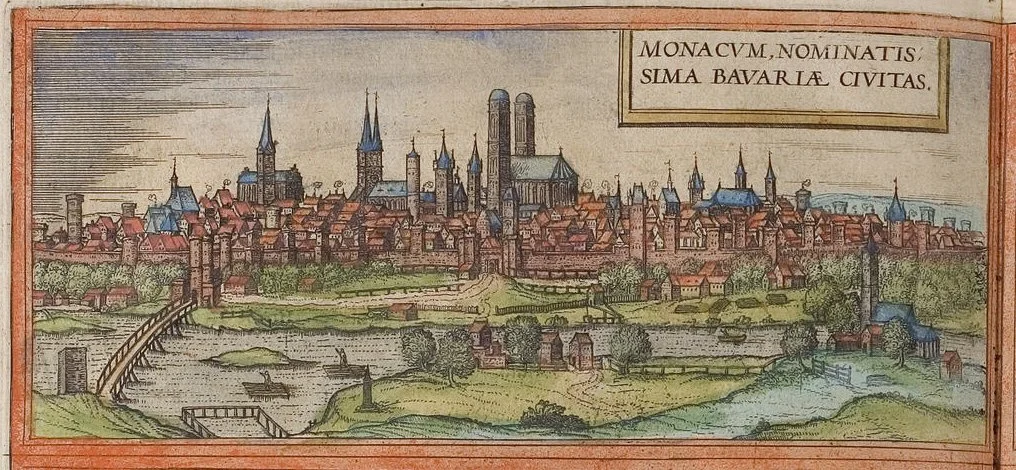
The Munich skyline in 1572, where people drank special autumn beers brewed the previous spring long before the first Oktoberfest. -Georg Braun; Frans Hogenberg: Civitates Orbis Terrarum, Band 1, 1572
What Makes a True Oktoberfest Beer?
The timber-framed buildings are pressed so tightly together that when the floorboards creek underfoot the neighbours hear it. Beautiful cross-hatched Bavarian facades decorate the houses starting just above the worn cobble streets before zig-zagging all the way up to the wooden shingled roofs. It’s a beautiful summer day. Hot, dry, with just enough breeze to take the edge off.
Around a corner the shops share the same architecture. A fire is raging beneath a giant copper kettle in one of the units. Dried wood cracks in the heat, bang!, firing a red-hot cinder across the room.
This is a bad idea. Or so thought Duke Albrecht V, when he banned brewing in Bavaria between April 23 (St. George’s Day) and September 29 (St. Michael’s Day).
Five months is a long time without beer. But the people didn’t seem to mind. The risk of fires was real, and the beer wasn’t worth it anyway. The warm season brought wild yeasts to life, blew them around through open windows, and made beer sour. People would have to make due with the old stock.
The last brews of the season, made during March and April were made stronger and hoppier to buffer against the unwelcome yeasts. Hops are anti-microbial, and a low-sugar solution reaching 8% alcohol (or more) was a tough place to grow anyway. These beers, deep umber or black with a rich, smoky maltiness, were known as Märzenbier, would be stored in sealed wooden vats in cool cellars until St. Michael’s Day. Then there would be a party.
Steins would fill with the rich liquid, wafting warm toasted bread through the foam as the tan bubbles settled down. This is the original autumn beer of Bavaria, Märzen. But it pre-dates Oktoberfest.
But take a sip of an Oktoberfest beer today. It’s not dark or even amber. It isn’t especially heavy, but bright, clean and remarkably drinkable. There’s enough malt character to remind you that this is something more substantial than an everyday lager, but you won’t mistake it for bread. And there’s no smoke.
So what happened to the original Märzen?
Beer for an October festival
When the first Oktoberfest was held in 1810, there was no such thing as an "Oktoberfest beer."
The celebration began with the marriage of Crown Prince Ludwig of Bavaria and Princess Therese of Saxe-Hildburghausen. A horse race was held outside Munich's city gates on a meadow that would become known as the Theresienwiese, the Wiesn to generations of Münchners.
The celebration returned the next year. Beer sellers followed. Beer and food stalls became part of the festival. First people stood. Then there were chairs. Then tents. Huge tents. The harvest and market festivals common to the season consolidated around Munich in a giant party.
But brewing beer for an autumn festival was hard. People liked lager, but lager needs cool temperatures and so it can’t be brewed during the warm months. The traditional solution was to brew a stronger beer toward the end of the winter brewing season, around March, and store it cold through the summer. Sometimes people would cut massive blocks of ice and slide them down into a cellar to keep it cool for longer. People brewed around nature.
They also brewed for the occasion. As the autumn festival grew and people drank more the dark, rich, smoky strong beers of the past three centuries were impractical. People wanted something lighter, in both taste and alcohol. Something stronger than a regular beer to keep with seasonal tradition, but drinkable, to keep with the times.
Then, in 1872, these more refreshing beers combined with unusually hot weather to create a problem. People drank the beer too quickly. One festival vendor, Michael Schottenhamel, was about to run out of beer halfway through the event when his customers, mostly students and soldiers, drank it all.
Running out of beer would be a disaster. But Mr. Schottenhamel couldn’t bring some in from a rival Munich brewer. He asked his friends, the brothers Gabriel and Joseph Sedlmayer, if they had any stock left. They were almost out, too. But they had a secret weapon in their cellars. An experimental March beer brewed using Vienna-style malting techniques. It was brighter and cleaner, but more expensive because of the premium, cleanly kilned malts it used. Afraid of what would happen if he ran out of beer, Schottenhamel took a risk and rolled out barrels of this new amber liquid.
It was so good even the students and soldiers didn’t mind that it was more expensive. Other Munich brewers rushed to copy it and by the next year the amber Märzen, brewed in the Vienna style, became the hit beer of Oktoberfest. This Vienna lager propelled the Schottenhamel tent along its winning trajectory from a 50-seat shack in 1867 to an 8,000 person tent by 1908. A young Albert Einstein even helped install the lights one year.
And then mechanical refrigeration arrived in Munich's breweries. Paulaner was one of the first to install refrigeration equipment, in 1881.
Suddenly a brewery could make a winter beer in July. Some brewers kept to the old ways, making the malty Märzen, but many adapted to new tastes. Beer was becoming paler in the late 19th and early 20th centuries. Technology and science allowed brewers to consistently make shelf-stable pale, light beer. Malt was paler, pure strains of yeast isolated, microbes were identified and cleaned out of equipment. Pale beer was a taste of the future, the taste of a changing world.
This kind of change is what Oktoberfest has been about all along. The Oktoberfest tradition doesn’t reside in the recipes. It survives in the beer culture the recipes carry forward.
The city that had made strong dark beers embraced lighter dunkle, making dark lager famous, before it turned to amber beers and then embraced Helles. Eventually, Oktoberfest gave way to what we now generally call Festbier: a strong golden lager, usually around 6% alcohol, with a firm malt backbone but a considerably lighter colour and easier-drinking finish.
The beer that defined Bavarian autumn festivals came to define Oktoberfest. But consider what Oktoberfest itself had become. A prince’s wedding had morphed into a festival, then an international spectacle with thousands of people gathering inside massive tents, or partying at pubs around the world wishing they could have been in Munich. Oktoberfest is now a festival of beer. And the beer arrives in a one-litre Maß amid thousands of people, brass bands, roast chickens, singing, conversation and noise.
And then another litre arrives.
And a great festival beer has a peculiar job. It has to taste substantial without becoming exhausting. It needs enough malt character to feel celebratory while remaining dry enough to invite another drink.
The old Märzen had solved one problem: how to brew beer in March that could survive until autumn.
Modern Festbier solved another: how to make a strong lager that thousands of people would happily drink by the litre.
This raises an interesting question. What makes a true Oktoberfest beer?
Is it the brewing technique? The original recipes from the 1500s? Or is it the 1800s dark lager recipes, or even the Vienna-style lagers or their pale adaptation?
Here’s what the history tells us: tradition was never in the recipe. The identity of Oktoberfest beer has changed along with the festival, brewing technology, and tastes of the revellers. It even changes with where you celebrate. In Munich, pale, crisp, deceptively strong Festbier is popular. In North America the amber style is more common because it’s seen as more traditional.
Whatever part of the tradition you choose to celebrate, one thing remains the same. Oktoberfest is a time to drink in communion with the spirit of all those who have celebrated together in centuries past, and with all those who will continue to do so in centuries to come.
Join the Stein Club
We have two weeks of Oktoberfest celebration at Good Cheer, starting this Saturday.
And we’re kicking it off with the essential Oktoberfest beer of the 21st century: Paulaner Oktoberfest. One of the six official beers of the festival, Paulaner Oktoberfest is the most recent refinement of the autumn beer tradition going back 500 years to Duke Albrecht V and his summer brewing ban. As a Munich brewery dating all the way back to 1634, Paulaner has seen it all.
Come try it in a proper 1L stein!
If you haven’t already, get your 1L limited edition Good Cheer stein by clicking HERE. It gives you discounts from September 19 through October 4 and special 1L pours (you can also just fill it half-way, it’s fun to hold a proper Maß).
You can see our September calendar HERE