
A Princess Died in 1854. We Still Celebrate Her Wedding Today
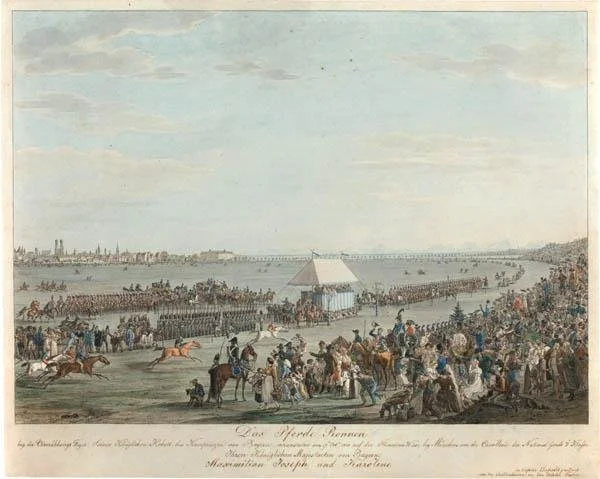
The first Oktoberfest - October 17, 1810
Dear Reader,
The world’s largest beer festival starts on September 19. Each year, six to seven million revellers enter Oktoberfest’s giant tents.
Oktoberfest serves Märzen/Festbier in 1 litre steins at long tables beneath thick wooden beams decorated with hops and Bavarian bunting. But it wasn’t always that way. The first Oktoberfest wasn’t a beer festival at all. It was a wedding.
Well, that’s an over-simplification. Since the beginning, Oktoberfest has been a cultural event. It weaves history, nation-building, and the human need for conviviality and celebration into the background of a turbulent and ever-changing world.
This week, the Time Machine travels back to the middle of the Napoleonic Wars and the first Oktoberfest to explore how the world’s most famous party came to be.
A Princess Died in 1854. We Still Celebrate Her Wedding Today.
Children strode across an open meadow. It was a procession of youth and promise, moving toward a newlywed princess in the soft morning light. They carried flowers and the fruits of the land, representing the regions of the newly founded Kingdom of Bavaria.
The hill on which Princess Therese sat formed a giant natural amphitheatre looking over a rolling plain that stretched toward the growing Munich skyline. A giant captured Ottoman tent stood just beyond the children, past rows of soldiers in ceremonial dress, surrounded by a vast multitude. It was October 17, 1810.
Munich in 1810 had a population of just over forty thousand. Three quarters of that number turned up at the meadow to celebrate the wedding.
It was the fifth day of an idyllic party and an almost unimaginable affirmation of hope following two decades of hardship.
Bavaria was caught between the warring superpowers of Austria and France. An ally of France, its towns were bombarded, occupied, and drained of their resources by invading Austrian troops during the War of the Third Coalition in 1805. French soldiers billeted at the homes of unoccupied towns, eating the food right off the tables of Bavarian families.
Soldiers, both enemy and allied, stripped fields, stole crops, slaughtered livestock and raped women. The state was running out of money as it struggled to support a large standing army, host allied troops, and fight Austria.
Then, on December 2, 1805 a battle changed the course of Bavarian history. Napoleon's greatest military masterpiece, his resounding defeat of the superior forces of Tsar Alexander I and Holy Roman Emperor Francis II at Austerlitz led to peace. The Treaty of Pressburg, signed the day after Christmas, forced the Austrians to recognise the Duchy of Bavaria as a kingdom. On New Year's Day, 1806, Maximilian Joseph was proclaimed King of Bavaria.
Peace didn't last long.
Austria invaded Bavaria in 1809. Napoleon rushed to defend his ally, defeating Austria at the Battle of Wagram and signing the Treaty of Schönbrunn by the end of the year.
The Bavarians were exhausted. The new kingdom needed to build an identity. And its first royal wedding, of Therese of Saxe-Hildburghausen and Crown Prince Ludwig, was a rare opportunity for nation-building.
The new kingdom was generous.
The shopping list for Ludwig's guests, the people of Bavaria, included 32,000 litres of beer, 8,000 litres of wine, 24,000 sausages, 16,000 portions of roast meat, 32,000 portions of bread and 4,000 cheeses.
All this was consumed during five days of celebration and pageantry, ending with a festival and horse race in the countryside.
It was on the last day, before breakfast and before the horse race, that Princess Therese received the procession of children. They represented the regions of the kingdom, dressed in local costume and bearing flowers and the fruits of the land.
It was a symbolic pageant.
Therese had arrived in Bavaria only days earlier. Now Bavaria was introducing itself to its new princess while simultaneously presenting its new identity to the people themselves.
The Kingdom of Bavaria had existed for only four years. War and diplomacy had assembled territories with different histories and identities under a single crown. Now those differences were being presented not as divisions, but as parts of a whole. Even the couple represented unity. Therese was Protestant, Ludwig, Catholic.
The children made a wordless show of unity. They wore different clothes and carried different products, but they walked together toward the same princess.
The festival did much the same thing.
It was an affirmation of Bavarian culture, linking older traditions to a new kingdom. Its great spectacle was a horse race inspired by the medieval Scharlachrennen.
Local farmers competed on their own horses. Smaller traditions of autumn markets, agricultural celebrations, feasting and beer drinking were brought together in one enormous public celebration. People called it Oktober Festen.
A country that was four years old was beginning to sprout from ancient roots.
The princess went home when the wedding ended, but Munich wanted to party again.
So they held it the following year.
The second Oktoberfest
The second Oktoberfest was already different from the first.
In 1811, the Bavarian Agricultural Association took over. The horse race remained, but agricultural shows, livestock prizes and farming exhibitions were added. The royal wedding celebration was becoming an agricultural festival.
Then the cold hand of death took up its war trumpet one more, with devastating effects on Bavaria. Beholden to Napoleon, to whom they owed their independence, thirty thousand men marched with him to invade Russia in 1812. It was Napoleon's most horrific failure. Only one-in-ten Bavarian soldiers staggered home. The rest lay dead, frozen on foreign fields.
There was peace after Napoleon's exile to Elba in 1814, and then again following his final defeat at Waterloo in 1815, but Bavaria was tired. After seven years, the Agricultural Association could no longer afford to host the festival. It passed to the City of Munich in 1818 where it would become more than a giant trade show.
The festival would promote Munich itself, its businesses, its culture and the growing city. Munich also wanted to entertain people again. After decades of trauma and loss, this festival wasn’t just a commercial enterprise, it was a way of showing people that civic life still offered things worth living for.
Vendors were allowed to purchase stalls selling food and drink as part of the entertainment. Diners and drinkers stood during the first year. Then chairs appeared for the second. Small beer stands followed in the years to come. At first they were little more than places to store barrels, serve beer and shelter a handful of customers.
Everyone else remained outside. When it rained, people drank their beers standing in the mud. But something curious happened as the decades passed.
Therese gradually disappeared from the festival created for her wedding.
The agricultural exhibition had not been part of her wedding. Neither had the beer stalls, performers, shooting galleries or amusement rides that followed. Each generation added something of its own. Each new addition eventually became part of the tradition.
Therese became Queen of Bavaria in 1825. Her marriage to Ludwig proved considerably less romantic than the celebration that began it. Ludwig had numerous affairs, and his later infatuation with Lola Montez helped fuel the political crisis that ended with his abdication during a series of upheavals in Western Europe during 1848.
Therese died of cholera in 1854. By then, the party thrown for her wedding had been going for more than forty years. It had outlived the occasion that created it but was not yet the Oktoberfest we know today.
A carpenter builds a tent
In 1867, a carpenter and innkeeper from the Upper Palatinate named Michael Schottenhamel received permission to build a small wooden beer shack behind the royal tent on the fairgrounds. It held about fifty people, a mini-insurance policy against bad weather.
Five years later, Schottenhamel found himself confronting another problem. The weather was too good.
The summer of 1872 had been unusually hot. Munich's stocks of the Lager and Sommerbier normally reserved for Oktoberfest were running out as people quenched a mighty thirst.
Schottenhamel needed to stock his popular shack with beer. But from where?
He took a chance, buying a stronger, more expensive, beer from the Franziskaner-Leist brewery, brewed in March in the Vienna style. By royal decree, brewing was banned during the hot summer months to prevent spoilage. The last beers of the season, brewed extra-strong in March (Märzen) to survive months of cold storage in dark caves, were finally unleashed to toast the autumn harvest. It was something the festival-goers weren't accustomed to drinking. But they loved it.
The beer was a Märzen, named for the month in which beers of its kind were traditionally brewed. Another tradition had been invented. Märzen became the classic Oktoberfest beer we still drink today.
As the beer changed, so did the buildings.
Schottenhamel erected a canvas tent in 1886. By the mid-1890s, Munich's breweries were building temporary beer halls capable of accommodating around 1,500 people. But one entrepreneur looked at halls containing fifteen hundred drinkers and thought they were still far too small.
Georg Lang and the mega-tents
Georg Lang was a Munich outsider. He was a Nuremberg publican and festival entrepreneur known as the Krokodilwirt, the Crocodile Innkeeper, because of his famous inn named The Crocodile. A showman and aggressive promoter, Lang was a pioneer in the use of electric lights, famously using them to illuminate a 25-person band he hired to entertain his guests.
And, like a crocodile peering out of the swamp at a water buffalo, Lang was hungry for Munich's greatest beer prize - a stall at Oktoberfest. But the festival's strict rules meant he couldn't have one since he wasn't from Munich.
The City wanted to keep vendors small and local, preserving the traditional feeling of the festival. Lang had another idea. In 1898, he hired five local innkeepers to bid for five adjacent stalls on the festival meadow. Just before the festival opened he quickly tore down the partitions that divided the stalls, and combined them under a giant tent that could fit six thousand people.
He called it the Bayerische Riesenhalle, the First Bavarian Giant Hall.
Thousands of people could drink together under one roof. And he entertained them. He installed a thirty-piece brass band dressed in Oberland costume. Songbooks were distributed to drinkers. Numbers displayed in the hall told the crowd which song to sing. Customers were even given little sticks with which they could beat time.
Among the songs in Lang's 1898 songbook was one written by a Saxon composer named Bernhard Dietrich.
Ein Prosit der Gemütlichkeit.
Raise your glasses.
Drink together.
Then order another beer.
Lang made the orchestra play it again and again. Each time, he had six thousand people stand, sing it together, and toast. Ever the showman, Lang had discovered something enormously powerful and brought it to Oktoberfest: atmosphere could sell beer.
More importantly, thousands of strangers singing, drinking and raising their glasses together produced the feeling that Germans call Gemütlichkeit, a difficult word to translate precisely, but one that captures warmth, fellowship, belonging and good cheer.
Oktoberfest had found the experience that would define it. The City Councillors, initially angered by Lang's blatant violation of their rules, were swayed by the convivial vibe he brought to the festival. When they voted on whether Lang would be allowed a license only one opposed him.
Other breweries followed Lang's example.
In 1913, the Bräurosl tent reached 12,000 seats, the largest beer hall ever erected at Oktoberfest.
Forty-six years had passed since Michael Schottenhamel opened his fifty-seat shack. Oktoberfest had become something its founders in 1810 would barely have recognised.
And then Europe destroyed itself.
A tradition interrupted
One hundred years after Napoleon’s disaster in Russia, the blood of generation would again soak the soil of the Northern Front.
The festival had already been cancelled during nineteenth-century wars and cholera epidemics. The First World War stopped it again. Inflation and economic crisis followed. Then came National Socialism and the Second World War.
The Oktoberfest that returned after WWI belonged to a very different Bavaria.
The kingdom was gone. The monarchy was gone. The old political purpose of the festival was gone. But the festival remained.
And in 1950, another tradition was invented.
On September 16, Munich's mayor, Thomas Wimmer, entered the Schottenhamel tent to open Oktoberfest. According to Oktoberfest legend, Wimmer had been opening a nearby trade fair and was running late. Rain was pouring down, and the Schottenhamel tent happened to be the nearest shelter.
Wimmer took a wooden mallet and attempted to tap the first keg. No beer came out. He tried again. And again. And on and on, as thousands of people watched.
It took him seventeen blows.
Finally the beer flowed. “O'zapft is!” he proclaimed, "It is tapped!"
From that slightly inglorious beginning came one of Oktoberfest's most famous traditions. Every year, at noon on the opening Saturday, Munich's mayor taps the first keg inside the Schottenhamel tent.
Only then may the other Oktoberfest tents begin serving beer.
Therese's meadow
The strange thing about Oktoberfest is that everyone knows what it is, yet it's surprisingly difficult to describe. Culture is much the same. Strip away its many definitions and you arrive at something like: the way things are done around here.
But why are things done that way?
Each generation inherits something from the last, changes it, and passes it on. Innovations become customs. Customs become traditions. Eventually everyone forgets there was ever a first time.
That's Oktoberfest.
It began as a nation-building project spun off from a royal wedding. It became an agricultural fair, then an economic development project, then a party. The party became a tradition. The tradition became a spectacle. And the spectacle went global.
Two hundred and sixteen years later, almost nothing the children saw that morning remains.
Even Therese herself was largely forgotten.
But her name wasn't.
The meadow on which Munich celebrated the wedding was named Theresienwiese in honour of the young bride.
More than two centuries later, millions of people still make their way there each autumn.
And Münchners don't usually call it Oktoberfest. They call it die Wiesn, the meadow.
Therese's meadow.