
The Vanishing Point
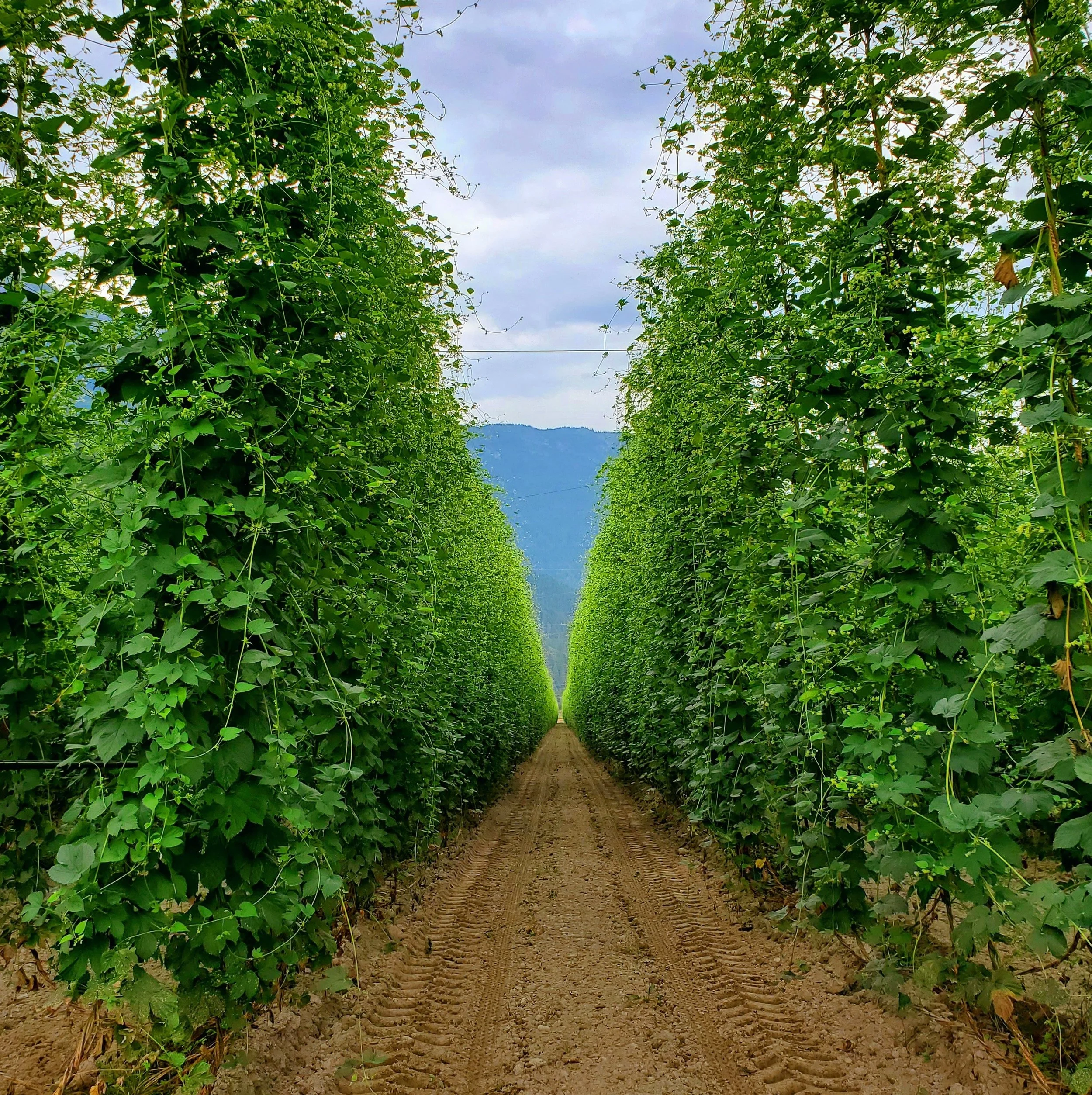
Myrtle Meadows hop yard - Pemberton Valley, BC. One of the best in the world.
Dear Reader,
Half the work has been done, and each day is a race against the weather.
It’s the middle of the hop harvest. Varieties like Saaz are packed and ready to go. Cascade and Centennial are being plucked from their bines as you read this. Comet is a couple weeks away.
Growing and harvesting hops is an art. Yes, lab tests are available to tell farmers when hops should be picked, but in the few days it takes to get samples back from the lab the time to pick will be over. Getting it right requires a combination of experience and a regular kitchen oven.
Would you like some baked hops?
Of course not.
However, since farmers want to harvest hops when their moisture content is 10%, ovens are a great tool. You can weigh a bowl of hops, then put it in a warm oven. Take it out and weigh it again. Repeat until it stops losing weight. What percent weight did they lose? That’s the moisture content.
You can also squeeze the hops cones. They should rustle like a paper lantern and pop back when your thumb lets off the pressure. But don’t squeeze too hard or they’ll just get squished.
Science. Art. Like brewing.
I’ve spent a lot of time on hop farms, and more studying the plant. Before launching Good Cheer Brewing I tried starting a company called Project Hop that would have been a quality assurance program for small-scale producers, had that industry not been decimated nearly as soon as it got going.
This week, I bring you a story of independent hop producers. These are the folks that provide distinctive hops shaped by terroir – the unique flavour and aroma imparted by the growing conditions of a specific place.
Hops are clones. Each variety, of which there are hundreds, is grown from root stock. The genes of each type of hop are the same, but the conditions they grow in cause them to be expressed differently. That’s what makes the products of independent hop farms exciting. Each new farm is a chance to encounter new flavours and aromas.
I love how beer can be a reflection of not only the people who make it, but also the places where the ingredients grow, and the techniques farmers use to grow them. But being a small farmer is tough. Good Cheer supports them in its own small way by buying as many hops as we can from independent farmers. Small-scale agriculture is a notoriously hard way to make a living.
In this week’s Time Machine, we’re going back about ten years, to a time when hops looked like the new cash crop and craft beer was not only the hottest trend in drinks, but a cultural phenomenon.
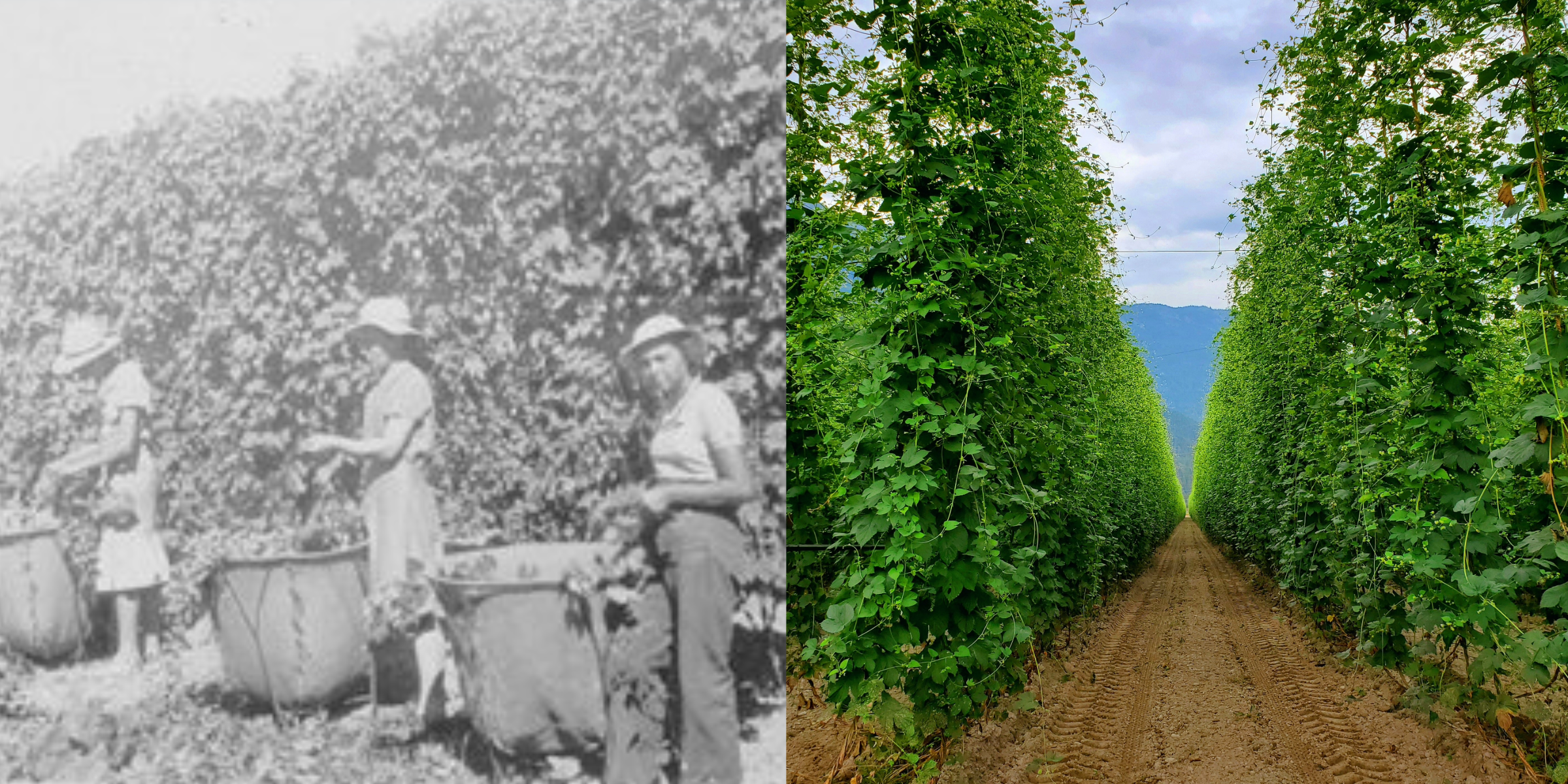
Hop yards, 1940s and 2023 in Chilliwack (L) and Pemberton (R), BC
The Vanishing Point
Two walls of green extend toward the horizon. The healthy dark leaves of the hop bines glow as fading sunlight catches the top of their trellises. At the distant end of the row, they converge with deep brown soil and blue mountain haze. It’s almost like the background of an unfinished Renaissance painting, where four triangles intersect at the centre of a frame waiting for a subject.
“We’ve hosted weddings here!”
I imagine a bride in a flowing white dress and a groom dressed in a sharp black suit standing at the Vanishing Point, completing the imaginary artwork.
“It’s beautiful,” I reply. Walking through the forty-acre hop yard at Myrtle Meadows hop farm, the operator, Eelco de Zwann, explains how the land is perfect for growing hops. The long, hot days in the Pemberton Valley are perfect for this light-sensitive plant. The soil, built up over centuries of flooding by the adjacent Pemberton River, is rich. You can even pan for gold in it.
After touring the farm, Eelco takes me to his processing facility. It’s on the property, a minute’s walk from the field. Inside, a state-of-the-art hop harvester and dryer wait for harvest season. The adjacent building, essentially a refrigerated barn, contains a hammer mill for turning hop flowers into a pelletized product that will be shipped to brewers.
The whole process from harvesting to packaging in oxygen-purged mylar bags takes less than 48 hours. The hops, once dry, are kept cold and are isolated from heat and light. This is a sophisticated operation run by an experienced farmer hired for the purpose. Myrtle Meadows makes some of the best hops in the world. Lab tests show some varieties contain double the average concentration of key brewing compounds like alpha acid, and have higher total oils. One crop of Cascade, a variety that typically ranges from 5-7% alpha acid, had over 12%.
Independent hop yards are the kind of business the craft beer revolution was supposed to produce. Local ingredients for local beer, like how things used to be.
For centuries, people would gather in hop yards from mid-August to mid-September to harvest hops by hand. Working class women would gather with their children and set up camp next to fields lined with rows of five-metre-high trellises, thick with green. The husbands would come on the weekends, partially to help, and partially to keep an eye on the under-employed men working alongside their families.
The work camps would be gone by the end of the second World War, but harvesting would still depend on an irregular local workforce that included neighbourhood children and women whose own children had moved on from home. A man from the Fraser Valley, BC, reflects on what this used to be like:
“I have only the most vague memory of being in the hopyard during the late 1940's… With enormous anticipation we listened for the truck … it had a covered roof and was equipped with three long benches. Our preference was to get on our knees and lean against the raised tailgate; but as I recall, sometimes that was prohibited. At times when we turned a corner the benches would tip over, and sometimes we helped things along, just to upset the old ladies… Arriving, we called for 'wire down' and then got to work. We filled the basket more or less, dumped the contents into a sack, and started over… The sacks were weighed with a scale hung from the overhead wires… The weight of each sack was called out to Nick Boschman, standing off to the side and looking very official. He clicked out the amount on the precious little yellow card we brought home to our parents each day… When we arrived home our fingers were black from a somewhat sticky yellow substance in the hops. We used a gritty soap called "Snap" to clean our hands each day.”
-Ed Lenzmann, reflecting on his childhood experience as a hop picker
Most of the small hop farms would be gone by the 1960s, replaced by huge, consolidated operations with specialised harvesting and processing equipment. British Columbia, for example, went from a world-leading hop region in the late 19th century with 2,000 acres under cultivation to having no hop farms by 1997. Then, slowly, the small farms started to come back.
Demand for hops boomed during the 2010s, driven by the craft beer renaissance and accelerated by the dual popularity of West Coast and Hazy IPAs around 2015. Regional markets, like BC, Ontario, Quebec, Colorado, Michigan, and Vermont were full of breweries but had virtually no local hop production.
The economic opportunity looked enormous.
Craft beer was built on local, small-scale production. It was time for local, small-scale ingredients.
The potential for local hops excited farmers. The craft beer industry was booming. By the mid-2010s, Ontario had fewer than 100 acres of hops, but its growers' association envisioned an industry of 1,250 acres worth $25 million a year. In British Columbia, a government-supported feasibility study estimated that supplying the province's craft breweries could require 450 to 500 acres of hops at a time when the province had fewer than 100. In Quebec, a survey of just 46 microbreweries projected some $2.5 million in annual hop purchases. Industry surveys said brewers wanted to use local hops and were willing to pay a premium.
Farmers started to diversify by putting some of their land toward this new cash crop.
Between 2011 and 2021 hop acreage doubled in the United States, one of the world’s leading hop producing countries. Commercial hop production surged in Canada. Canadian commercial hop acreage grew from nothing in 2010 to over one thousand acres by 2020. And this wasn’t a few big farms. It was dozens of micro-farms all across the country.
Each farm invested heavily in its hops. It costs over $15,000 per acre to prepare for cultivation, then three to five years for the plants to reach maturity. The payoff looked worth it. At maximum yields a hop farm can gross $20,000 or more per acre.
But hop farming is a risky business.
Plants need constant attention. Different varieties have different yields. Hops are sensitive to disease. And agriculture is too slow to respond to changing consumer fashions.
By the time small hop farmers were ready to meet the demand they planned for, West Coast IPA was falling out of fashion. The hazy IPA was taking over, and this was bad news for independent farmers.
West Coast IPAs, with their piney, dank and citrus aromas are traditionally made from public domain hops, created by public breeding programs. Hazy IPAs, with their big juicy and tropical fruit aromas, are overwhelmingly made with hops that are the intellectual property of big hop companies. Citra, for example, became so dominant that one in five acres of hops in the United States was planted with that single proprietary variety, out of hundreds of varieties under cultivation. Small farmers can’t plant it, or many of the other proprietary varieties increasingly sought by brewers.
Independent hop farmers suddenly had a big investment that was finally yielding a product, but one where demand was drying up. The price of their hop varieties stagnated, then fell. In many cases, the new generation of hop farmers failed to hit their anticipated yields, sometimes harvesting only half of what they had planned for.
And then COVID hit.
The uncertainty panicked many brewers who feared being stuck in long-term contracts with big producers right at a time when their taprooms were shut. Small producers were stuck holding inventory just as consumer tastes were changing again.
The hazy IPA was still the dominant hoppy style, but drinkers began exploring new tipples as COVID restrictions eased. Hard seltzers were in vogue. Then RTDs. Breweries, many stuck with large loans and groups of investors from the exuberant pre-COVID era diversified. Seltzers, then hard iced teas, sometimes spirits. Sour beers started to cut into the IPA market.
Small producers died hard. Hop acreage in the United States receded from 60,000 acres in 2021 to 42,000 acres by 2025. Canadian acreage dropped from over 1,000 to just under 500 during the same period. Many farmers never recovered their initial investment. As the craft brewing industry contracted during 2023-2026, demand for hops contracted further still.
Few independent hop farms remain.
This summer I received an email from Eelco. Myrtle Meadows hop farm has shut down mid-season.
There stands today, September 1, a lush hop yard in the heart of the Pemberton Valley. The hops wind around ropes rising to meet the sun as large, ripe hop cones sway in the breeze. You can reach out and pick them. As you do, aromas of fresh pine and citrus waft through the warm late-summer air. It’s quiet. There is no one here to pick them.
Treads of tractor tires fade into the dusty earth between the high rows of green to meet the blue mountain haze.
It’s beautiful, like an unfinished Renaissance painting whose artist had died.