
More Beneficial Than All the Medicines: The Story Behind Good Cheer
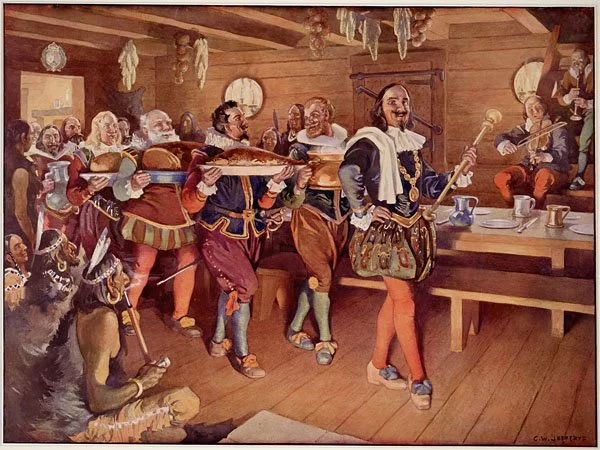
The Order of Good Cheer, by C.W. Jeffries
Dear Reader,
When was the last time you got together with friends?
It seems there is so much else to do. Work, school, taking kids to their activities... We need to do these things, and we can take great pleasure in them.
But what about taking time to connect with others doing the same things?
It can seem that at times we live private, parallel lives with our friends. We know they’re out there, but we don’t often see them.
Creating a third place where people can connect is the driving idea behind Good Cheer. And it’s nothing new. People have always created communal places to connect with one another and, as we’ll see in today’s Time Machine, sometimes those places haven't just sustained morale. They have sustained life itself.
Good Cheer Brewing is named after the Order of Good Cheer, a dining society founded by Samuel de Champlain in 1606. Champlain is remembered as the Founding Father of French Canada, but the story behind the Order begins long before he arrived in Canada.
It begins with religious massacres, civil war, a king trying to put a fractured country back together, and a Canadian winter that killed nearly half the men who faced it.
What eventually emerged from all of that was an idea remarkably similar to the one behind Good Cheer today: gathering together isn't frivolous. Community is something people need.
We are much more comfortable today. We aren’t fighting off death at every turn, but we are fighting disconnection, isolation, and a society that increasingly seems to sort itself into opposing camps.
So, let’s find a reason to get together and bring the joy of camaraderie into our lives with inspiration from a club that did just that, over 400 years ago.
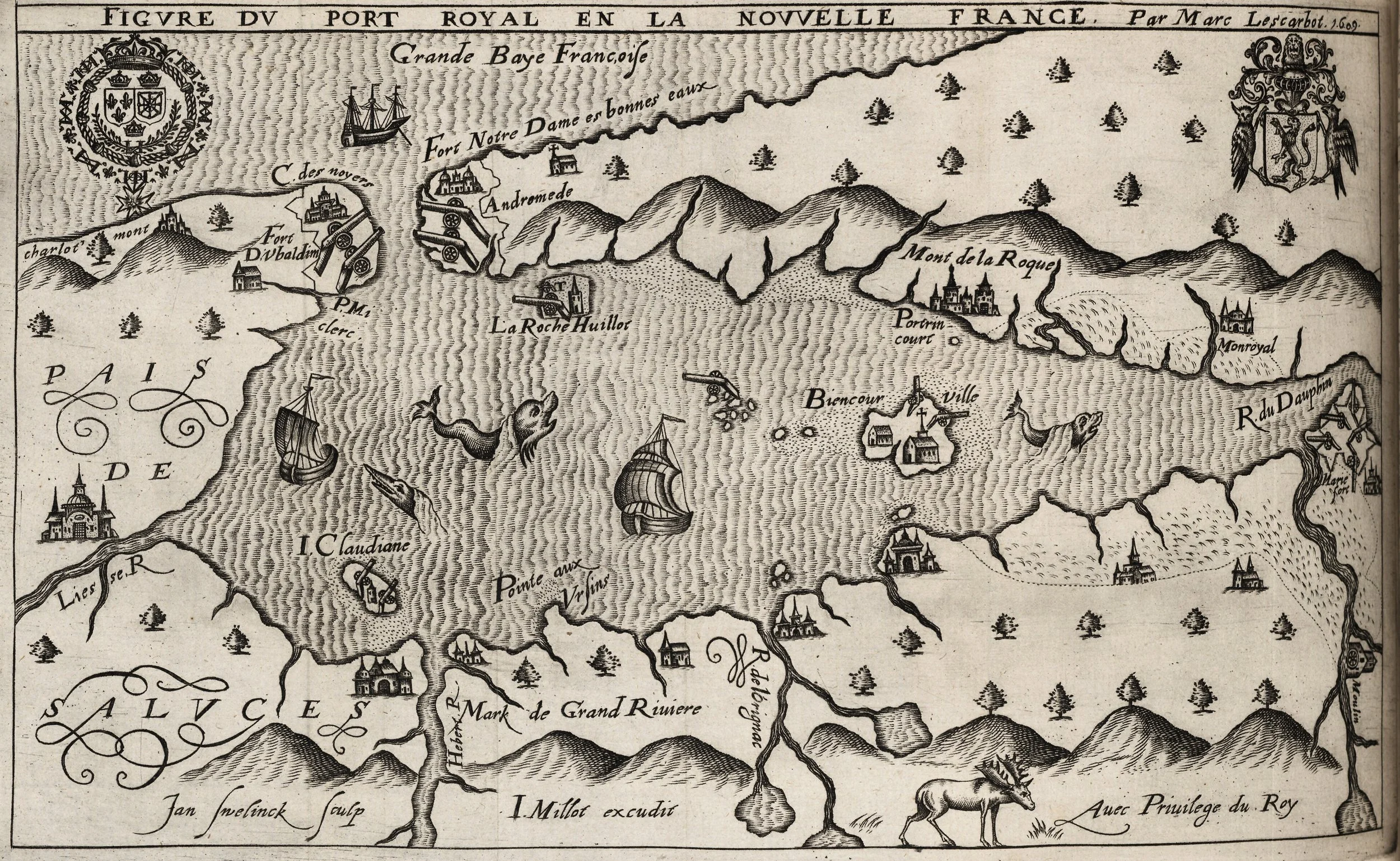
Map of New France - Lescarbot (1609)
More Beneficial Than All the Medicines
August 23, 1572. Paris was tense in the wake of France's civil war.
Eighteen-year-old Henry of Navarre, a Protestant, had just married Margaret of Valois, a Catholic. The match was meant to reconcile factions that had fought for a decade. Four days after the wedding, Admiral Gaspard de Coligny, an important Protestant leader and one of Henry's allies, was shot. He survived, and the Protestants demanded justice. The Catholic king would give them the opposite.
Fearful of reprisals, King Charles IX and his council decided to strike first. Armed men broke into the apartment where Coligny was recovering. His guards were overwhelmed. Coligny was killed and his body thrown out of a window. It was then mutilated, dragged through the streets, and hung upside down.
Catholics moved house to house in an escalating frenzy, murdering Protestants and looting their homes. The violence spread across the country and lasted for weeks. Thousands died in what became known as the St. Bartholomew's Day Massacre.
Charles IX died two years later and what was known as the War of the Three Henrys began. Charles’ successor, Henry III, eventually had his Catholic League rival, Henry the Duke of Guise, assassinated. The following year, a Catholic extremist assassinated Henry III in revenge. Henry III had no heirs and the throne passed to last Henry standing - Henry of Navarre, whose wedding had been marred by a massacre seventeen years earlier.
He became Henry IV, King of France, though much of the country still refused to accept him because he was Protestant. It took him four more years of fighting and a conversion to Catholicism before he secured the throne. In 1598 he negotiated the Edict of Nantes, a settlement between Catholics and Protestants.
He emerged from that violence a kind of Renaissance humanist. He was pragmatic, suspicious of fanaticism, and convinced that people with profound differences could still live under one political order. He found a kindred spirit in a man some twenty years younger: Samuel de Champlain.
Champlain had come of age amid the same wars, serving in Henry's army in Brittany, first as a quartermaster organising supplies and troop movements, later rising to a senior logistical post. After the fighting ended in 1598, he worked aboard his uncle's ship to the Spanish West Indies and produced a report so detailed, with illustrations and maps, that it made its way to Henry IV himself. The king granted him a pension, and Champlain became attached to the court. In 1603 he joined an expedition to New France as the king's observer, carrying with him Henry's conviction that a divided society could be rebuilt.
But in what is today Canada, Champlain found a new enemy: winter.
Winter, 1604–05. Sainte-Croix, modern-day New Brunswick
“Winter came upon us sooner than we expected, and prevented us from doing many things which we had proposed... The cold was sharp, more severe than in France, and of much longer duration... many of our company were attacked by a certain malady called the mal de la terre, or scurvy... There were produced in the mouths of those who had it, great pieces of superfluous and drivelling flesh, which got the upper hand to such an extent that scarcely any thing but liquid could be taken. Their teeth became very loose, and could be pulled out with the fingers without its causing them pain... a violent pain seized their arms and legs, which remained swollen and very hard, all spotted as if with flea-bites... So that out of seventy-nine, who composed our party, thirty-five died, and more than twenty were on the point of death.”
—Samuel de Champlain, Voyages, 1613.
They had crossed an ocean hoping to build something better than a country that killed its own over what they believed. Winter killed them anyway. Not with muskets or mobs, but by rotting their flesh and seizing their limbs.
The survivors abandoned Sainte-Croix and moved roughly 150 kilometres east to Port-Royal, in modern-day Nova Scotia. Scurvy returned the following winter. By the third year, Champlain had watched nearly half his men die and his dream of a new society was close to dying with them.
Fresh supplies and new men arrived in the summer of 1606, among them Marc Lescarbot, a lawyer, poet, and fellow survivor of the wars, disillusioned with corruption at home. He arrived just before Champlain left on a mapping expedition. When the expedition returned that November, Lescarbot staged a welcome-home spectacle in the harbour: boats decked out as Neptune's court, trumpets and cannon fire, a story of the sea god returning home flanked by French and Indigenous leaders. It was the first theatrical performance staged by a European in North America and a sign that this outpost was becoming more than a struggle for survival.
Champlain built on the idea and turned survival itself into a competition. He created the Order of Good Cheer.
Every fortnight, one man was named Officer of the Order, responsible not just for feeding the company, but for feeding them well. He would have time to hunt and fish and arrange activities, and would preside over dinner with a napkin on his shoulder, a wand of office in hand, and the Order's collar around his neck, followed by every other member of the Order, each carrying a dish. Each officer tried to outdo the last. The forests and waters around Port-Royal supplied ducks and geese, partridges, moose, caribou, beaver, otter, bear and rabbit, and fresh fish was abundant. Moose meat was prized, and beaver tail was considered a delicacy.
The Mi'kmaq, whom the French invited to their feasts, called the officer the Atoctegic, and joined the ceremony. At evening's end, the officer removed the collar and passed it to the next man to hold office, along with a cup of wine, and the responsibility passed with a toast.
“We passed this winter very joyously,” Champlain wrote, “and fared well, by means of the Order of Good Cheer which I established there, which every one found useful for health, and more beneficial than all the medicines we might have used.”
Something else was happening at that table. Catholics and Protestants were eating together. It had been only eight years since the Edict of Nantes, and the crew included both Catholic priests and a Protestant minister. They may not have become great friends. When one priest and the minister died in quick succession, they were buried together. The men joked for years that they were probably still arguing about religion in the grave.
But in this seventeenth-century society, tolerance was enough. After decades spent decades killing each other over their differences, Frenchmen were now trying to build houses, explore, and survive winter together. And at the table of the Order of Good Cheer, they feasted together.
Nor were the French alone. Port-Royal stood in Mi'kma'ki, and the Mi'kmaq, led by the sakmow Membertou, became essential allies, guides, and trading partners. Eventually they became trusted neighbours. When two Frenchmen stayed behind in 1606 to guard the settlement Membertou promised to treat them “as kindly as his own children.” Champlain remembered him as a friend for the rest of their time together, and later in life the childless Champlain would adopt an Indigenous girl as his daughter. When the French were recalled home in 1607, they left Port-Royal itself in Membertou's care. They were gone for almost three years, until they returned in 1610 to a warm welcome.
It would be easy to romanticise this. Both sides had their own interests in the alliance, and neither ceased to be a seventeenth-century society. The French helped the Mi'kmaq and Algonquin fight the Iroquois. But the contrast with the France these men had left behind was striking. In Paris, Catholics had hunted Protestants through the streets and hung a dead man's body from a gibbet. At Port-Royal, they shared a table, and the French and Mi'kmaq built an alliance strong enough to trust one another with their lives.
The Order of Good Cheer wasn't simply about helping Champlain's men survive winter. Around its table, people who believed different things and came from different worlds were expected to look out for one another.
After everything Champlain had seen in France, perhaps that was the point. A new society needed more than a leader who could help people survive together. It needed someone who could provide people with a culture worth living in.