
The Medieval Prince Who Made Hops Famous
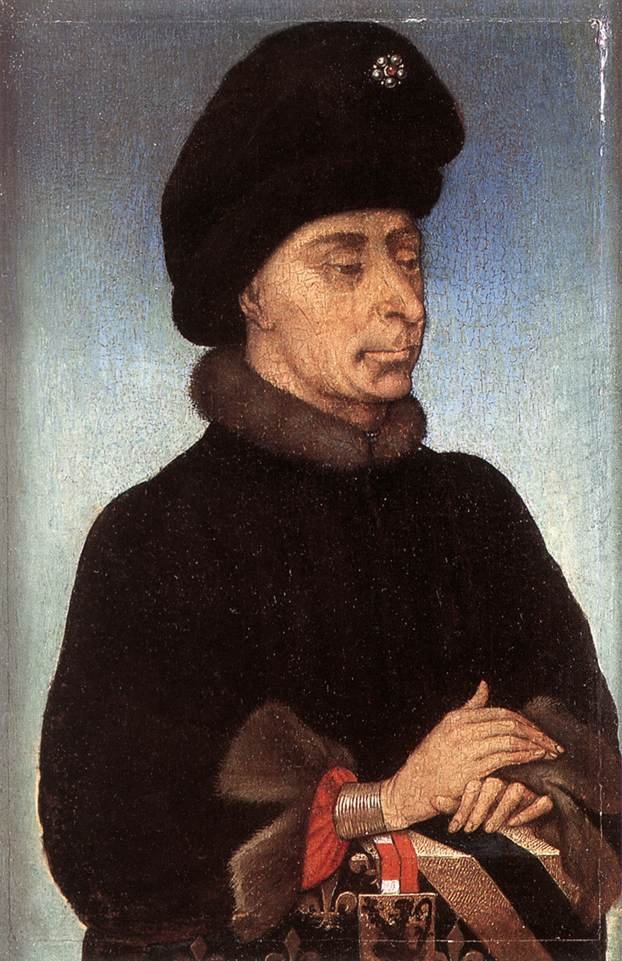
Jean Sans Peur, John the Fearless, had a reputation for courage, cunning, and ruthlessness. He was also the first ruler known to make hops part of his political branding.
Dear Reader,
It’s time to celebrate.
I write this on my twentieth wedding anniversary.
But don’t worry, my wife is asleep. Though that’s not why I’m celebrating.
International Beer Day was founded nineteen years ago. The latest edition was this past Friday. Its stated purpose is to celebrate brewers, servers, and to unite the world in a shared love of beer. That’s a nice idea, but I’m not sure how successful it’s been because I only found out about it this past Saturday.
This niche micro-holiday emerged as part of the Day Naming Craze of the mid-2000s. Social media and Internet culture were accelerating what sociologists call reflexive post-modernity – essentially a splintering of society from a grand, unifying narrative to a growing number of distinct sub-cultures. Many groups wanted their own day, and so did many industries. The result was a deluge of near-meaningless holidays no one has heard about.
Happy Global Kinetic Sand Day, everyone! (seriously, look it up)
While we must defer to future historians for a verdict on the ultimate cultural significance of having four times more novelty days than actual days each year, we can consult living ones about past attempts to institutionalise celebration.
Christmas, for example, has been extremely successful since Constantine placed it on December 25 in the year 336.
But that’s an exception.
For most of history, sub-national groups celebrated their identity and interests not through special days but with membership in special groups. In medieval Europe this was often done through guilds and chivalric orders.
One of them helped make beer what it is.
It’s called the Order of the Hop and it’s still conferred today, six hundred years after it was founded.
Beer in the early 1400s was not just an everyday drink. It was political. Nobles and clergy controlled an ingredient called gruit, a secret blend of highly taxed herbs that brewers were often required to use. But gruit had competition.
Hops were gaining popularity. They tasted good, made beer easier to export by helping to preserve it, and they weren’t taxed. Politically savvy rulers looking to curry favour with everyday people knew beer was an easy way to popularity.
One particularly ambitious noble became a champion of hopped beer as he curated his reputation in preparation for an audacious attempt to take over a kingdom. His story is below.
Let’s get into it.
The Medieval Prince Who Made Hops Famous
September 25, 1396. Nicopolis, modern-day Bulgaria.
Knights sat atop armoured horses. The animals' steel-clad heads, necks, shoulders, backs, and flanks shimmered beneath the late summer sun. Beneath the steel, man and beast vibrated with anxious energy, eager for battle.
The infantry stood beside them, filled with dread.
Lightly armoured and carrying little more than lances and swords, they would be the first to meet an Ottoman shield wall. Many of their soft, exposed bodies would soon be torn apart as their blood soaked into the dry Bulgarian earth.
The Ottoman Turks had spent decades pushing steadily into eastern Europe. A great crusading army had gathered to drive them back. French and Burgundian knights stood beside Hungarian infantry and other allies along the banks of the Danube.
Across the valley, Sultan Bayezid I had chosen his ground carefully. One wing rested against the heights below the citadel of Nicopolis. The other leaned upon dense woodland.
The Europeans would have to attack uphill.
Their commander, King Sigismund of Hungary, knew exactly what his opponent intended. The Ottoman infantry were an expendable force whose job was to absorb the initial assault before disciplined cavalry struck the exhausted crusaders. Sigismund's own infantry would therefore advance first while his heavy cavalry waited to deliver the decisive blow in a counter attack.
It was a sensible plan.
But one ambitious man had no intention of waiting.
Jean, Count of Nevers, considered it beneath the dignity of his knights to allow infantry the honour of the first attack. Glory belonged to knights. Just before Sigismund gave the order, Jean spurred forward. Four thousand mounted knights thundered after him.
The charge was magnificent.
The Ottoman front ranks were smashed. Men disappeared beneath iron-shod horses. Spears splintered. Heads rolled. Shields shattered. Within minutes the crusaders had swept away everything before them. As the knights crested the ridge, the ground fell away to reveal a hidden valley.
Waiting below stood Bayezid's reserve.
Thousands of fresh armoured cavalry, still in formation and on fresh horses.
The Burgundians and French had ridden straight into the trap Sigismund had tried to avoid.
Behind them, the Hungarian infantry advanced, unaware that the battle had already been lost. A hidden flank of Serbian heavy cavalry appeared and slaughtered the Hungarians while the French and Burgundians were trapped on the other side of the hill.
By sunset, one of the greatest crusading defeats in European history was complete. Tens of thousands lay dead.
The three thousand captured knights, accustomed to the chivalric code of Europe, expected to be ransomed. But most were executed as a reprisal for crusader executions of Ottoman prisoners from decades prior.
Jean was one of the few to survive. His father, the Duke of Burgundy, was exceptionally rich and the Ottomans knew it.
Jean was ransomed.
Within a decade his father would be dead and Jean would become the Duke of Burgundy. He would never let his ego get the better of him.
Jean understood something many nobles of his day never did. There was an advantage to being known as a man of the people. Burgundy's wealth came from its brewing towns in what is now Flanders, and Jean began to build support by making the townspeople feel that Burgundy belonged to them.
In 1406, Jean founded the Order of the Hop to do just that. Most medieval princes created knightly orders to celebrate noble blood or military victories. Jean created one to celebrate ordinary people and named it after a climbing vine that was weaving its way into everyday life.
For centuries, many European beers had been flavoured with gruit, a secret blend of highly taxed herbs that was often controlled through feudal monopolies. Hops were different. They were not taxed and they slowed spoilage, allowing beer to survive long journeys to distant markets. Brewers across northern Europe were increasingly embracing the new ingredient, and avoiding taxes in the process. Jean became an advocate of hopped beer and gave awards to people who brewed and sold it.
In the early 1400s beer was not simply something people drank. It was political. Brewing was an industry that employed farmers, maltsters, coopers, bargemen, merchants and brewers. Regular people drank beer daily. Jean positioned himself as a man of the people, pushing back against a greedy nobility who wanted to tax and control this common staple.
The Order of the Hop leaned into the idea of a more independent merchant and working class. It was bestowed upon prominent brewers, wealthy guildsmen and influential citizens of Flanders. It was an extraordinary choice. Few princes elevated merchants and craftsmen into the symbolic orbit of ducal honour. It was a way to show he supported working people in their struggle for recognition in a world dominated by nobles.
Jean cultivated that image carefully. While other princes surrounded themselves with courtly extravagance, he courted guilds, championed urban reform, and presented himself as the defender of ordinary townspeople against corruption at court.
People loved him.
His rival, Louis of Orléans, the mad King’s brother and the most powerful man in France, was not so lucky. Extravagantly wealthy and elitist, many of his people hated him. Especially in contrast to Jean.
Then, in November 1407 on a narrow Paris street, masked men stepped from the shadows and cut Louis down with axes. Louis of Orléans died where he lay.
Jean confessed to being the man behind the killing.
What’s more, he celebrated the murder, claiming that Louis had been a tyrant and that removing him had been an act of public service. The gamble paid off.
France erupted. The kingdom split into two armed camps: Burgundians, supporting Jean, and Armagnacs that supported the old order.
Civil war had begun.
The following year, Jean marched east to Liège, where rebels had risen against his brother-in-law. This time the reckless young knight of Nicopolis was gone. At the Battle of Othée he fought on the front lines, cementing the idea that he was not above the risk he asked of his troops. But this time he followed a disciplined battle plan. The rebels were crushed. Jean's reputation for fearlessness grew. He became known as Jean Sans Peur, Fearless John.
By 1418, France was bleeding. The English had crushed the French at Agincourt three years before. Half of the French nobility was dead in an afternoon. The English returned to lay siege to Rouen in 1417 while the civil war dragged on. Paris was exhausted and ripe for conquest.
On the night of May 28, Fearless John’s sympathisers inside Paris quietly opened one of the city gates. Jean's soldiers poured through. The Dauphin, heir to the throne, fled. By dawn, Paris belonged to him.
The mad king was helpless, out of public view, and Jean declared himself his protector. He was now leader of all France, in the name of the mad King, whose son was in exile.
The reckless count who had once charged blindly over a Bulgarian hill had taken the French capital without fighting a single battle in the open field.
It was the greatest, and last, victory of his life. Within sixteen months, he would ride to a bridge at Montereau and never return. The Dauphin’s men would kill him with axes as he went to negotiate a peace, unarmed.
The old monarchy was restored after three more decades of war.
Today, six centuries on, almost none of Fearless John’s victories have survived him. Paris moved on. Even Burgundy herself is now part of France.
But in the brewing towns of Flanders, something smaller has lasted until today. Not the ambition. Just a wreath of hop leaves circling a coat of arms, and a title a young count invented to win the love of the people.
Of everything Jean sans Peur fought and killed for, it’s the hop, a piece of his propaganda, that stays with us today. It’s in the beer we drink. And it’s in the Order of the Hop, still conferred on hop growers and scientists who help this plant make its way into the everyday life of ordinary people six hundred years later.