
The Lost Beer of Iceland
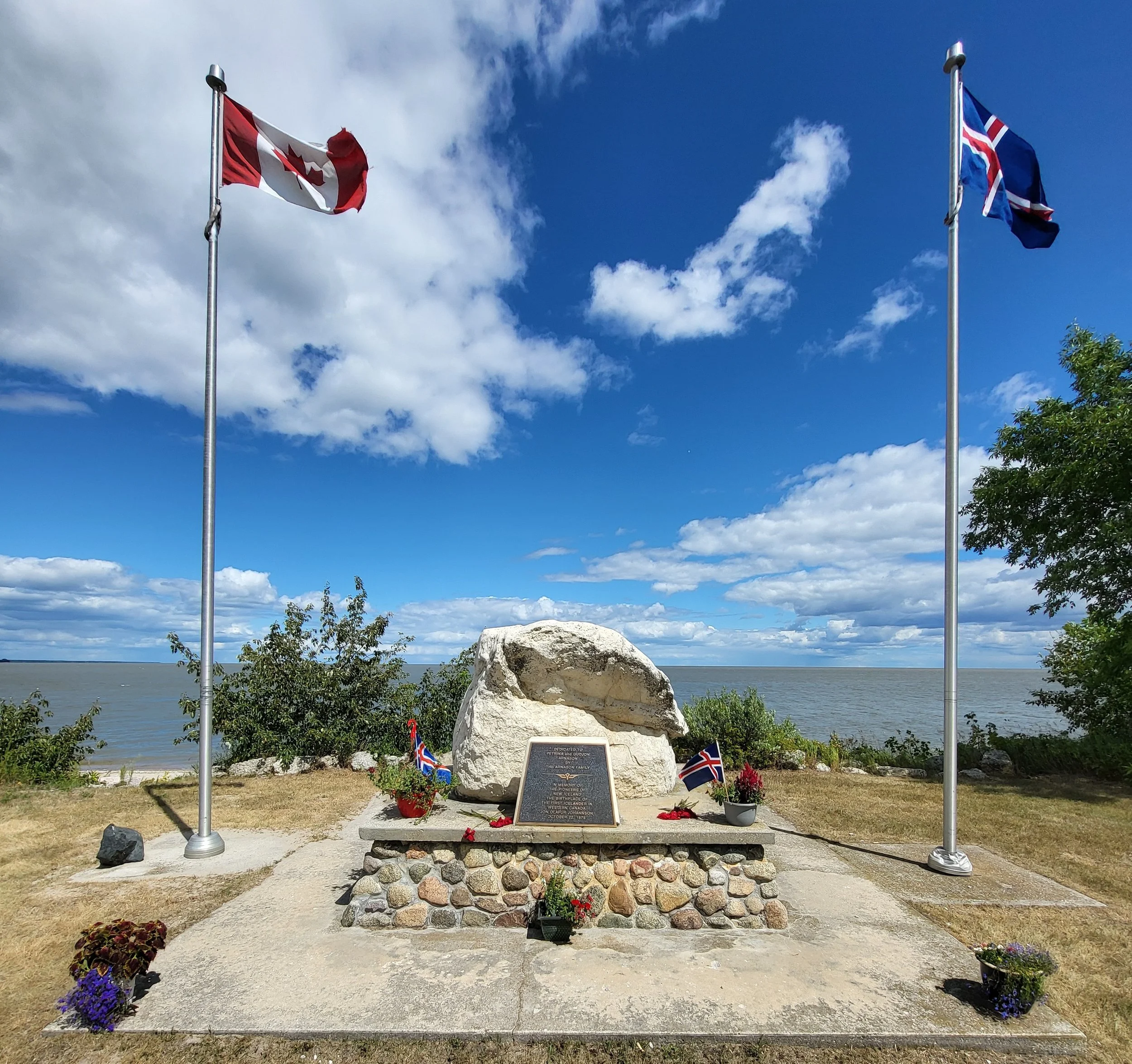
This stone marks the spot where the first Icelanders landed in Western Canada in 1875.
Dear Reader,
The tugboat forced its way north against the wind. It sat low, breaking heavily through each wave. White spray soaked the cockpit and grey water flowed over the deck. The captain looked back at the barge he was towing as its weight held his bow low in the wave troughs.
“Cut the rope!” he ordered. One of his men grabbed a saw and, fearful of the storm, set its teeth to the heavy hawser. The rope frayed with each confident push and pull. Fiber by fiber the thick braid came apart until snap! The weight of the barge fell away and the tug was carried up high on the next wave.
The families on the barge watched the tug move up the coast as the wind and waves carried them back south. The waves no longer slapped and sprayed like before. They jostled. Men, women, children, and all their earthly possessions, adrift on a grey lake under a grey sky.
How appropriate.
They had little more than hope. That’s why they came.
Iceland was a poor country, still under Danish rule. There had been poor harvests for several years, ash spewed by volcanoes had ruined some farms, and about one hundred Icelanders had gambled on a new life in Canada.
It was October 21, 1875. The first Icelandic settlers in North America since the Viking Age washed up on the shores of Lake Winnipeg. They didn’t land in a port, or settle in a town. They carved a home out of the forest and made a living from the lake.
It was a different time. Manitoba was only 5 years old and a fraction of the size it is today. The Icelanders were granted land in the Interlake region, then frontier country called the District of Keewatin. They were granted a remarkable degree of self-government. Their settlement became a tiny republic known as Nýja Ísland (New Iceland).
More joined them in 1876. They learned to hunt and trap in the sparse forests with the help of local Cree people. One Cree man, John Ramsay, helped save dozens of lives during an 1875 smallpox epidemic in which his own wife and daughters perished.
Nýja Ísland lasted until 1887, when Manitoba expanded to its contemporary borders and the tiny republic was dissolved. Many of the descendants of the original Icelandic Canadians remain to this day. I’m a fifth-generation descendent of these people and as I write, sit only two hundred metres from where my ancestors washed ashore 151 years ago. My mother grew up here and it’s where I spent much of my childhood.
So why, then, doesn’t Good Cheer make traditional Icelandic beer?
The answer spans one thousand years, beginning in the 11th century and taking us all the way up to the year 1989.
The Lost Beer of Iceland
A turf house stands on a hill atop a grassy plane. Carefully placed red and black stones make the foundation, vertical wood panels the façade, and a verdant green plane drapes the back as if the land were holding the house in a soft embrace. The plain gives way to grey sea and grey mountain under a bright blue sky.
Icelandic farmsteads were remarkably prosperous early in the nation’s history (c.900-1300). Turf longhouses were built with imported timber. Livestock were plentiful, woodland remained in many regions, and the sagas describe households with servants, guests, and frequent feasting.
Homesteads even had saunas, called a baðstofa (bathing room).
People brewed and enjoyed beer (öl). A law code, the Grágás, references it, and the sagas frequently mention brewing, drinking, and ale-feasts. The early Icelanders clearly brought Scandinavian brewing traditions with them.
But it wouldn’t last.
Iceland was a poor country by the High Middle Ages. The timber was gone. Much of the thin soil, disturbed by the plow, had blown into the sea. The baðstofa was no longer a bathing room. It was the only heated room in the house. And it was often heated by the cattle who occupied a small room below it designed for the purpose.
Family members gathered in the baðstofa during the long winters to eat, spin wool, repair fishing gear, tell stories, and read. Beds lined the sides of the room, doubling as seats. The landscape had become unforgiving.
Refuge was a crowded room that smelled like livestock, often lit by a single candle, with a name from a time whose luxury seemed impossible.
Barley, always difficult to grow, became harder during the Little Ice Age. This cool period in
Northern Europe lasted from about 1300 to 1850, with the coldest years falling between 1645 and 1715. As farms began to fail, Icelanders became even poorer while imports became more expensive. Brewing, once an ordinary household activity, became rare.
The decline in Icelandic society’s living standards had turned into a fight for survival by the 1700s. People got by on dried fish and dairy. What had once sustained prosperous Viking farmsteads had become one of Europe's harshest rural economies.
Beer was a luxury, and one tainted by its association with Danish rule. From the seventeenth century onward, Denmark imposed a royal trade monopoly that required Icelanders to buy and sell through licensed Danish merchants. Combined with Iceland's harsh climate, volcanic eruptions, recurring famines, and limited natural resources, the monopoly contributed to centuries of poverty and isolation. By the nineteenth century, however, Icelandic nationalism was growing.
Improved technology imported to Iceland during the 19th century boosted crop yields along with the entire economy. The country remained poor, but imported goods like Danish beer and spirits, began to appear.
By the nineteenth century, Iceland had largely lost its own brewing tradition. The beer now arriving in its ports came not from Icelandic farmsteads but from Denmark. To many Icelanders, beer no longer represented their own history. It represented colonial rule. At precisely the same time, a powerful temperance movement was preaching thrift, sobriety, and moral discipline. The result was remarkable: a drink that had once been brewed by Iceland's earliest settlers came to be viewed as both a foreign luxury and a moral vice.
Iceland was granted Home Rule in 1904, and in 1908 voted to ban all alcohol. Icelandic prohibition would be repealed piece by piece over decades, beginning in 1922 when Portugal said it would stop importing Icelandic fish if Iceland didn’t re-start importing their wine. Spirits were legalized in 1935, along with beer under 2.5%, creating one of the strangest liquor laws in Europe.
Strangely, Icelanders could buy spirits but not regular strength beer. The rationale was that beer, being affordable, would lead to drunkenness among the young and disrupt the work-ethic of the working class. Icelanders found a way around the law. People simply mixed a bit of spirits with weak beer to create regular strength beer.
This went on for decades.
Then, on 1 March 1989, all beer became legal. Bjórdagurinn (beer day) is still celebrated on the anniversary of the repeal of final piece of prohibition.
Slowly, Icelandic brewing restarted. When the craft beer scene exploded around 2010, this arctic nation found itself unconstrained by tradition. It was time to create, rather than re-create, Icelandic beer.
Today there are 26 breweries in Iceland using ingredients like arctic thyme, angelica, birch, crowberries, seaweed, and smoked malts (including sheep dung smoked malt). New traditions are being born in a nation that has recovered from centuries of harsh living to have one of the highest standards of living in one of the world’s most peaceful societies.
Iceland's original brewing tradition may be lost. Unlike the beers of Belgium, Germany, or Britain, there was no unbroken chain of brewers passing recipes from one generation to the next. The thread was broken centuries ago.
Yet Iceland has done something remarkable. Rather than trying to recover a tradition that no longer exists, its brewers have built a new one, drawing inspiration not from the past alone, but from the landscapes, herbs, and volcanic energy that have always defined the island.
Some brewing traditions are preserved.
Others must be reborn.
When my ancestors stepped ashore on Lake Winnipeg in 1875, they carried with them a language, a culture, and the memory of a homeland that had endured a thousand difficult years. They did not bring an Icelandic brewing tradition, because by then there was scarcely one left to bring.
Today, Iceland has found its beer again, not by recovering the past, but by creating something entirely new.