
The Unplanned Inheritance of a Longed-For Son
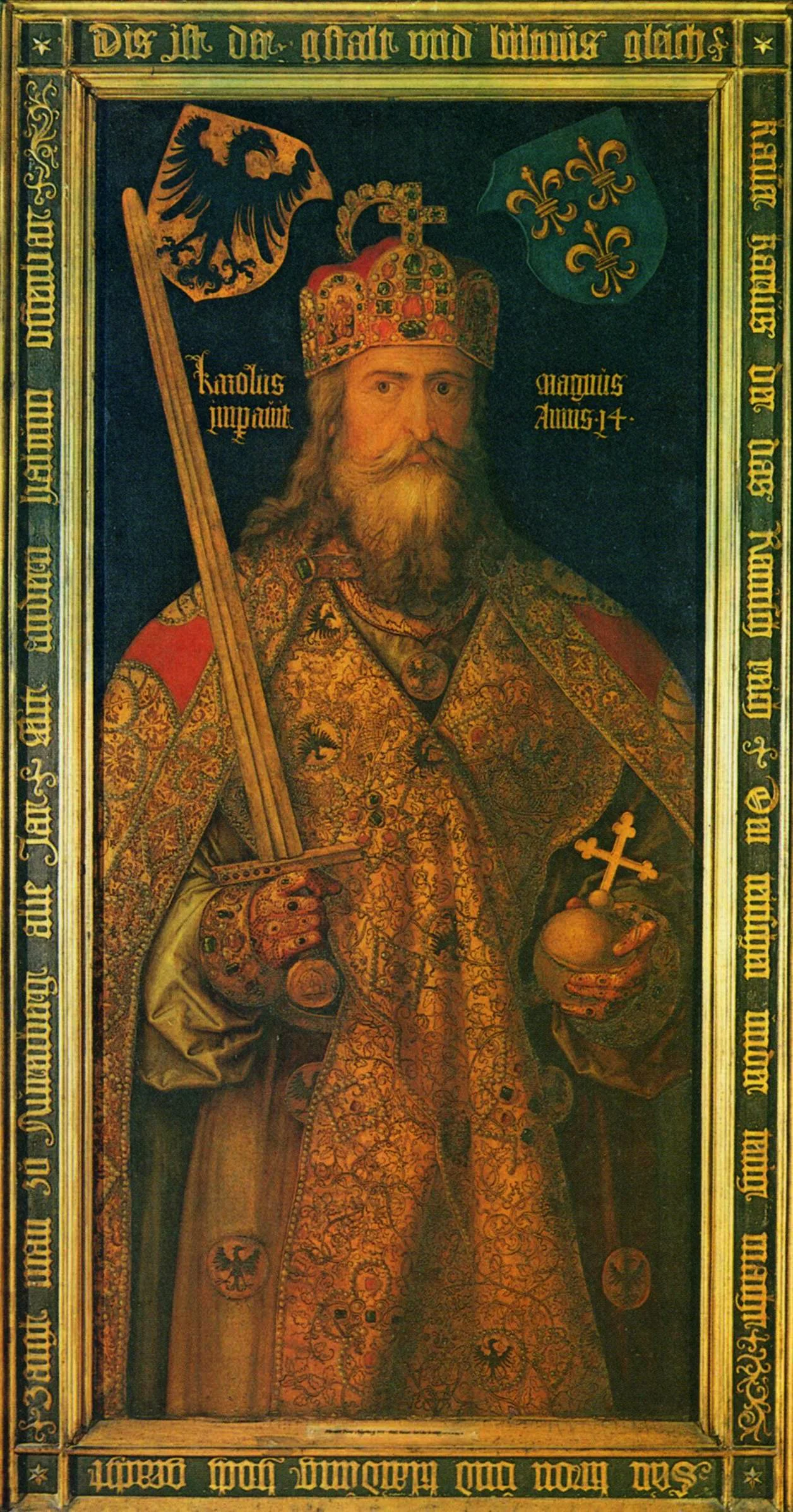
Emperor Charlemagne by Albrecht Dürer (1512). The accidental godfather of hopped beer?
Dear Reader,
A steward walks the edge of a walled garden with a list in his hand. Sage. Mint. Coriander. Caraway. He checks each bed against the king’s instructions, then heads to the brewhouse to make sure a skilled brewer is at work. The king isn’t here, and may not come all year. But the king’s court and his armies have to eat and drink, so everything must be ready all the same.
There is one plant missing from the list: hops.
Today we think of hops as a fundamental part of beer. Popular culture celebrates the Reinheitsgebot, known today as the Bavarian Purity Law of 1516 decreeing that beer be made only from barley, hops and water (people did not yet count yeast as an ingredient). But for most of history hops were absent from brew kettles. During the early Middle Ages they grew on some monasteries destined for use as medicine, rope, or die. So how did a bitter climbing vine go from the margins of the medieval estate to the centre of European brewing? And what did the first hopped beers taste like?
This week’s story begins with a mother’s prayer, passes through the court of Charlemagne, and ends in a merchant’s cargo hold. It’s context for our latest brew Cervesia, a beer re-created from the early 9th Century and an example of one of the earliest hopped beers.
The Unplanned Inheritance of a Longed-For Son
c. 1070 BC. Ramah, in the hill country of Ephraim.
A woman knelled in the dim light of a temple. Tears streamed down her cheeks as she mouthed a silent prayer in agony. She longed for a son but could not conceive. According to the Book of Samuel, Hannah, one of two wives of a man named Elkanah, was constantly taunted by her rival because she had no children.
During one of the family’s annual trips to the sanctuary at Shiloh, her grief overflowed. Seeing her lips move without hearing her voice, the priest Eli assumed she was drunk. “Stop that! Put away your wine,” he told her. But Hannah hadn’t been drinking. She was mouthing a silent prayer. Eli realized his mistake and blessed her, asking the God of Israel to grant her request.
Hannah conceived and gave birth to a son, Samuel. True to her vow, she brought him to Shiloh once he was weaned, leaving him to serve under Eli’s guidance. Each year she visited him and brought him a little robe. Samuel became the last judge of Israel and the man who anointed its first two kings, Saul and then David.
April 2, 748. Northwestern Europe, possibly near Quierzy, in modern-day France.
A woman longed for a son. Bertrada, wife of the military leader Pepin, knew her family’s ambitions needed an heir. Pepin was trying to complete a conquest launched by his father Charles Martel and depose the last Merovingian King. Bertrada, wife of Pepin the Short, saw something of the biblical Hannah in her own experience of motherhood. Her son, Charles, born on April 2, would inherit a family’s ambitions and help transform Europe.
Pepin was not yet king. He was Mayor of the Palace, an office through which his family wielded much of the practical power in the Frankish kingdom. His father, Charles Martel, had strengthened that position through warfare and political alliances. Pepin wanted the crown itself.
But he needed legitimacy.
Around 750, he sent envoys to Pope Zachary, asking whether the title of king should belong to the man who held power (himself) or to the man who possessed the title alone (his rival). The papacy was at that time facing intense pressure from the Lombards in Italy and could no longer depend on effective protection from their allies at the Byzantine court in Constantinople. Pepin offered a powerful alternative. When the Pope responded that he who holds power should rule Pepin acted fast. His armies deposed the last Merovingian king the following year, 751, and Pepin became king of the Franks.
In 754, a new Pope, Stephen II, travelled to the Frankish kingdom and personally anointed Pepin and his sons. The ceremony was performed in the manner of the Old Testament kings Samuel had once anointed and set the Frankish kings on a course to become the Defenders of Christianity. Stephen II forbade the Franks, under threat of excommunication, to choose a king from outside Pepin’s family.
The longed-for son was now heir to a kingdom he would grow into an empire. Charles, known to history as Charlemagne, became sole king of the Franks in 771. In 774, answering a papal appeal, he captured the Lombard capital of Pavia and the Lombard crown. He styled himself a defender of the Church, supporting churches and monasteries while spreading the faith across a continent through conquest and coercion.
Conquest created a practical problem: how to feed and run what he had won. Among the surviving texts of his administration is the Capitulare de villis, a set of instructions for managing royal estates. Its date is debated; around 800 is common, though some scholars place it earlier at around 792. It lists more than seventy plants the estates were expected to grow, alongside fruit trees: vegetables, and aromatic and medicinal herbs including sage, mint, coriander and caraway. Hops are not on the list, but they were grown on some estates following orders by Charlemagne’s father Pepin in 768. The document also required estate managers to have skilled makers of beer, cider, and other drinks.
Such organisation mattered. An army of thousands needed grain for bread and beer, and pasture, hay, and other feed for the horses and pack animals that moved it. Royal estates and powerful church landholders formed part of the wider provisioning system, and a failed harvest could leave people hungry and limit what an army could accomplish. Food security was a practical foundation of power, and that included ale.
Charlemagne would go on to rule territories stretching from northern Spain to northern Germany and deep into Italy, with influence reaching into central Europe. On Christmas Day in 800, twenty-nine years after becoming sole king of the Franks and seventeen years after his mother’s death, he was crowned emperor in Rome by Pope Leo III. His dynasty would be known as the Carolingians, from his Latin name, Carolus.
His influence extended beyond the lands he conquered. A moderniser, he gathered scholars at his court, encouraged schools, and sought better standards of learning and administration. Religious and classical texts were studied, corrected, and copied. This revival, known as the Carolingian Renaissance, helped preserve ancient knowledge and strengthened traditions of scholarship that would outlast his empire. An empire needed people who could read and administer it, but it also needed people who could feed it. Among them were brewers.
c. 768–1380. Central and Northern Europe
Monks had for centuries brewed ale. But so had many other people. Across much of Europe, brewing was household work, often undertaken by women. Monasteries, however, brought together resources that could support brewing on a larger scale: agricultural estates, grain stores, dedicated facilities, and a special ability few at the time possessed. Literacy.
Literacy allowed knowledge to travel with a precision that memory alone could not match. Processes could be recorded, instructions communicated, and observations preserved for another generation. Monastic records give us valuable glimpses of how brewing was organized, although much of the practical knowledge of household brewers went unwritten.
These religious communities also enjoyed the support of powerful rulers. A charter often cited as issued by Pepin in 768 granted property to the Abbey of Saint-Denis that included humlonaria: hop gardens. At Corbie, regulations issued by Abbot Adalhard in 822 allocated malt and hops to the monastery’s gatekeeper for brewing.
Hops were not the only option, and for centuries they were not the usual one. Much medieval ale was flavoured with gruit, a blend of herbs that could include bog myrtle, yarrow, and wild rosemary. In many regions the right to produce or sell gruit, the gruitrecht, was controlled by rulers and bishops, who profited from it. Hops, which could be grown by almost anyone, offered a way around that arrangement, and a way to make a drink that lasted.
That last quality did not go unnoticed. Hildegard of Bingen, a twelfth-century abbess, belonged to a monastic culture of learning that Carolingian reforms had helped create. In Physica, a natural history she compiled around the middle of the century, she wrote that hops, added to drinks, helped hold off spoilage, though she was not wholly enthusiastic about them. She did not invent hopped beer, but she recorded something that would become increasingly valuable. Hopped beer lasted longer, which meant it could travel farther.
Medieval ale was typically produced in small batches, perhaps a hundred or two hundred litres. Spoilage wasn’t much of a concern because batches of this size were consumed quickly. But by the fourteenth century, northern German brewing towns such as Hamburg were producing in batches of thousands of litres, far more than could be sold at once. They sold the surplus through the trading networks of the Hanseatic League. Their hopped beers could withstand storage and transport, helping transform beer from a locally consumed drink into a commodity traded across northern Europe.
Charlemagne’s empire fractured in the decades following his death, but the learning and productive life he encouraged continued in monastery libraries, gardens, and workshops. Long before hops became the defining ingredient of European beer, they grew among the resources of religious estates, and later scholars recorded their ability to help preserve drinks. Over centuries, botanical knowledge and brewing experience met the ambitions of merchants, making hopped beer a product that could travel far beyond its brewhouse.
From a mother’s hope to a kingdom, and from an estate garden to a merchant’s cargo, the story of hopped beer, like much of history, is a story of consequences no one could have planned. It shows how some of the quieter instructions of history hidden in the shadow of great rules can be traced directly to our contemporary world. Orders about gardens and estate management helped furnish the raw material that monks and nuns would turn into knowledge, brewers into craft, and merchants into a product so familiar that we rarely wonder how it came to be.