
Viking Age Ale is Still Alive
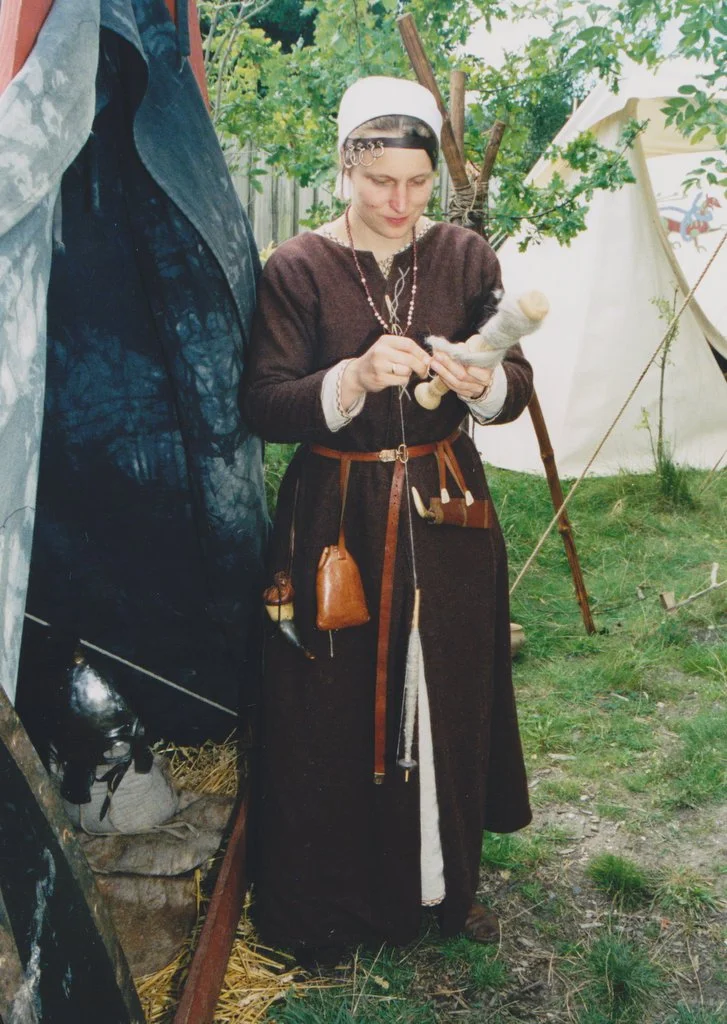
Viking Age women were the original brewers of the råøl. Photo by Peter van der Sluijs.
A grassy plain drops sharply into the sea. It’s surrounded by mountains. There’s a waterfall on one side feeding a small retention pond and a large turf-roofed house surrounded by small outbuildings nearby. A large boat has just landed, with a dragon head prow. Cargo is being unloaded. Treasure is being unloaded. Even wine is being carried up the bank.
Women are preparing a meal. One dips her wrist into a barrel of sweet liquid. Finding it blood-warm she lifts a set of interlocking carved rings off a shelf. They’re covered in thin white flakes, caught in the rough surface grooves. She dips it into the liquid and stirs. Soon the wort will begin to ferment. It won’t be long until the next batch of ale is ready.
For millennia, European women were brewers and brewing happened at home. By the high Middle Ages men had largely taken over as brewing became a profession, taxed and regulated like it is today.
What was beer like before it shifted from a household chore to an industry? Let’s find out with a journey to medieval Norway, when people longed for ales, like the ones mum used to make.
—-
Imagine you’re sitting in the front seat of a small, single engine airplane flying low over the north Atlantic. As you look out across the seascape you see tiny, exotic islets jutting straight out of the dark grey water. Some are barren and rocky, but covered in birds. Others are matted with deep green pasture that ends abruptly at steep, brownish-black cliffs.
The islets are fascinating, tiny worlds isolated from the continent, one another and even time itself.
In the brewing world, kveik yeasts are like these islets. Discovered by industrial society on isolated farms in Norway, they are extremely resilient, fast fermenting, tolerant of high temperatures and of high alcohol. Commercial propagation of kveik began in the 2010s and they were touted as a new breed of super yeast that could cut production time by two-thirds. Depending on the strain and fermentation temperature they could produce clean flavours, or big fruity ones. Might these be a kind of Holy Grail for fermentation?
Alas, to the fickle taste of the modern craft beer drinker kveik fermented beers were just too… different. They could be fruity, but not the way people were used to. They could be clean, but not the way a lager was. Kveik stood out a little too much in a market segment dominated by indistinguishable non-conformists.
Or maybe brewers had just not stretched their imaginations enough.
Kveik isn’t just a faster way to make a regular line up of contemporary beers. It’s a way to make an entirely different kind of drink.
Imagine you’re back in that plane. You’re banking hard to take another pass around the islets. You peer straight down at the sun glinting off the water when suddenly the ocean itself recedes into the depths of the earth as if a drain plug was pulled from the sea floor. Just then the plane rights itself. You look toward the islets and realize they aren’t islets at all, but the peaks of giant mountains that were hidden beneath the waves.
A new world is set out before you, both familiar and foreign. There are craggy rocks covered in plants but where you expect grasses and trees you see kelp and seaweed. Instead of fertile valleys fading upward to barren peaks, you see fertile peaks giving way to the nothingness of the former depths. What is this strange upside-down world?
This is the world of medieval brewing.
We’ve heard about it. We’re aware that, somehow, its legacy surrounds us. It’s buried in our collective consciousness next to de-contextualized factoids like knights used to fight in shining armour and it must have sucked to be a serf. But, like a forest creature scurrying in the night, it seems to disappear the moment we try to look straight at it. How, in a world of microbiology, chemistry, and industrial process engineering, can we hope to make the ephemeral idea of medieval ale something more tangible, something we can really understand?
Kveik.
It’s not for fast-fermented hazy IPAs. It’s not for fast-fermented pseudo-lagers. It’s a creature that thrives in its native habitat, the sugary, herbal, resinous wort it has for centuries transformed into ale. They were commonly brewed with infusions of juniper and sometimes also contained other conifers, a result of branches being used as a sieve to separate wort from spent grain.
In that environment it doesn’t make things taste different. It makes them taste like they should. And the taste of medieval ales is a departure from what you normally expect to get in a can at the liquor store. They weren’t flavoured with hops, but with herbs. They were either still or very slightly carbonated. And there were no distinct styles, just what people made on this farm or in that house.
Medieval ale was as much a reflection of terroir, the locally available ingredients, as it was of culture. Each brewer selected which ingredients she wanted to use and how they would be combined. Brewing beer, like baking bread, was household chore and it was women who made it. The earliest commercial brewers in England were even called alewives, semi-affluent women who had the means to produce and sell a surplus of ale to passers-by.
In medieval Scandinavia, and probably long before that, women brewed råøl on their farms. Råøl, literally raw ale, is unboiled maltøl (Norwegian farmhouse ale). Maltøl is not itself a style the way we think about beer styles today, but rather a word used to describe the diversity of historical Norwegian brewing.
Domestic life in medieval Norway differed from continental Europe in a few ways. People lived on relatively isolated farms rather than in villages or towns. Farmers could grow their own brewing ingredients and developed a brewing tradition where wort was made without boiling it, saving the work required for cutting and drying extra firewood.
People, being curious and social, would share information with their neighbours and try each other’s beers. If one woman’s yeast culture stopped working, she could borrow yeast from a neighbour. Over time, different valleys developed their own brewing traditions and even their own yeast strains. Sunnmøre, Hornindal, Voss, and Aurland have their own varieties of kveik each with its own flavour profile. These yeasts were passed down across the generations and often stored in interlocking, grooved rings called kveikstokk.
Ale was a drink that fuelled Viking age peoples, both as a food and as a ceremonial drink. Stronger ales were brewed for yule and were served alongside other more prestigious drinks like mead and wine, when available. Mead is associated with Vikings in the popular imagination, and they certainly drank it, but it was much less common than ale. That’s partly what made it special.
A Viking that died a good death would go to Valhalla, where the goat Heiðrún would produce mead from her udders as a consequence of her constant snacking on the leaves of the tree Læraðr. Warriors drink top-shelf stuff in paradise, so mead seized our popular imagination. But wine was even more prestigious. It may come as a surprise that Vikings enjoyed wine, since we associate that with ancient Greeks and Romans, but they did. Vikings were in Italy.
For medieval Scandinavians, mead was rare and wine rarer still. It was ale that was lord of the dinner table. There was even a law enacted as part of a Christianising campaign during the reign of King Håkon (935-961) that required households to brew their own ale during jól (yule), which Håkon moved to coincide with Christmas. The later Gulating Law from the 12th century went further, requiring these ales to be blessed in the name of Christ and St. Mary.
But what were these ales like?
In the 2010s Lars Marius Garshol began investigating traditional farmhouse brewing. These traditions weren’t unknown, but they were poorly documented and even less studied. Garshol spoke with brewers and documented their techniques and yeast cultures. In 2014 Garshol visited the Voss area and brewed with Sigmund Gjernes, a man who possessed a special kind of yeast passed down over generations. The yeast fermented at twice the temperature of normal brewing yeasts, triple the speed, and left none of the off flavours that brewers had come to expect from fast, warm fermentations.
Garshol began collecting, documenting, and distributing the cultures. In 2018 a genomics study confirmed kveik yeasts as a distinct branch of the brewing yeast species saccharomyces cerevisiae. In August 2026 another study examined 25 types of kveik and results suggest that it is an early diverging domestic yeast lineage connected to modern brewing yeasts by a common ancestor 4,000 – 8,000 years in the past.
Kveik may contain some of the oldest living yeast lineages still in continuous use after thousands of years. It should be used to make some of the oldest ales.
Thanks to Garshol and the farmers who worked with him, we can.
By combining traditional processes used by contemporary farmers with historical texts and kveik yeast we can now re-create medieval beers with reasonable accuracy. It’s difficult to say what, exactly, any particular medieval ale was like since each farm had its own style and every batch was slightly different from the last, but that’s a great part of the story.
Contemporary brewers can become participants in an ancient farmhouse brewing tradition by bringing our own versions of these traditional ales into the world. The more batches are brewed, the more likely it becomes that some of them will be accurate reproductions of what once graced the table in a Viking Age household. We’ll never be able to say for certain which ones, but that’s part of the fun. We have an opportunity to go beyond commercial beverage production and become active participants in an unbroken cultural practice going back hundreds, and likely even thousands of years.
Medieval beers taste different. That’s the point. They aren’t what’s taught in school or laid out in beer judging courses. They don’t follow trends. They’re family traditions of brewing ales like the ones mum used to make, centuries ago.