
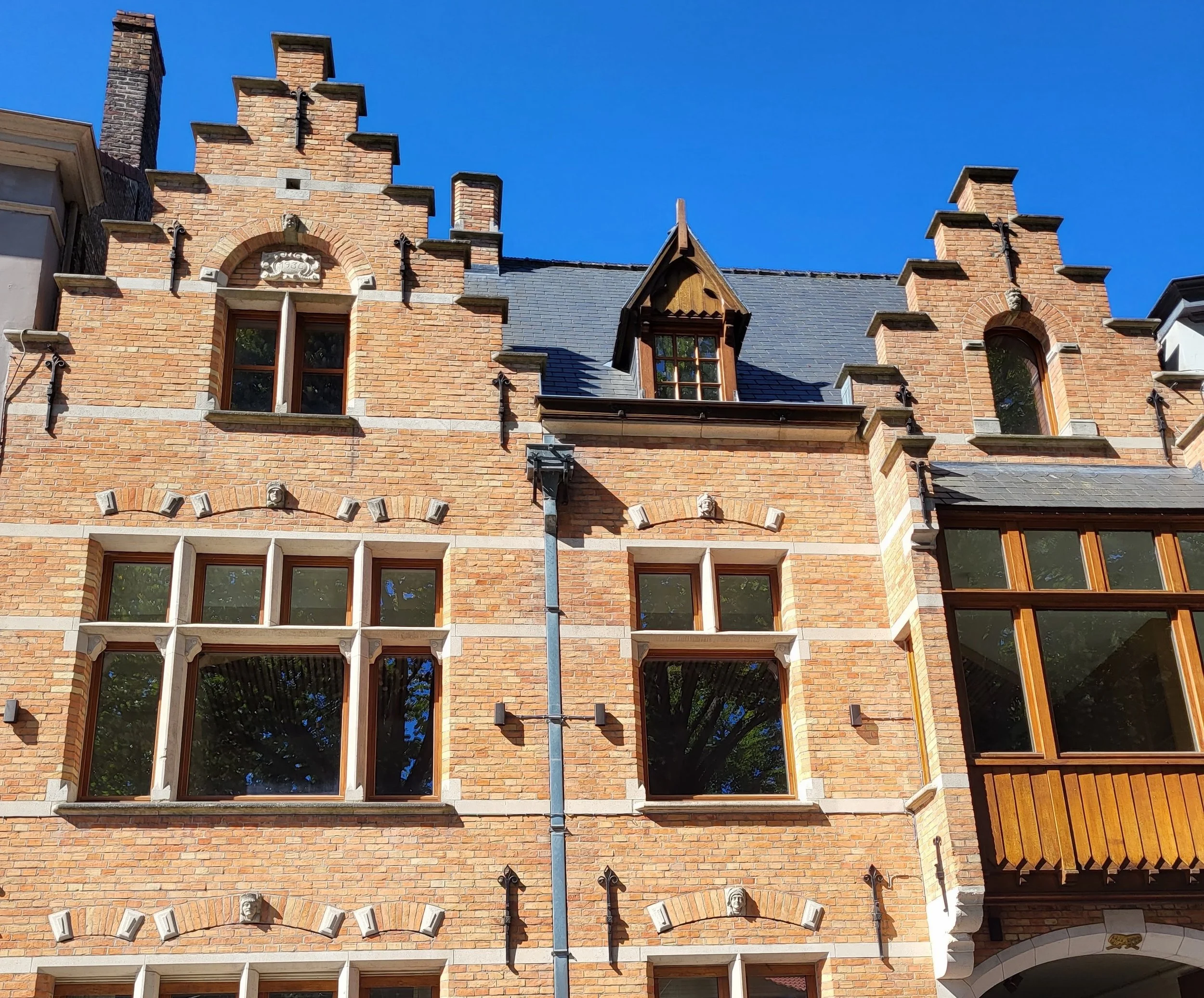
Outside the entrance to De Halve Maan Brewing in medieval Bruges.
Part 2 of Who Makes the Rules for Beer
Artists at Work
Light pours into the workshop through high windows, illuminating the aged stone walls. Sculptures and canvases in various stages of completion are spread throughout the room. Students and assistants are hard at work.
A master artist sits in a corner, gently blending one thin layer of oil at a time into the pigment already on the canvas. Leonardo da Vinci is perfecting his sfumato painting technique. The edges of his forms blend imperceptibly into the background, vanishing like smoke. What appears as distinct subjects and features are, on close inspection, part of a greater whole of light and dark.
Rembrandt is different. His edges are defined and sculpted. High-contrast between bright figures and dark shadow give his chiaroscuro paintings vivid, three-dimensional drama. A Rembrandt figure imposes itself before a landscape. A da Vinci subject is a part of it.
Both masters produced characters with agency, intrigue, and passion. They used the same kinds of raw materials to paint, but the systems that organised how they painted distinguish one’s work from the other’s.
The brewers of Bavaria and the Low Countries, working during the lifetimes of both these masters, transformed the same kinds of ingredients into beer under two different legal systems. What resulted were two very different regional brewing cultures.
The centralised Bavarian government gave control of the region’s brewing to dukes. The rules they created about ingredients and taxes sculpted Bavarian beer into three distinct forms. Noble families produced wheat beer, the Church brewed strong ales, and citizen brewers sold simple, regular-strength brews. Bavarian dukes decided who could make what and how much it cost. But there was no Duke of Beer in the Low Countries. There were towns.
Local governments regulated brewing in the Low Countries. Here, as in Bavaria, there were strict laws for brewing. But subtle differences in the rules of dozens of cities and towns created a regional sfumato that made it hard to tell where one style ended and the next began.
Beer was a golden goose for Renaissance governments in Western Europe. At one point beer and its taxes made up between one third and half of the state’s income in what is now Southern Germany, more than half of the revenue for Amsterdam and the Dutch town of Middelberg, and over 40% in Oudenaarde, Ghent, Haarlem and Leiden. It’s not hard to see why there were so many rules. The taxman needed his cut.
Cities and Towns
Cities and towns in the Low Countries created rules that resembled the 1516 Bavarian purity law requiring citizen brewers to use only barley, hops, and water. Except instead of one law, there were dozens. In 1559 Halle required beer to be brewed with 3 parts wheat and 5 parts a mix of barley and oats. In 1615 Hoegaarden required brewers to use four parts barley malt, four parts wheat, two parts oats, and to be Catholic.
Where Bavaria drew one hard edge, the Low countries blurred dozens of small ones.
The fragmentation went back centuries to the widespread adoption of hops in brewing. Hopped beer lasted longer that un-hopped beer, so it could be shipped. The historian Richard Unger credits the growth of Hanseatic brewing partly to the ability to produce larger copper kettles.
Where the law welcomed hops, brewers used them. Leuven’s brewers had switched to hops completely by 1436. In 14th century western Flanders, where the law was less favourable to hops, these spread slowly. Brewers there needed another barrier against spoilage so they used acidity. The lactic and acetic acids in some styles, like Oud Bruin, lower a beer’s pH enough to hold off many spoilage organisms. One study¹ argues this is why that style, traditionally brewed in Oudenaarde by 1545, is so sour and so lightly hopped. Local rules there even fixed how long Oud Bruins’ malt was dried and how long the wort was boiled.
Legal borders had become flavour borders by the 1500s. The beer-producing regions of Europe’s beer belt, from the North Sea to the Alps made sours in the west (Flanders), hopped beer in the middle (Brabant and Holland), and a mix of barley-only and wheat-heavy brews in Bavaria. And the scale at which these regions produced beer was very different.
Entry to the trade was guarded everywhere, but by different gatekeepers. In the Low Countries the gatekeeper was the town and its guild. Brewers’ guilds were monopolies and, like other medieval guilds, their oath-bound members pledged to uphold certain standards, like those in Brussels who could use only grain milled in the city.
In 1845 Belgium had 3,089 breweries, one for every 1,500 people. By 1900 it had slightly more (3,223) but nearly 15,000 brands. These included sours, wheat beers, multi-grain beers, and brews with spices and herbs. Mayors were often brewers, and most villages had a Catholic and a Liberal brewer who competed, among other ways, through beer.
Then came a law aimed at something else. In 1919 the Vandervelde Law prohibited spirits in cafés, hotels, and train stations, and required anyone buying spirits to buy at least two litres. Its Socialist authors regarded beer as a respectable drink and spirits as a source of misery for workers. Beer stayed legal and brewers filled the gap, often with strong beers. One study traces Westmalle’s Dubbel (1921), Moortgat’s Victory Ale, Duvel (1923), and the Westmalle Tripel (1933) to the law, which stayed in force until 1983.
From Legal History to Cultural Identity
What began as tax policy became re-imagined as culture.
In Bavaria, the beer purity law (today known as the Reinheitsgebot) is seen as a five-hundred-year-old tradition. In 2016, 85 percent of German consumers called it essential to good beer. But the term was first used by Hans Rauch during a tax debate on March 4, 1918 and wasn’t well known until a decades-long marketing campaign after World War II. The law, and its exceptions, did shape styles like altbier, kölsch, hefeweizen, and bock. But it wasn’t intended to make beer better. It was made to raise taxes.
In the Low Countries, particularly Belgium, people are proud of the massive variety of beers, many of which defy clear style guidelines by blending into one another. A 2016 UNESCO report recognised nearly 1,500 types of Belgian beer. Many of these have their own special glassware and pouring a beer into the incorrect glass or at the wrong temperature is now called “absolutely inappropriate” by a Flemish tourism guide. But there isn’t evidence that Low Countries brewers were free spirits indulging their creativity. Rather, they were forced, like Bavarians, to brew under a strict legal code. Only there were many codes rather than one.
What’s in Your Glass?
Leonardo and Rembrandt worked in the same medium, and a Bavarian and a Flemish brewer worked in the same craft. What differed was the palette each system allowed. Bavaria's rules narrowed it, and its brewers refined what remained. The Low Countries' dozens of local rules left it wide, and its brewers let one style blur into the next.
Look again into the drinking glass. What you see depends on what’s in it. In Bavarian beer you’ll see one tradition, refined. In Belgian beer, and to an extent Dutch, you’ll see many traditions blurred together. When you take a sip, you’ll taste the living legacy of centuries of history.