
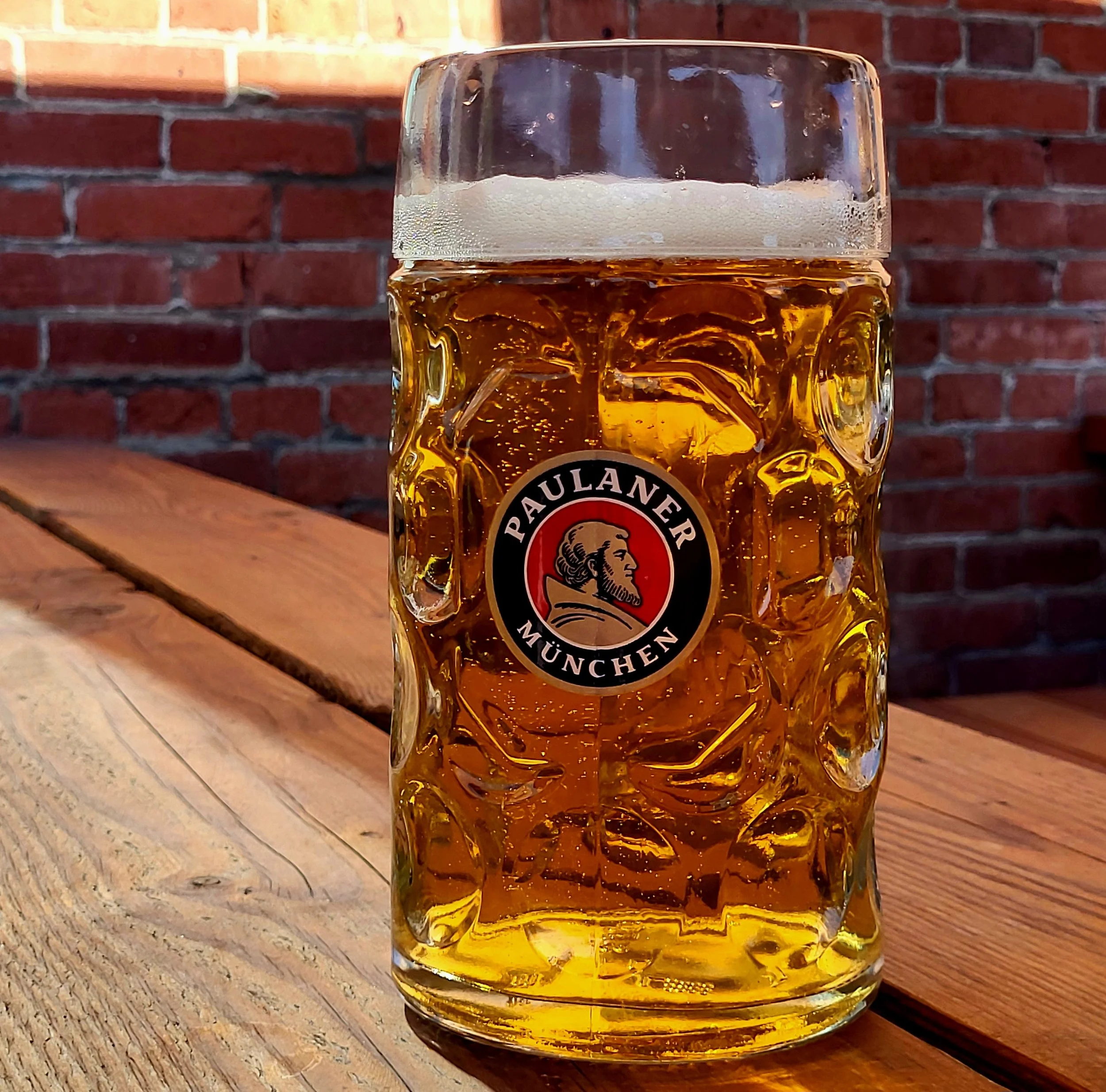
Look closely, what stories are swirling within the glass?
Dear Reader,
Peer through the drinking-glass and read the beer within. What does it tell you?
Colour and clarity share a story.
Look closer. What do you see? Nothing more? Then raise a glass to smell and taste.
Here, the microscopic text is magnified into something our senses can detect. A close reading of beer tells tales of those who did the brewing and those who profited from it. It shows us who governed the place that made it, what the Church allowed, and which rivers and roads carried beer in trade. Beer styles are also records of technological progress.
The same basic ingredients make very different beers when the societies that produce them are organized differently.
And then there are the special beers. The ones used to celebrate or show status. The little extras added to the brew kettle for special occasions (or special people) tell their own story. Only now our liquid text records the differences among people living in the same communities rather than those living apart.
In today’s story, we explore part one of a two-part series showcasing two famous brewing traditions: those of Bavaria and the Low Countries (Belgium, The Netherlands, and Luxembourg). The regions are, and have for centuries been, quite similar. They are celebrated for brewing, innovative, and have similar climates. They speak similar languages, have similar social hierarchies, and are all Christian. But the beers produced by the people of these regions are very different. This is because they differ in a crucial way: Bavaria, one of the most assertive administrative states in Europe, regulated brewing from the capital. The Low Countries regulated brewing town-by-town.
Who Made the Rules for Beer? Part 1 - Bavaria
Prologue
The wild countryside was being tamed. Farms, towns, and cities were being carved out of the wilderness as the Roman Empire poured resources into reshaping the wild lands and unruly peoples of Galilee. Bandits had for centuries set out from the fertile olive oil and fish producing lowlands to raid caravans traversing their rough country. Peasant farmers, dispossessed of their ancestral farms by wealthy Romans, were forced into the rugged hills. There, they formed armed bands and played out, hand-to-hand, the tensions between traditional rural life and centralised Roman organisation.
Galilee was an agricultural backwater in the time of Augustus (27BC to 14AD). It was also a Jewish stronghold in the middle of the Greco-Roman world. The Romans brought the Galeans paved roads, theaters, and an economic boom. The construction industry created work for thousands as cities like Tiberias were founded and those like Sepphoris were rebuilt. But the improved transportation and booming economy meant more taxes were owed and now these were easier to collect. Render to Caesar that which is Ceasar’s, and to God that which is God’s.
It was a time of tension, uncertainty, and rapid change. A man of great learning, Jesus of Nazareth, travelled the countryside on newly paved roads. One of them connected his hometown to the regional capital. He preached a philosophy that helped people cope with disruption, endure suffering, and find hope in a society being turned upside down. Three centuries later his teachings would be blended with Greco-Roman scholarship and religion to become the title track in a collection of Classical philosophy’s Greatest Hits – Christianity.
This new religion, married to the Roman Empire with the conversion of the Emperor Constantine in 312, spread throughout the Mediterranean world in the centuries that followed. It then invaded Europe on the back of Charlemagne’s war horses as the eighth century bled into the ninth.
Several hundred years later, by the 17th century, Christianity had split in two. Regardless of variety, Catholic or Protestant, it was the shield-arm of the Leviathans that governed early-modern Europe. The favour of God provided the legitimacy rulers needed to maintain in God-fearing societies. The other arm held alternately a sword or a pen, shaping societies through rules and imposing them through force.
Bavarian Rulers
Bavaria’s co-ruling dukes, Wilhelm IV and Ludwig X, had put down their swords and picked up their pens. Though battles may be fought on the front lines, they are won on the supply lines. The dukes needed food security, tax revenue, and a happy populace. And so, they wrote a very bureaucratic text about price caps, tax collection, and logistics. We know it today, romantically, as the most famous beer law in the world: the Reinheitsgebot, the Bavarian Purity Law of 1516.
The Reinheitsgebot permitted only barley, hops, and water as ingredients – no wheat and no rye. These were needed for bread. But the law was needed for taxes. Rules kept being added and by the 1550s Albrecht V banned summer brewing, ostensibly for quality control but really because Bavaria’s tightly packed wooden cities were at risk of burning down in the dry summer months from the great indoor fires needed to make beer.
The law had the effect of standardising beer in three ways. Limiting ingredients restricted the range of flavours available, capping prices and taxing inputs led brewers to choose cost-effective malts, and winter brewing allowed cooler fermenting yeasts to dominate.
While bureaucratic rules shaped much of brewing, administrative states tend to create special exceptions for special people. These exceptions, too, shaped Bavarian beer.
People loved wheat beer but armies needed bread. So, the brewing of wheat beer was restricted to certain nobles. A Ducal monopoly was granted to the Degenberg family, who could make and sell wheat beer. When their line died out in 1602 the monopoly was transferred to the Wittelsbach dukes. One of the Wittelsbach rulers, Maximillian I, opened wheat breweries, protected by a state monopoly, and began widely selling wheat beer, keeping the profits. Wheat beer became a regulated luxury and is an early example of a state-run brewing monopoly with profits going to the rulers.
But the shield-arm of the state, the Church, wanted in on the act. It would soon find a way through the pen wielded by the other half of power.
Bavarian Clergy
The friars at Paulaner monastery in Munich were hungry. They had eaten little for weeks and were forbidden meat, eggs, and dairy. It was Lent. They looked for sustenance in liquid bread by brewing something strong, dark, and rich enough to feel like a meal.
The Paulaners were Minims, a monastic order founded in Italy that arrived in Munich in the early 17th century. By 1630 they were brewing. Like most monks, they made light ales for daily consumption with meals or as a refreshment during work. But during Lent, when the table was sparse, their beer became fuller.
They couldn’t use wheat, but they could take advantage of resources the state provided. They had the financial resources to make strong beers and the ability to continually improve them. Monks had a secret weapon when it came to brewing. Literacy. Their education allowed them to approach brewing scientifically and the resources provided by the state provided them with the raw materials to test new ideas. They soon started making exceptional beers for their sparse table during Lent.
Known initially as Lentenbier (beer for Lent) the style was coveted by laymen and nobles alike. Those who could afford to wanted to drink like a monk. Paulaner started selling its strong beer. Seeing a market, it soon became available year-round. Still brewed during winter, it kept well into the summer months. Called Salvator (Saviour), it stood out among other Bavarian beers for its depth and richness.
Unlike wheat beers, anyone could brew a Salvator clone. But few did. The state offered tax advantages in return for the divine support offered by the Church. Strong beer was expensive and monks could sell it tax-free. The increasingly powerful merchant class had been complaining about the unfair advantages given to the Church since the mid-15th century. They would keep complaining for nearly four hundred years.
But it’s hard to sympathise with them because they were hardly outsiders.
For much of the Middle Ages, commercial brewing in Munich was reserved for the city’s established elite. In 1372, short of beer and short of tax revenue, Duke Stephan II allowed any citizen to apply for a permit. It sounds like the opening of a market. It wasn’t. The right to brew remained the ruler’s to give, and it was granted as a tenure, a Braulehen, tied to a particular house with its own brewing shed. To brew for sale you needed property, a kettle, a cellar, and the sovereign’s blessing. Those who held a tenure were organised as a craft of their own, answerable to both the duke and the city. Those who without the money and connections couldn’t brew beer for sale.
So the citizen brewers were not a free market crying foul. They were a licensed craft complaining about rivals with better licences, and the Church was not the only one they griped about. In 1589 Duke Wilhelm V founded the Hofbräuhaus to supply his court, and for a long time it was the only brewery in Bavaria permitted to make both brown and white beer. The duke was now a brewer, a tax collector, and the grantor of everyone else’s permit. Beer and its taxes are said to have supplied between a third and a half of the state’s income in the seventeenth century.
Bavarian beer wasn’t shaped by competition. It was shaped by permits. The state, the Church, and citizens each held a different kind of licence the declared what could be brewed, when, by whom, and at what price it could be sold.
By the late 17th century, the Bavarian bureaucracy had produced three distinct styles, brewed by three different kinds of institutions with different kinds of licenses. There was the light, highly regulated, barley beer made by commercial breweries. There were fancy wheat beers produced by a Ducal monopoly. And finally, there were rich, strong, expensive ales made by monks. What a person brewed and drank what wasn’t so much a question of taste, but of how they were connected to the state.
The Low Countries were a different case altogether. And their brewers produced a very different kind of beer.