
1817 Patent Porter
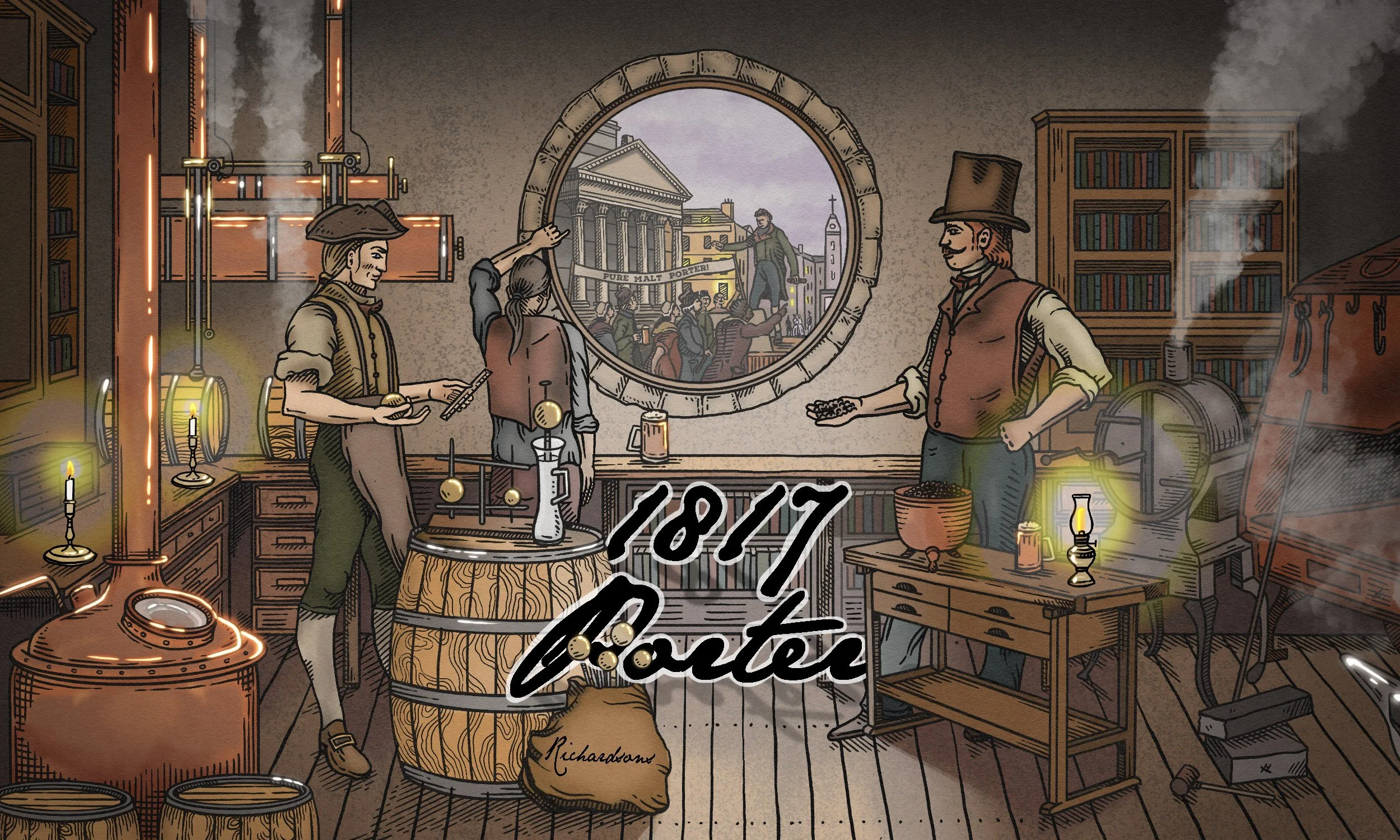
By the early 19th century, London porter faced a crisis. Not of flavour, but of arithmetic. Daniel Wheeler solved it in 1817.
For nearly a century, porter had been the drink of the industrial city. Brewed in enormous quantities and shipped across Britain and the Empire, it was one of the first truly mass-produced beers in history. Labourers, dockworkers, factory hands, and merchants drank it by the gallon in the smoke-filled taverns of London. Dark, nourishing, bitter, and durable, porter became the defining drink of the Industrial Revolution.
But science was changing brewing.
In the late 1700s, brewers began using a new scientific instrument: the hydrometer. For the first time, breweries could accurately measure how much fermentable sugar different malts produced. And the results created a problem.
Traditional brown malt, which gave porter its deep colour and roasted flavour, turned out to be inefficient. Pale malt yielded far more usable sugar per shilling. Brewers suddenly realized they could save enormous amounts of money by replacing brown malt with pale malt.
The economics were impossible to ignore.
But there was a catch. Pale malt alone could not produce the flavour, colour, or character drinkers expected from porter. Some breweries responded by adding burnt sugar, molasses, or other darkening agents to imitate the appearance of traditional porter while benefiting from the efficiency of pale malt. Drinkers grew suspicious. Rumours spread that London’s breweries were adulterating beer with unknown additives and industrial chemicals. Trust in porter, Britain’s most famous beer, began to erode.
Parliament stepped in.
The 1816 Malt Act attempted to restore confidence by prohibiting brewers from using anything except malt and hops in beer production. No colouring agents. No flavouring additives. No shortcuts.
But the law created a new dilemma.
How could brewers produce the dark, robust porter people demanded without relying on inefficient brown malt or banned additives?
In 1817, Daniel Wheeler offered the answer.
Wheeler was not a brewer, but an engineer and inventor working during a period when science and industry were rapidly transforming British life. Steam engines, mechanised factories, iron foundries, and industrial chemistry were reshaping the world. Brewing was changing with them.
Wheeler patented a new roasting method that used a revolving metal drum to roast malt at extremely high temperatures. The result was “Patent Malt,” an intensely dark malt capable of giving beer its deep black colour and roasted flavour in small quantities while allowing brewers to retain the efficiency of pale malt as the base of the beer.
The invention transformed porter forever.
Within years, London breweries adopted patent malt widely. Porter became darker, cleaner, and more consistent. What had once required large quantities of smoky brown malt could now be achieved with precision and control. The modern dark beer was born not in medieval tradition, but in the furnaces and machinery of the Industrial Revolution.
Our 1817 Patent Porter is brewed in tribute to this turning point in brewing history. Built on pale malt and sharpened with traditional black patent malt, it reflects the moment when chemistry, engineering, regulation, and industrial capitalism collided inside the brewhouse.
This is not merely an old beer. It is a beer from the age when brewing ceased to be purely agricultural and became industrial science.
A beer from coal-fired London. From brick breweries rising beside crowded rail yards and smoke-blackened streets. From an age of inventors, furnaces, accountants, and labourers drinking dark porter beneath the glow of gaslight.
Availability: Seasonal
Release Date: Autumn
First Produced: 2024
Alc/vol. 5.4%