
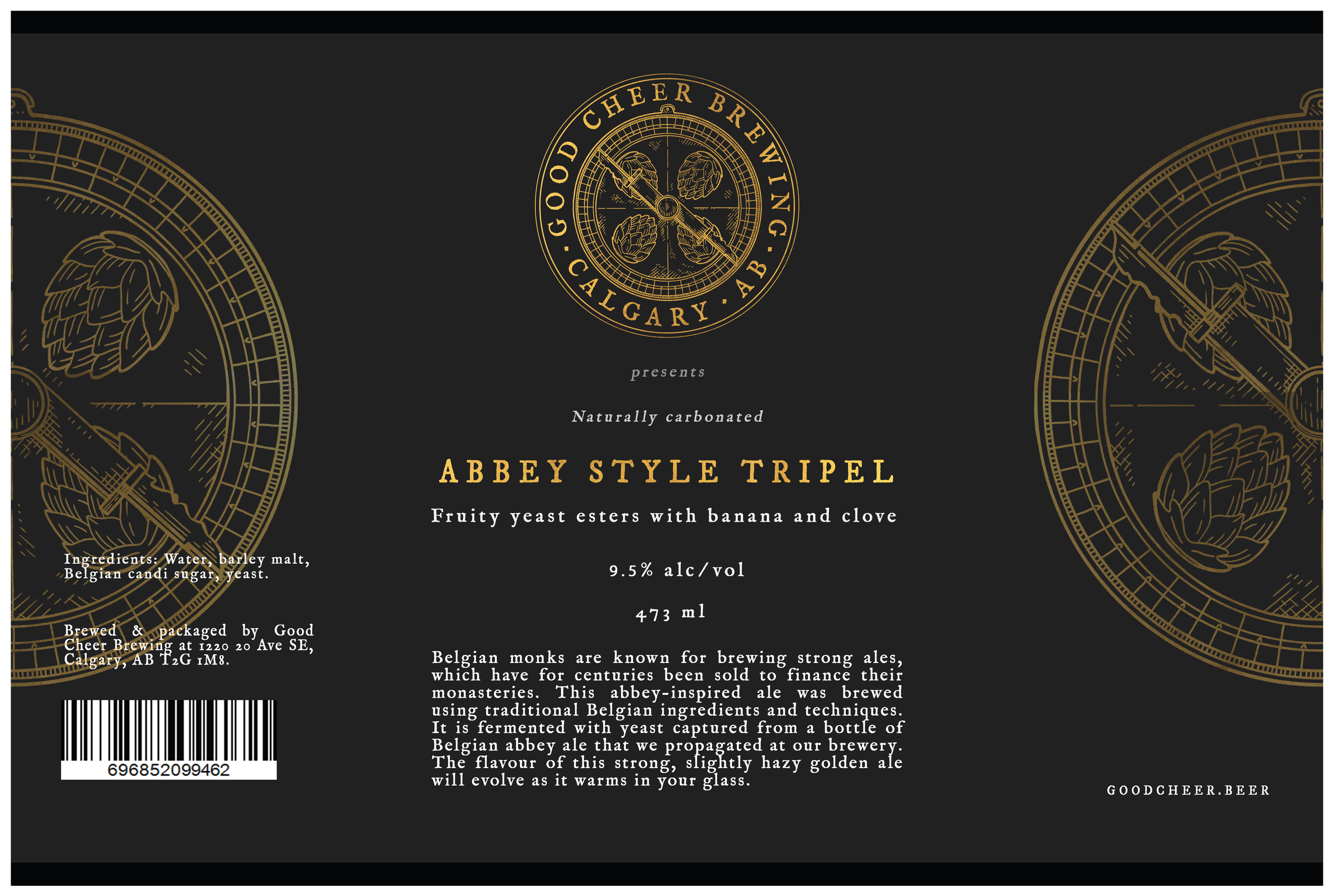
1956 Abbey Style Tripel
For nearly a thousand years, monks have brewed some of Europe’s finest beer. Then, for a brief moment in history, that tradition nearly disappeared.
Beginning in the Middle Ages, monks began transforming beer into something recognisably modern using a tool that set them apart from almost every brewer around them. Literacy. For most of history, beer was brewed at home by women. It was nourishment, and prepared by households like any other food. Monks have always brewed, but until the early 9th century they did so almost exclusively for their own consumption. This would change with the Emperor Charlemagne.
Following his conquest of much of Europe, the first Holy Roman Emperor Charlemagne was confronted with a new enemy. Famine. He fought this with a series of agricultural reforms and in the process transformed beer.
In a decree called the Capitulare de Villis (c.800 AD), Charlemagne required that malt and beer be prepared under strict standards of cleanliness and that imperial estates, including monasteries, employ professional brewers (called siceratores). He mandated that these estates distribute beer to labourers and then sell their surplus. Over centuries, some monasteries acquired special brewing rights and legal protections that gave them an unusual advantage: while smaller brewers came and went, monastic breweries could accumulate knowledge, improve techniques, and build brewing traditions across generations.
Monasteries were among the most stable institutions in medieval Europe. While kingdoms fractured and armies marched across the continent, abbeys preserved agriculture, literacy, and craft traditions behind the stone walls that often still stand today.
And then this tradition nearly disappeared.
The industrialisation of Europe transformed brewing during the 19th and early 20th centuries. Massive urban breweries flooded Europe with pale, cheap lager. Then came the catastrophes of the 20th century. Two world wars devastated a continent. Monasteries lost equipment, farmland, labour, and revenue. A famous Trappist brewery at L'Abbaye de Notre Dame de Scourmont had their equipment confiscated by the Nazis and melted down into munitions and communications equipment. Some breweries closed permanently. Others survived only barely.
The monasteries that endured faced a choice: modernise or disappear.
And so, quietly, abbey brewing entered the industrial age.
Steam boilers replaced direct-fired kettles. Refrigeration improved fermentation control. Laboratories allowed monks to study yeast scientifically. Stainless steel replaced aging wood. Ancient religious communities adopted modern industrial technology not because they abandoned tradition, but because they hoped to preserve it.
One monastery would become especially influential in this transformation: Westmalle Abbey.
In 1934, Westmalle introduced a strong pale ale called Superbier. Over two decades brewing science advanced, Belgium rebuilt after war, and the recipe slowly evolved. In 1956, Westmalle transformed it into something that would permanently change Belgian brewing.
The modern Tripel was born, and it looked nothing like the strong beers that came before it.
At the time, strong beer was usually dark, heavy, sweet, or wine-like. Westmalle Tripel was something different entirely. Pale gold in colour, brilliantly carbonated, and deceptively drinkable, it combined expressive monastery yeast character with continental hops, pale pilsner malt, and large amounts of candi sugar to create strength without heaviness.
The Tripel became one of the most influential ales ever brewed and a clear reflection of its moment in history.
Postwar Europe was rebuilding. Ancient institutions adapted themselves to modern industry. And nowhere was this contradiction more striking than inside the Trappist breweries of Belgium, where monks in white habits used stainless steel tanks, laboratory equipment, and modern bottling lines to produce some of the world’s most sophisticated ales.
Our 1956 Abbey Style Tripel is brewed in tribute to that moment. Based on the famous mid-century Westmalle profile, it represents the bridge that carried monastic brewing across the ruins of postwar Europe and into the technological age.
Golden with a dense white head, it opens with pear, citrus, spice, fresh bread, and soft alcohol warmth. A dry finish keep its strength graceful rather than heavy.
This is not merely a strong beer. It is a snapshot of a key moment in the 1,200-year history of monastic brewing. The Tripel is proof in a glass that traditions survive not by resisting change, but by mastering it.
Availability: Year Round
First Produced: 2026
Alc/vol. 9.5%